
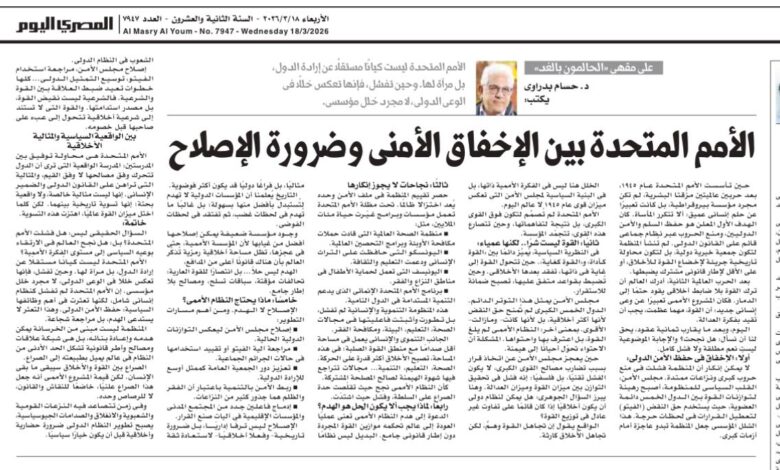
When the United Nations was founded in 1945, after two world wars that tore humanity apart, it was not merely a bureaucratic institution. It was the expression of a deep human dream: that the tragedy should never be repeated.
The first declared goal was the preservation of international peace and security, and the prevention of war through a collective system based on international law. The organization was not created to be an international charity, but to be a bold historical attempt to subject power to ethics, or at least to a shared legal framework capable of restraining it.
After the Second World War, the world realized that leaving power without moral restraint inevitably leads to destruction. The UN project was therefore an expression of a new human awareness: that power, no matter how great, must be limited by the idea of justice.
Today, after nearly eight decades, we have the right to ask:
Has it succeeded?
The objective answer is neither an absolute yes nor a complete failure.
First: Failure in Preserving International Security
It cannot be denied that the organization has failed to prevent major wars and prolonged conflicts.
The Security Council, the political heart of the system, has become hostage to the balance of power among the five permanent members, where the veto is used to block decisions at critical moments. This institutional paralysis has made the organization appear powerless in the face of major crises.
The flaw here is not in the idea of the United Nations itself, but in the political structure of the Security Council, which reflects the balance of power of 1945, not the world of today.
The United Nations was not designed to stand above the great powers, but as a result of their agreements. When these powers clash, the institution freezes.
Second: Power Is Not Evil… but It Is Blind
In political theory, a distinction is always made between power as a tool and power as a goal.
When power becomes a goal in itself, it loses its moral dimension.
When it is restrained by agreed rules, it becomes a guarantee of stability.
The Security Council represents this permanent tension.
The five major powers were not given veto power because they were more moral, but because they were — and still are — the strongest.
In other words, the international system did not abolish power; it acknowledged it and tried to contain it.
The problem is that containment has sometimes turned into domination.
When the Security Council fails to make a decision because of conflicting interests among major powers, the failure is not technical, but philosophical.
It is a failure to balance the scale of power with the scale of justice.
This raises a fundamental question:
Can an international system be moral if it is built upon an unequal distribution of power?
Reality tells us that ignoring power is an illusion, but ignoring ethics is a catastrophe.
Third: Achievements That Must Not Be Denied
Limiting the evaluation of the United Nations to the security file alone is an unfair reduction.
Under the UN umbrella operate institutions and programs that have changed the lives of hundreds of millions, such as:
-
The World Health Organization, which led campaigns against epidemics and global vaccination programs.
-
UNESCO, which preserved human heritage and supported education and culture.
-
UNICEF, which works to protect children in areas of war and poverty.
-
The United Nations Development Programme, which supports sustainable development in developing countries.
This humanitarian and developmental system has not failed.
It has evolved and proven effective in health, education, environment, and poverty reduction.
The developmental and humanitarian side operates in a space less dominated by hard power.
In this space, ethics can move more freely.
Health, education, development — fields where the desire for domination recedes in favor of common interest.
It is as if the UN system succeeded where the struggle for power weakened, and failed where it intensified.
Fourth: Why the Solution Should Not Be Destruction
Calling for the dismantling of the international system would in practice mean returning to a world governed by raw balances of power without a unifying legal framework.
The alternative is not a perfect system, but an international vacuum that may be far more chaotic.
History teaches us that international institutions are not easily destroyed and replaced by better ones.
They are often demolished in moments of anger, then missed in moments of chaos.
The existence of a weak institution that can be reformed is better than its absence.
Even in its weakness, the UN remains a symbolic moral space reminding the world that there is a law higher than cannons.
Destruction is not a solution —
it is a victory for naked power: temporary alliances, arms races, and interests without a shared framework.
Fifth: What Does the International System Need?
Reform, not demolition.
Among the most important paths for development:
-
Reforming the Security Council to reflect current global balances
-
Reviewing the veto mechanism or restricting its use in cases of mass crimes
-
Strengthening the role of the General Assembly as a broader representation of international will
-
Linking security to development, since poverty and injustice are roots of many conflicts
-
Integrating new actors from civil society and regional organizations into decision-making mechanisms
Reform is not an administrative luxury.
It is a historical necessity — and a moral act — to restore people’s trust in the international system.
Reforming the Security Council, reviewing the veto, expanding representation — all these steps help rebalance the relationship between power and legitimacy.
Legitimacy is not the opposite of power; it is the source of its sustainability.
Power that lacks moral legitimacy eventually becomes a burden on its owner before it becomes a burden on others.
Between Political Realism and Moral Idealism
The United Nations is an attempt to reconcile two schools:
-
The realist school, which sees states as acting according to interests, not values
-
The idealist school, which relies on international law and human conscience
It is neither pure idealism nor pure realism.
It is a historical compromise between them.
But whenever the global balance of power shifts, this compromise trembles.
Conclusion
The real question is not:
Did the United Nations fail?
But rather:
Has the world succeeded in raising its political awareness to the level of the UN idea?
The United Nations is not independent from the will of states; it is their mirror.
When it fails, it reflects a flaw in international awareness, not merely an institutional flaw.
The UN has not failed as a comprehensive human system,
but it has stumbled in its most important political function: preserving international peace and security.
This stumbling does not require destruction, but courageous revision.
The organization is not a concrete building that can be demolished and rebuilt.
It is a network of relationships, interests, and legal frameworks that form the minimum order in a world naturally inclined toward conflict.
The struggle between power and ethics will remain as long as humanity exists.
But the value of the UN project is that it made this struggle visible, subject to debate and law — not to bullets alone.
In a time when nationalism, populism, isolation, and geopolitical confrontations are rising,
developing the international system becomes a civilizational and moral necessity before it is a political choice.