
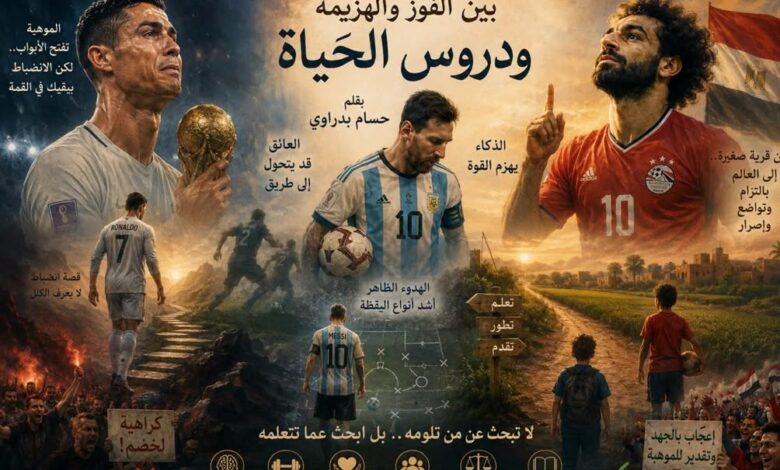
I must begin with a confession: I have been an admirer of Cristiano Ronaldo since the earliest days of his career—not only because of the extraordinary talent that has brought so much joy to football fans, but also because of his professionalism and discipline, both on and off the pitch. Perhaps because of that admiration, I found myself, almost unconsciously, keeping a certain distance from Lionel Messi, despite always acknowledging his exceptional brilliance. Sometimes, the heart chooses its loyalties without needing an explanation.
Fifteen years of rivalry between Ronaldo and Messi made football richer, more captivating, and more beautiful.
I was deeply saddened to see Ronaldo leave the World Cup in tears. I had hoped to watch him reach the final, even at the remarkable age of forty-one.
Yet what happened after the recent Egypt–Argentina match compelled me to reconsider—not my opinion of Messi as a footballer, but my own mindset as a supporter, and the mindset of a society that so often searches for a scapegoat.
Suddenly, sections of our media portrayed Messi as personally responsible for the refereeing decisions that many believed had gone against Egypt, while almost no attention was given to our own mistakes during the final ten minutes of the match—the very period that ultimately decided the outcome.
What fault was it of an Argentine player that he became, overnight, the focus of an unprecedented wave of hostility? The campaign had little to do with football itself and much more to do with the release of collective frustration seeking a convenient target.
We blamed him personally for Egypt’s elimination from the Round of 16, as though he should have refrained from scoring the winning goal out of sympathy for Egypt—or in protest against refereeing decisions that many of us considered unfair.
Such controversies are, after all, part of football.
The opposite reaction was equally revealing. Egypt’s qualification for the Round of 16 was celebrated with extraordinary exuberance, as though we had won the World Cup itself.
Exaggeration in victory. Misplaced blame in defeat. In both cases, the same thing was missing: objectivity—and the willingness to examine ourselves honestly or to build on genuine achievements so they become lasting progress rather than fortunate moments.
The question that continued to occupy my mind was this: What are we teaching our children and young people when we behave this way? What message do we send when defeat must always be someone else’s fault, while victory is celebrated without proportion or perspective?
While reflecting on these questions, I came across a thoughtful article by the Moroccan philosopher Said Nachid, who explored Messi’s career as a source of lessons extending far beyond football and into the art of living. I would like to share some of those insights, blended with reflections of my own.
The first lesson is that an obstacle can become the path itself.
As a child, Messi suffered from growth hormone deficiency. He possessed little more than an uncertain talent and quiet determination. When FC Barcelona embraced him and financed his treatment, they did not simply help him grow—they enabled him to transform what seemed like a disadvantage into his greatest competitive strength. His small frame gave him an unusually low center of gravity, extraordinary balance, and an unmatched ability to change direction, making him almost impossible to catch. This echoes an ancient Stoic insight: what obstructs action can itself become the means of action.
The second lesson is that intelligence often overcomes strength.
Messi played in an era filled with physically imposing defenders, yet he never relied on direct confrontation. Instead, he depended on reading space, anticipating movement, remaining agile, and reacting with remarkable speed.
The third lesson is perhaps the deepest: outward calm may conceal the highest level of awareness.
Watching Messi during a match, one might think he has drifted out of the game. While everyone else is sprinting, he often appears to be walking. Yet in those moments he is reading the field like a chess master studies the board—observing, calculating, conserving his energy until the perfect opportunity appears. Then, at precisely the right moment, he strikes. It is an economy of effort combined with extraordinary generosity of attention and impeccable timing.
These three lessons, I believe, offer a valuable framework for evaluating our own collective behavior after every sporting victory or defeat.
Our recent experience suggests that we remain too attached to a culture that glorifies noise and emotional outbursts, while constantly searching for someone else to blame. Messi, through his composure, intelligence, and quiet confidence, offers a very different message: that apparent weakness can become uniqueness; that those who know when to act need not act constantly; and that one of the greatest forms of strength is self-control.
When I reflect on Messi’s story, however, I realize that it is not unique. The same pattern appears in the lives of the greatest footballers of this generation—including the one I have personally admired above all others: Cristiano Ronaldo.
Ronaldo was not born a superstar. He came from a modest home on the island of Madeira and climbed every step of his career through relentless daily effort and unwavering discipline until he became one of football’s greatest legends. His story is not merely one of talent, but of extraordinary commitment: a rigorous diet, relentless training even after reaching the summit, and an uncompromising determination to remain among the very best every single season.
That, in itself, is a lesson no less valuable than those we learn from Messi: talent alone is never enough, and remaining at the top is often harder than reaching it.
Closer to home, we have another equally inspiring example: Mohamed Salah.
An Egyptian who emerged from the small village of Nagrig in Gharbia Governorate, Salah built a professional career that secured him a place among football’s global elite while carrying Egypt’s name onto the world’s greatest stages and into its most prestigious clubs.
His story is precisely the one we should tell our children. Like Messi and Ronaldo, he came from humble beginnings and proved that modest origins are never barriers to greatness. The journey to the top begins with a single step from a small village. True representation of one’s country is not achieved through angry chants in the stands or hostility toward opponents, but through the quiet resilience with which Salah built his career—brick by brick—with talent, discipline, perseverance, and humility.
Finally, I would like to offer our young people a fatherly piece of advice.
Rather than hating Messi—or any rival—we should learn from him. We should learn discipline from Ronaldo, and perseverance and humility from Salah despite all they have achieved.
Noble competition does not require enemies to condemn; it requires role models against whom we measure ourselves.
That, in my view, is the greatest lesson our children should take from every match—not from who won or who lost, but from the stories of those who played it.
Instead of passing on resentment and hostility toward every opponent, let us pass on admiration for hard work, respect for talent, appreciation for knowledge and teamwork, true sportsmanship, personal responsibility, the courage to accept defeat, and genuine respect for one’s competitors.
Let us celebrate when we win and grieve when we lose—that is only natural. But above all, let us accept responsibility for our mistakes and learn from them.