
Two books I have read:
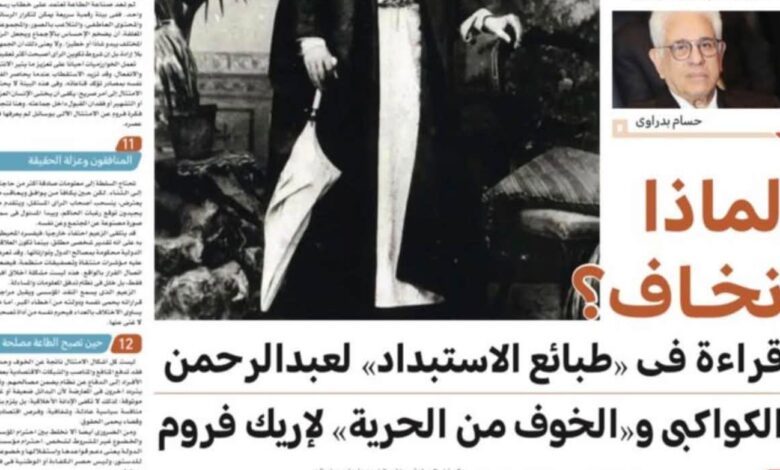
A Reading of The Nature of Despotism by Abd al-Rahman al-Kawakibi
and
Escape from Freedom by Erich Fromm
By Hossam Badrawi
Is human beings’ love of freedom innate, or is freedom a value they must learn, one they may even come to fear if they have never learned how to exercise it? Is despotism simply a ruler imposing his will, or is it a more complex relationship between an authority that demands obedience and a society that may gradually become accustomed to submission? And can a despot fall while despotism remains alive in people’s minds?
These questions led me to read two of the most important works exploring the relationship between human beings, power, and freedom. The first is The Nature of Despotism and the Struggles Against Enslavement by Abd al-Rahman al-Kawakibi, and the second is Escape from Freedom by Erich Fromm. They are separated by time, culture, and experience, yet they converge on a troubling truth: despotism is not merely a political system; it can become a psychological, social, and cultural condition.
Al-Kawakibi examines how absolute power corrupts society, while Fromm asks why individuals may flee from their independence into the arms of a power that offers them reassurance. Bringing their ideas together, I arrive at a dangerous cycle: despotism creates fear, and fear can reproduce despotism.
The most important question is: How do we break this cycle?
First: Abd al-Rahman al-Kawakibi — Dissecting the Disease of Despotism
Abd al-Rahman al-Kawakibi was born in Aleppo in 1855. He worked in journalism, intellectual life, and reform, living under the Ottoman Empire during the political and administrative crises that marked its later years. He moved to Egypt and died in 1902.
In The Nature of Despotism, he explored the relationship between absolute power and religion, knowledge, wealth, morality, education, and progress.
What strikes me, as a physician, is that he approached despotism much as we approach a chronic disease: he did not merely describe its symptoms; he investigated its causes, its interconnected consequences, and the ways to prevent it.
A despot is not necessarily someone who raises his voice or resorts to violence. He may appear courteous and even achieve notable accomplishments. Yet he remains despotic if he monopolizes decision-making and refuses accountability.
Despotism is measured not only by what a ruler does, but also by what society is unable to prevent him from doing.
Despotism and Knowledge
Al-Kawakibi understood that knowledge which awakens awareness of rights and accountability poses a threat to absolute rule.
I believe we must distinguish between education that provides a degree or a practical skill and education that develops an independent, critical mind.
A despot may need engineers, doctors, and technicians, but he fears the citizen who asks: Why? And by what right?
The number of schools and universities is not, by itself, a sufficient measure of liberation.
Do we reward questions or punish them? Do we teach our children how to think, or what to think?
An educational system based on rote learning and fear of making mistakes may produce large numbers of educated people without building free citizens.
Despotism and Religion
Al-Kawakibi’s criticism was not directed at faith itself, but at the use of the sacred in the service of political authority.
When criticizing a human decision becomes an offense against religion or the nation, politics turns into a domain beyond scrutiny.
This phenomenon is not confined to religious societies. Nationalism, ideology, or the image of a leader can also be elevated to sacred status, making opposition appear equivalent to treason.
A strong state does not need to sanctify its ruler; it needs to respect the law.
The nation cannot be reduced to one individual, regardless of that person’s standing or achievements.
Despotism, Morality, and Education
When honesty becomes dangerous, people learn to flatter. When speaking candidly becomes costly, hypocrisy spreads. When advancement depends on loyalty rather than competence, pleasing the person in charge becomes more important than doing the job properly.
Silence may even be presented as a virtue, while independence becomes an accusation.
However, we must not blame those who remain silent under genuine threats. A person may fear losing their livelihood or compromising their family’s safety.
That is why resisting despotism cannot simply mean demanding courage from people. It requires building institutions that make honesty safe and disagreement legitimate.
Despotism can also begin at home, at school, and in the workplace: a father who refuses to accept questions, a teacher who considers disagreement an insult, or a manager who demands loyalty rather than competence.
Not every form of authority or organization is despotic. The difference lies between fair rules that respect human dignity and obedience demanded merely because someone possesses power.
Second: Erich Fromm — Why Does the Individual Flee from Freedom?
Erich Fromm was born in Germany in 1900. He worked in psychoanalysis and sociology, witnessed the rise of Nazism, and emigrated during the 1930s.
He published his book Escape from Freedom in 1941, also known in Britain under the title The Fear of Freedom.
Fromm sought to understand why broad sections of the population respond to authoritarian appeals, even when those appeals threaten their independence.
He distinguishes between freedom from external constraints and positive freedom: the freedom that enables individuals to develop their own identities and establish authentic relationships with others.
Old restrictions may disappear, yet individuals can find themselves alone, confronted with the responsibility of making their own choices. Independence then becomes a source of anxiety rather than reassurance.
The Three Mechanisms of Escape
First: Authoritarianism and Submission
Individuals attempt to escape feelings of helplessness by merging themselves with a greater power. They submit to the strong and may, in turn, become harsh toward the weak.
They see the leader as an extension of themselves and borrow a sense of strength from him.
Second: Destructiveness
An individual may seek to eliminate whatever threatens their sense of security or control rather than confront and manage the anxiety itself.
Third: Automaton Conformity
Individuals surrender their uniqueness in order to repeat the opinions of the group. They fear standing apart from it and may even believe that they are making completely free choices.
Here, independence can be lost without any direct act of repression.
Nazism as an Example and a Warning
Fromm attempted to explain the appeal of Nazism through the interaction of social and economic crises with the feelings of isolation, helplessness, and need for belonging experienced by certain segments of society.
The leader offers followers a ready-made identity and an enemy to blame for their suffering.
However, Nazism cannot be reduced to a single psychological explanation. Propaganda, violence, institutions, economic crises, and political conflicts are all essential elements in understanding its rise.
Third: Where Al-Kawakibi and Fromm Meet
Al-Kawakibi asks: How does power produce fear and corrupt society?
Fromm asks: How does fear become a motive for submission and the search for authority?
Together, they describe two sides of a reciprocal relationship, not an inevitable law that applies to everyone.
A cycle may begin with the concentration of power and the absence of accountability, followed by fear and the erosion of trust, then obedience and conformity, weakening participation and institutions, and ultimately reproducing concentrated power.
But people do not all respond in the same way. Some resist, others negotiate, some emigrate, and others work toward reform.
That is why removing a ruler is not enough. Faces may change while administrative practices remain the same, and slogans may be replaced while a culture of fear survives.
Democracy is not simply about elections, although free elections are essential. It also requires an independent judiciary, separation of powers, a free press, the right to organize, the peaceful transfer of power, and the protection of minorities.
Fourth: Voluntary Despotism — When Society Participates in Creating Its Own Chains
I use the expression “voluntary despotism” here as an analytical description of conformity or the surrender of certain freedoms in pursuit of security, belonging, or personal benefit. It is not a judgment that victims of repression have freely chosen their own oppression.
Consent extracted under conditions of fear and deprivation is not free consent in the moral or political sense.
When people fear chaos, they may become excessively willing to accept the concentration of power.
The fear of chaos is not always imaginary; instability can carry genuine human costs. The mistake, however, is turning the legitimate demand for security into an open-ended mandate, as though protecting society requires abolishing its right to oversight and correction.
The danger increases when the image of the leader becomes a promise of salvation.
Public discourse presents him as the only person capable of rescuing the nation, and the success of the state becomes reduced to his individual success.
At that point, asking about alternatives is portrayed as a threat to stability, and the institution becomes less important than the person holding office.
This perception weakens the state itself because it ties its continuity to the survival of one individual.
Modern Media and the Manufacturing of Certainty
The manufacturing of obedience no longer depends on a single official narrative.
In today’s fast-moving digital environment, repeated messages, emotionally charged content, manipulated images, and closed online groups can amplify the perception of consensus, making differing opinions appear abnormal or dangerous.
This does not mean that audiences lack agency. Rather, the conditions under which opinions are formed have become more complex.
Algorithms sometimes reinforce content that generates attention and emotional reactions. They may also intensify polarization when individuals surround themselves with sources that confirm their existing beliefs.
In this environment, conformity does not require an explicit command. It may be enough for someone to fear isolation, public humiliation, or rejection by their own community.
Here, Fromm’s concept of automaton conformity reappears through means that did not exist in his time.
Hypocrites Around Power and the Isolation of Truth
Those in power need truthful information more than they need praise.
But when those who agree are rewarded and those who object are punished, independent voices withdraw, while those skilled at anticipating the ruler’s wishes move forward.
The official then begins hearing a manufactured version of society and of himself.
A leader may receive outward expressions of admiration and interpret them as absolute personal appreciation, even though international relations are governed by the interests and calculations of states.
He may also be presented with selective indicators and organized applause, gradually weakening the connection between decision-making and reality.
This is not merely a matter of individual morality. It is a dysfunction in the system through which information flows and accountability is exercised.
A leader who listens to institutional criticism and accepts the review of his decisions protects both himself and his country from greater mistakes.
By contrast, one who equates disagreement with hostility deprives himself of an indispensable instrument of correction.
When Obedience Becomes a Matter of Self-Interest
Not all forms of conformity arise from fear alone.
Personal benefits, positions of influence, and economic networks may lead some individuals to defend a system that protects their interests.
Others may hesitate to oppose it because the available alternatives appear weak or unreliable.
That is why moral condemnation alone is insufficient. What is needed is fair political competition, transparency, economic opportunities, and a judiciary that protects rights.
It is also essential not to confuse respect for institutions with unconditional submission to an individual.
Respecting state institutions means supporting their rules and independence and ensuring that they remain subject to the Constitution. It does not mean reserving competence or patriotism for a particular group.
Fifth: How Do We Break the Cycle?
I believe the path begins with education for freedom.
Democracy is not born on election day. It begins when a teacher allows questions, when a child learns that fair rules apply to everyone, and when young people understand that their right to choose is inseparable from their responsibility toward others.
Then come the institutions: a respected Constitution, an independent judiciary, a parliament that exercises oversight, an investigative press, political parties that compete freely, local administrations that allow new leaders to emerge, and peaceful mechanisms for transferring power.
It is not enough for an institution to carry a democratic name. What matters is whether it possesses genuine authority and exercises it.
Security and freedom are not opposites.
Sustainable stability does not depend on silencing contradictions, but on establishing fair rules for managing them.
A free citizen is not someone who rejects all authority, but someone who accepts legitimate authority while retaining the right to hold it accountable and change it.
Nor should freedom be viewed as the individual’s responsibility alone. Poverty, discrimination, threats, and the absence of justice can make freedom of choice theoretically available but practically impossible.
Freedom requires social and economic guarantees just as much as it requires political rights.
Conclusion: From Fear to Citizenship
A despot may be able to govern a society through fear, but fear alone cannot build a creative society that is confident in itself.
An individual may succeed in getting rid of a despotic ruler, but that does not automatically make him free if he continues to fear disagreement and flee from responsibility.
Al-Kawakibi taught us that despotism is a disease that extends into every aspect of life. Fromm taught us that liberation from external constraints does not necessarily mean acquiring the ability to exercise freedom.
I would add that building a free society requires institutions that prevent the monopolization of power, an education system that develops independent minds, a culture that respects differences, and social security that makes genuine choice possible.
The most dangerous legacy of despotism is not merely weak institutions, but the habit of no longer exercising our own will.
And the most dangerous thing that can happen after liberation is to replace one individual with another without changing the relationship between power and society.
Do we want citizens who obey because they are afraid, or citizens who respect the law because they are partners in shaping it?
The difference between the two is the difference between a society that is governed and a society that governs itself.
Essential References and Methodological Notes
-
Abd al-Rahman al-Kawakibi, The Nature of Despotism and the Struggles Against Enslavement. Available in multiple Arabic editions. The specific edition consulted should be referenced when documenting direct quotations.
-
Erich Fromm, Escape from Freedom, Farrar & Rinehart, 1941. Published in Britain under the title The Fear of Freedom.
The comparative analysis, the expression “voluntary despotism,” and the applications to contemporary media and the construction of the leader’s public image are conclusions and reflections developed in this study. They are not direct quotations attributed to either author.
Hossam Badrawi | A Reading of Despotism and Freedom