
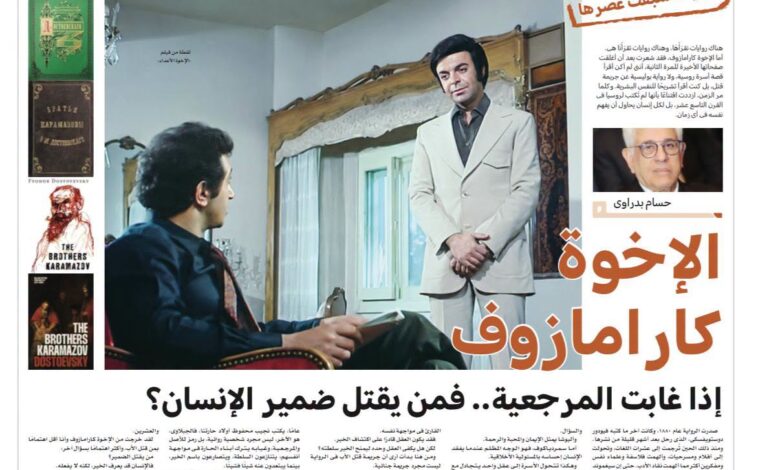
Reflections on The Brothers Karamazov
There are novels we read, and there are novels that read us.
The Brothers Karamazov is one of them.
After closing its final pages for the second time, I felt that I had not been reading the story of a Russian family, nor merely a crime novel about a murder and its aftermath. I had been reading a dissection of the human soul. And the more time passes, the more convinced I become that Dostoevsky did not write it for nineteenth-century Russia alone, but for every human being who has ever tried to understand himself, in any age.
Published in 1880, The Brothers Karamazov was Fyodor Dostoevsky’s final novel. He died only a few months after its publication. Since then, it has been translated into dozens of languages, adapted into films and plays, and has inspired philosophers, psychologists, and thinkers perhaps even more profoundly than literary critics. Sigmund Freud, Albert Camus, Jean-Paul Sartre, and many others found in it material for reflection that extended far beyond the boundaries of literature.
On the surface, the novel tells the story of Fyodor Karamazov, a corrupt and lustful father, and his four sons, each radically different in temperament. It then unfolds around his murder and the trial that follows.
But that is not really what the novel is about.
It is merely the doorway through which Dostoevsky enters the real question:
Where does conscience come from?
And can human beings build a moral system sufficient in itself, or do they always need a reference point higher than themselves?
Perhaps Dostoevsky’s genius lies in the fact that he did not make the Karamazov brothers merely fictional characters. He made them different faces of the human soul.
Dmitri represents the human being driven by passion.
Ivan represents the intellect that never stops doubting and questioning.
Alyosha represents faith, love, and compassion.
And Smerdyakov represents the dark side of the human being when the sense of moral responsibility disappears.
Thus, the family becomes a single mind arguing with itself.
As I read the novel, I found myself pausing over a question that we continue to debate in our own time:
Were morals born with religion?
Or did humanity discover them before religion?
History tells us that human beings understood honesty, justice, the prohibition of killing within the community, respect for promises, and care for the vulnerable long before the emergence of the revealed religions. In ancient Egypt, Mesopotamia, China, India, and Greece, moral systems emerged from human reason and experience centuries before the Abrahamic revelations.
But Dostoevsky is not really debating the origins of morality.
He is asking another, deeper question:
If I can recognize good through reason… what compels me to follow it when morality conflicts with my own interests?
And here I found that the novel offers no ready-made answer. Instead, it leaves the reader face-to-face with himself.
The mind may be capable of recognizing what is good.
But is reason alone enough to give goodness its authority?
This is where I began to see that the murder of the father in the novel is not merely a criminal act.
It is a symbol.
The father is not simply a person.
He represents reference, authority, and the value to which the sons turn when they disagree.
And when the father is killed, it is not merely a man who disappears. A question begins:
Who will fill the void?
At this point, I was reminded of Nietzsche.
When he made his famous declaration, “God is dead,” he did not mean that God had literally died. He was describing the collapse of the absolute reference point that had governed European civilization for centuries, and warning of the moral vacuum that might emerge if humanity failed to construct a new system of meaning and responsibility.
Dostoevsky wrote The Brothers Karamazov several years before Nietzsche’s famous declaration became widely known, yet he was living through the same intellectual climate, in which traditional faith was beginning to retreat before rationalism and science.
Nearly eighty years later, Naguib Mahfouz would write Children of Gebelawi.
Gebelawi, too, is not merely a fictional character. He is a symbol of origin and reference. His absence leaves the people of the alley to confront themselves, competing for power and fighting in the name of goodness while gradually moving further away from it.
I am not saying that Dostoevsky, Nietzsche, and Mahfouz were saying the same thing.
But each, in his own way, was circling around the same fundamental question:
What happens when the reference point that once gave human beings a meaning greater than their immediate self-interest disappears?
I believe this question has become even more urgent in our own age.
Artificial intelligence can analyze millions of pieces of data in seconds.
It may become more capable than human beings at diagnosis, prediction, and decision-making.
But it does not know compassion.
It does not feel remorse.
And it does not possess a conscience.
We must recognize that civilization does not need intelligence alone.
It also needs moral wisdom to guide that intelligence.
Perhaps this is why a novel written nearly a century and a half ago can feel as though it is addressing the questions of the twenty-first century.
I came away from The Brothers Karamazov less interested in who killed the father, and more interested in another question:
Who kills the conscience?
A human being may know what is good and still fail to do it.
He may know what is evil and then find a way to justify it.
He may build a magnificent civilization and then use it to destroy himself.
That is why I do not believe Dostoevsky’s true genius lay merely in the creation of his characters. His deeper genius was recognizing that the most difficult battles of the future would not be fought between nations, nor between ideologies, but within the human being himself.
Between reason and conscience.
Between freedom and responsibility.
Between the ability to act and the wisdom to use that ability.
And this is why I believe The Brothers Karamazov is not a novel about murder.
It is a novel about the question that will remain with humanity for as long as we remain human:
If everything becomes possible… who will tell us what we ought not to do?