
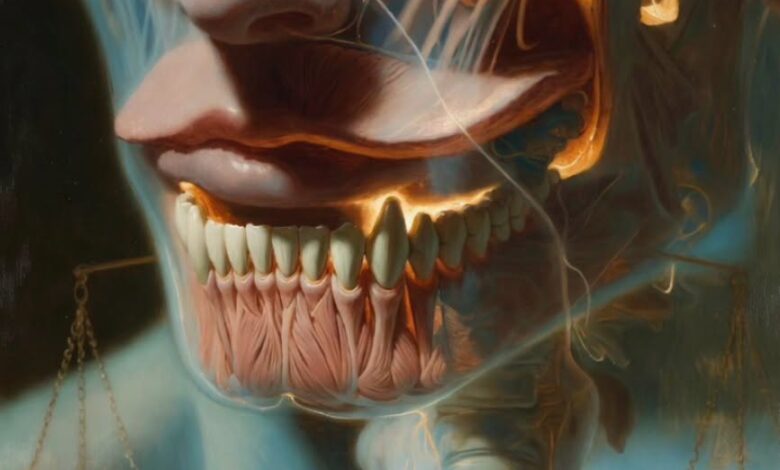
My dentist fitted a single molar in my lower jaw. It was only a few millimeters in size, yet a few days later I was surprised to discover that my tongue could no longer pronounce the sounds “s” and “th” as it had before.
I had been pronouncing those two sounds for more than seventy years without giving them a moment’s thought. Suddenly, they required concentration, as though my tongue itself had lost its way to a place where it had settled millions of times before.
For those unfamiliar with the mechanics: the “s” sound is produced when air passes through a narrow channel formed by the tip of the tongue near the front of the roof of the mouth, just behind the teeth, with an accuracy measured in fractions of a millimeter.
The “th” sound, by contrast, requires the tip of the tongue to touch or come close to the edges of the upper and lower front teeth at the same time.
So if the height of a single lower molar changes, or if the way the teeth meet changes by even a small amount, the precise geometry upon which these sounds are built is disrupted. The tongue is then forced to relearn a pathway it had memorized instinctively since childhood.
What is even more remarkable is that the story does not end with speech.
The upper and lower jaws do not meet randomly when we chew. They come together according to a precise map of dental occlusion, developed by the body over many years, in which each upper tooth settles into its corresponding position in the lower jaw and the forces of chewing are distributed across the teeth.
A single molar that is imperceptibly higher than it should be can shift the entire burden of chewing to one side of the mouth. This can fatigue the jaw, sometimes inflame the gums, and the effects may even extend to headaches and neck pain, because the entire body is connected by invisible threads.
This small event led me to reflect on something I had read years ago but had not appreciated fully at the time: the toes.
Many people think of the toes as evolutionary leftovers—small structures that lost their function once humans began walking upright and abandoned their lives in the trees, as though the body had kept them simply as unnecessary extras.
The truth is quite the opposite.
The big toe alone bears roughly forty percent of the body’s weight during each step, and it provides the final push that carries us from one step to the next.
The smaller toes act as miniature balancing levers. They sense the nature of the ground beneath us within fractions of a second and send signals to the brain, allowing it to adjust the position of the entire body before we fall—all without our being aware of any of this intricate coordination.
Anyone who has lost a small toe knows that their gait changes, and that the load shifts to the knee, then the hip, and eventually the spine—as though a disturbance at a single point forces the entire body to rewrite itself.
There is another organ, deeper than anything we can see or touch, that reveals the same lesson from a different angle: the diaphragm.
This thin muscle separating the chest from the abdomen does far more than perform its primary function of breathing. With every inhalation and exhalation, it becomes a hidden pillar supporting the entire body.
It works together with the deep abdominal muscles, the pelvic floor, and the spine as a single unit, creating something like an internal “cylinder” of pressure that stabilizes the torso and protects the back during even the simplest movements—from bending over to lifting something heavy.
Those who suffer from weakness or dysfunction in this coordination often experience lower-back pain for which no obvious cause can be found. The problem may not lie in the spine itself, but in a breathing muscle that appears distant from the spine while being deeply connected to it in function.
Even more remarkably, this same diaphragm gives the voice its strength and stability.
An actor, singer, or public speaker does not learn to “breathe from the diaphragm” as an artistic luxury. They do so because the column of air that produces the voice requires steady pressure that the lungs alone cannot provide.
And so, at a seemingly distant point in the body, the diaphragm meets the molar with which we began this reflection.
Both, in their hidden ways, contribute to shaping the sound we tend to imagine comes solely from the mouth and tongue.
This is the extraordinary truth about the human body that we notice only when something goes wrong:
It is not a collection of neighboring organs, but a single, intensely interconnected system.
It is so precise that a small change in a tooth, a toe, or a breath can send its effects reverberating through distant parts of the body that, at first glance, appear completely unrelated.
“We have certainly created the human being in the finest proportion.”
This is not merely a poetic statement. It can also be understood as a remarkably precise description of a body designed so that every part functions in service of the whole, with no organ truly independent of the others.
Perhaps there is a lesson here that extends beyond medicine and anatomy.
In our lives, our relationships, and our societies, we sometimes assume that a small detail is not worth our attention, and that a minor defect here will not affect the larger picture there.
But the human body teaches us that true balance—in an individual as well as in a nation—is not preserved merely by repairing the large and obvious parts.
It is preserved by recognizing that the smallest details—a molar, a toe, or a breath; a letter, a word, or a position—may be precisely what holds the whole together.
Or, when neglected, may be the very point from which imbalance begins.