
I wrote a short story titled “The Genes of Evil,” and afterward I read the novel The Colors of Evil: Red by Polish writer Małgorzata Oliwia Sobczak. I felt that what I had imagined and what I had read converged on a single question, and that the story and the novel, despite their different events, looked at evil through two opposite windows.
In my story, I imagined a father who works in law and spends his life prosecuting criminals and demanding their punishment, only to suddenly find himself on the other side of the courtroom: the father of a seventeen-year-old boy accused of killing a classmate with a single stab in front of dozens of witnesses.
In The Colors of Evil: Red, we encounter the brutal murder of a young woman whose body is found on one of Poland’s beaches, leading investigators into an intricate world of violence, exploitation, money, influence, and silence.
In my story, the investigation turns inward, into the body itself: genes, brain chemistry, and genetic predispositions toward impulsivity and anger.
In the novel, the investigation moves outside the body: into the family, society, institutions, and relationships that may protect a person—or leave them vulnerable to violence.
But the question in both works is the same:
Where does evil come from?
Is it born within us, partially written into our cells? Or is it formed outside us, in the environment that raises us and the pressures that surround us? Does a criminal commit a crime through free will, or is the crime the final moment in a long chain of causes, most of which the person never chose?
And is it enough to know who held the knife, or should we also ask who created the anger, who fed it, who concealed it, who saw the danger and chose silence?
It seemed to me that The Colors of Evil is the title that brings both works together. Evil is not always black, nor does it always arrive in the form of a monster we can easily recognize. It may be red, the color of blood and anger; gray, the color of silence and hesitation; white, dressed in the clothes of innocence and respectability; or golden, protected by wealth and influence. It may even be invisible and without color, hidden in a biological predisposition that does not create the crime by itself, but may make resisting an impulse more difficult for some people than for others.
That is why I placed what I imagined in The Genes of Evil alongside what I read in The Colors of Evil—not to search for an excuse for the criminal, but to understand the ambiguous distance between explanation and justification, between predisposition and choice, and between the justice that holds a person accountable and the science that tries to understand them.
The Story I Imagined
On an ordinary morning, Counselor Yehia Fouad was drinking his black coffee and reading the newspaper when his wife, Mrs. Afkar Al-Ayoubi, entered the room with an expression of distress he had never seen before.
She said in a trembling voice:
“The police are at the house, Yehia.”
The words were few, but they were enough to turn the family’s life into a nightmare.
Their seventeen-year-old son, Ashraf, was accused of killing a classmate in the school courtyard with a single stab to the chest. The crime had taken place in front of dozens of witnesses, yet everyone who knew Ashraf kept repeating the same sentence:
“He was quiet and kind… he never seemed violent.”
Yehia had spent more than twenty years as a prosecutor. He knew what an obvious case looked like, how evidence was assembled, and how facts became accusations, and accusations became judgments.
But for the first time, he found himself on the other side—not looking at an accused person from behind a case file, but seeing his son, his features, his childhood, and all the years he had lived alongside him.
During the first few weeks, he kept repeating to himself and to his wife:
“This is a mistake… my son didn’t do it.”
But the evidence accumulated mercilessly: surveillance footage, fingerprints, witness testimony, and messages revealing a heated argument that had preceded the murder.
The question was no longer: Did Ashraf do it?
It became:
Why did he do it?
That was when genetic testing made the truth more complicated rather than clearer. It revealed a group of genetic variants that might be associated with increased sensitivity to impulsivity and reduced control under pressure.
These genes were not a verdict of aggression, nor could they create a murderer. But they suggested that the kind of self-control that appears easy for some people may be an arduous internal struggle for others.
The expression “warrior gene” has long been popular in the media when discussing certain variants associated with the MAOA gene, which is involved in regulating the activity of certain neurotransmitters in the brain. But the label itself can be misleading. There is no single gene for evil, and genetic testing cannot predict that a particular child will become a criminal.
Genes provide predispositions, not destiny.
At that point, the father began putting himself on trial.
His own father, Ashraf’s grandfather, had been a violent man. Yehia had grown up amid beatings, shouting, and fear. He eventually escaped that home and swore that he would become a different kind of father.
He built a peaceful home and filled it with love, discipline, and balance. He never hit his son, never deprived him of affection, and tried to shut the doors of the past so that nothing could pass through them into his new family.
But what if some part of the past had entered by another route?
What if the son had inherited predispositions that neither the father had chosen nor known he carried? And what if the old fear had left traces in the father’s personality and behavior that he himself was unaware of, allowing it to seep into the peaceful home through words, silence, tone of voice, and the way anger was expressed?
Is it enough to escape the past to ensure that we do not pass it on?
The Story I Read
After writing my story, I read The Colors of Evil: Red and found Sobczak approaching the same question from the opposite direction.
The novel was published in 2019 as the first installment in a crime series whose volumes bear different color names. In 2024, it was adapted into a Polish film released by Netflix, bringing its story to a global audience.
The novel begins with the discovery of the body of a young woman on a beach in Poland’s Tricity area. The girl was not merely murdered; her body had been mutilated in a way that evoked an old crime committed many years earlier.
Had the same killer returned?
Or was someone else imitating the crime?
Or had the old truth never been discovered in the first place, with justice closing a file while the crime remained open in the memories of the victims?
Young prosecutor Leopold Bilski takes charge of the investigation, while the victim’s mother, Judge Helena, begins her own search for answers.
The prosecutor wants to know who killed the girl.
The mother wants to know how her daughter lived her final days, what she was hiding, and why she was unable to see her daughter walking toward danger.
Between these two questions, the novel reveals a world of influence, money, exploitation, fear, and silence. The crime no longer appears to be the act of a single murderer, but rather the product of an entire environment that allowed violence to grow, provided it with protection, and convinced many people that silence was safer than the truth.
And this is where the novel meets my story.
While The Genes of Evil searches for the roots of violence within the individual, The Colors of Evil searches for them within society.
While the father asks what he may have passed on to his son, the novel asks what the environment passed on to both the killer and the victim: fear, humiliation, helplessness, or a sense of impunity.
In both cases, the crime does not stand alone before the court. It brings with it an entire history of silent causes.
Do Evil Genes Exist?
This is the most intriguing—and most dangerous—question.
Some studies suggest that certain genetic predispositions may influence impulsivity, anger regulation, or responses to danger and stress. But these studies concern statistical probabilities within populations; they do not provide a moral judgment about any particular individual.
Not everyone who carries a genetic predisposition toward violence becomes violent, and not every criminal carries the same genetic variants.
A child may have a biological predisposition toward impulsivity, yet grow up in a safe and supportive environment and learn from an early age how to manage anger, eventually becoming a successful doctor, artist, or athlete.
Another child may carry the same predisposition but experience humiliation, violence, and neglect, growing up in an environment that rewards strength and despises weakness. The risk of an explosive reaction may then become greater.
But even here, the crime is not inevitable.
There is a profound difference between saying:
“The gene caused the crime.”
and saying:
“The biological makeup may have made resisting the impulse more difficult.”
The first statement turns the human being into a machine obeying the commands of its DNA.
The second acknowledges that people do not all begin from the same starting point, and that what is easy for one person may require enormous effort from another.
Predisposition is not action, and difficulty is not impossibility.
Explanation Is Not Justification
If we discover that a brain tumor affected a person’s ability to control their behavior, that information may change our moral and legal judgment. And if it is established that someone committed an act during a psychotic episode that severed their connection to reality, we do not judge them in the same way we judge someone who consciously planned their crime.
So why should we stop entirely when confronted with genetic predispositions or abnormalities in brain chemistry?
Perhaps because we fear that opening this door could undermine the entire concept of responsibility. If every person can say that their genes, childhood, or brain chemistry made them do it, who remains responsible for any action?
But fear of the misuse of science does not justify ignoring it.
The problem is that we insist on binary answers: responsible or irresponsible, free or determined, guilty or innocent.
Human reality is far more complicated.
Responsibility is not an electrical switch that is either on or off. It exists in degrees and is affected by awareness, intention, capacity for self-control, illness, age, and the circumstances surrounding the act.
Genes may explain why self-control was more difficult, but they do not prove that it was impossible.
And this is the dividing line between explanation and justification.
To understand the causes of a crime does not mean accepting it. To recognize a criminal’s diminished capacity for control does not mean denying the victim’s rights.
Compassion for the perpetrator must never become a new injustice toward the victim.
Who Is the Criminal in The Colors of Evil?
In traditional crime novels, we usually wait for the moment when the murderer is revealed. We feel that the mystery has been solved and that order has been restored to the world.
But The Colors of Evil makes the question broader than identifying the hand that committed the crime.
A murder may be carried out by one person, but the environment that made it possible may involve many others:
the person who exploited,
the person who covered it up,
the person who was afraid,
the person who bought silence,
the person who abused their authority,
and the person who watched another human being walking toward danger and told themselves that it was none of their concern.
The direct perpetrator is responsible for the act. But his arrest does not absolve society from examining the environment that made the crime possible.
We may punish the hand that held the knife while leaving untouched the system that produced the anger, fear, and sense of impunity.
In that case, we may have closed the case legally, but we have not understood it humanly.
This is what the law sometimes does: it searches for the final link in the chain because that is the link it can prosecute, while being unable to put the entire chain on trial.
The Father Who Puts Himself on Trial
Counselor Yehia was not defending his son’s complete innocence. He was defending his right not to be reduced to the worst moment of his life.
He saw the crime, but he also saw the child who came before it.
He saw his son in the defendant’s cage, then saw himself standing behind him, unsure whether he was his lawyer or a witness against him.
Had he passed some of his old fear on to his son?
Had the influence of the violent father he had escaped somehow infiltrated his new home despite all his efforts to become a different kind of father?
Are good intentions enough to prevent the past from passing from one generation to another?
We do not inherit only our children’s eye color and facial features.
We give them a complex biological mixture of predispositions, and then place them within an environment we create through what we consciously do—and what we fail to recognize in ourselves.
A father may escape a violent home, yet sometimes carry within him that home’s way of responding to fear, silence, and anticipating danger.
He may never hit his son, yet pass on suppressed anxiety, excessive sensitivity to humiliation, or an inability to express anger before it erupts.
Here, we must distinguish between guilt and responsibility.
A father is not guilty because he passed on his genes. He did not choose them and could not select what he would inherit.
But he becomes morally responsible for the environment he creates, for the warning signs he sees and ignores, and for seeking help when he recognizes danger.
Should We Test Children’s Genes?
What if genetic testing became routine for every newborn?
The goal might appear noble: to identify predispositions early and provide psychological and educational support for children at greater risk of impulsivity, addiction, or behavioral disorders.
But who can guarantee that probability will not become a stigma?
A child might enter school with a label in their file:
“High risk for violence.”
Teachers would watch them. Classmates would fear them. Every ordinary outburst of anger would be interpreted as the beginning of a future crime.
And so the classification might create the very destiny it claimed to predict.
Even more dangerously, governments, insurance companies, or employers could use such data to determine who deserves education, employment, or insurance—or even who should be allowed to have children.
At that point, we would return to eugenics: the illusion of “improving” humanity by controlling reproduction, not through the crude racist slogans of the past, but wearing a white laboratory coat and speaking the language of prevention and protecting society.
A human being is not the sum of the risk scores recorded in their genes.
Genes may tell us about probabilities within large populations, but they cannot write the moral biography of a child who has not yet lived their life.
Justice That Holds Accountable, Protects, and Treats
The law cannot abandon accountability. A society that does not hold murderers accountable forfeits its members’ right to safety.
But punishment should not be blind revenge.
Justice can say to the accused at the same time:
“You are responsible for the act you committed. But we also want to understand what made you more vulnerable to committing it, treat what can be treated, and protect society from its recurrence.”
This does not eliminate imprisonment for serious crimes, but it changes its purpose.
Prison ceases to be merely a place where the offender is made to suffer and becomes part of a system combining protection, accountability, treatment, and rehabilitation.
It also shifts our attention from the moment of punishment to years of prevention: supporting families, treating trauma, teaching children how to manage anger, detecting psychological disorders early, and confronting bullying and violence in schools.
The goal should not be to wait for a crime and then search the perpetrator’s genes.
It should be to understand the human being before they reach the moment of explosion.
Between Genes and Choice
I do not believe that human beings possess absolute freedom.
We did not choose our genes, our parents, our childhood, the social class or country into which we were born, or the historical moment in which we came into the world.
But neither do I believe that we are closed biological machines.
We move within a space between what we inherit and what we are capable of creating.
That space of choice differs from one person to another. It may become narrower because of illness, trauma, poverty, or fear, but it does not necessarily disappear.
Genes do not write destiny, but they may make some paths steeper than others.
Upbringing does not create a human being from nothing, but it can expand the space of choice and give a person the tools with which to resist their impulses.
As for justice, its task is to understand the path from which a person came without denying the step they chose to take at the end of it.
That is why, when I ask, “Whom do we put on trial—the son or the father?”, I find that perhaps the question itself has been framed incorrectly.
We do not put the father on trial for genes he did not choose, nor do we absolve the son because self-control may have been more difficult for him.
We put the act on trial, assess the degree of choice involved, understand the causes, and then ask what might have prevented the tragedy.
For evil is not a gene, not a single color, and not a single person.
It is a moment in which a hidden predisposition meets a conducive environment, sudden pressure, and a human decision.
We may be able to change the environment, treat the predisposition, and reduce the pressure.
But as long as a person retains the capacity to choose, they must remain responsible for their decision.
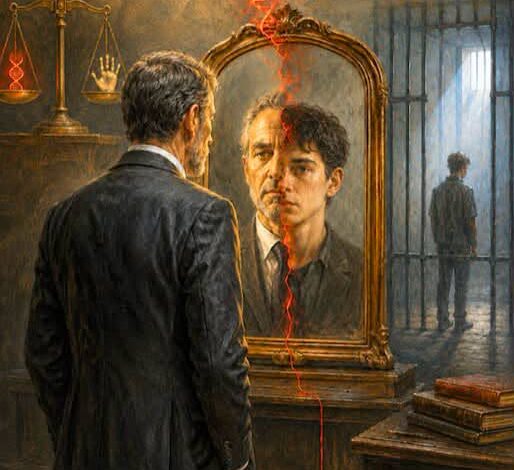
And at the end of the story, the father stands before the mirror and does not ask himself only:
“Did I create a criminal?”
He asks a more compassionate—and more painful—question:
“Which part of my son did he inherit from me, which part was shaped by life, and which part was shaped by him when he chose?”
Perhaps the answer does not grant anyone complete innocence.
But it prevents us from committing another injustice in the name of justice.
For justice that does not understand the human being can itself become another color of evil.