2026 Collective Activities & ArticlesAll ArticlesAlmasry AlyoumBy Dr BadrawiTranslated Articles

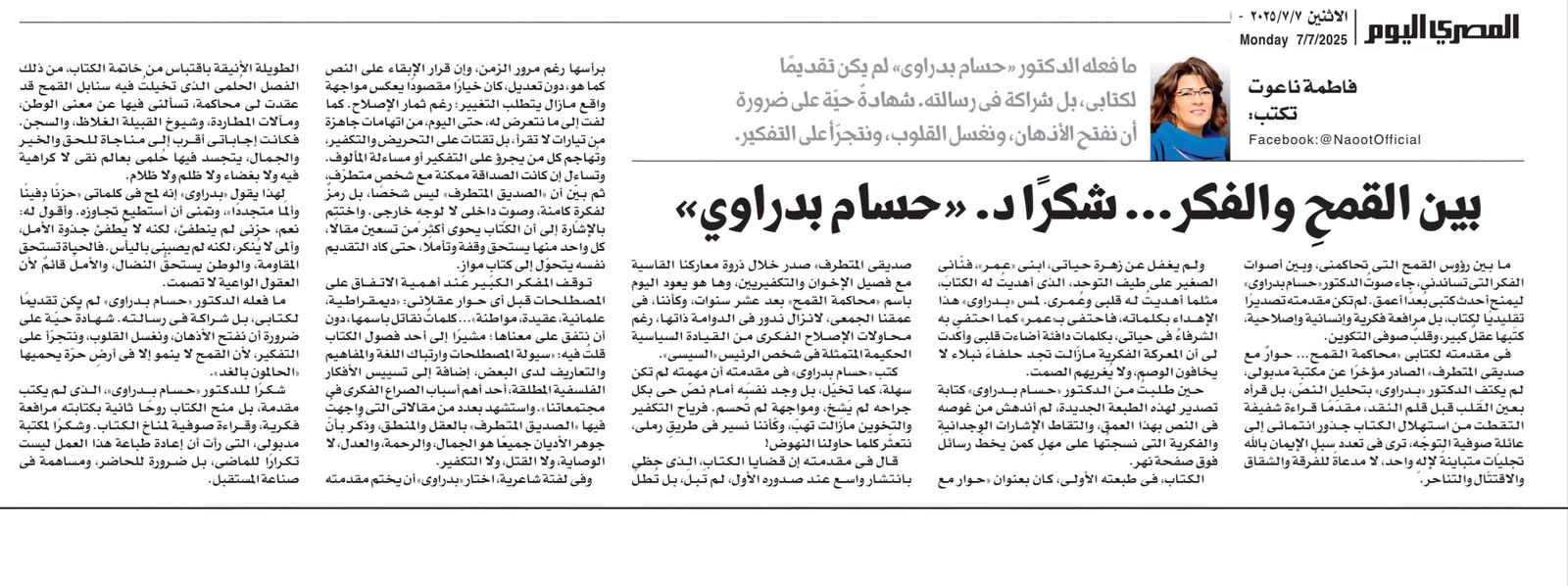
Hossam Badrawi Writes for Al-Masry Al-Youm: Wounds That Do Not Fade from Memory

On April 8, 1970, during the War of Attrition, Israeli aircraft turned the Bahr El-Baqar Primary School in Egypt’s Sharqia Governorate into a military target. The raid resulted in the killing of 46 children and the injury of more than 30 others, bringing the total number of child victims to around 80 dead and wounded. The children were sitting in their classrooms, dreaming of a better future, when the bombs rained down on them. There was no real military target inside the school, and to this day, Israel has not issued an official apology commensurate with the scale of the crime.

Today, exactly 56 years later, the tragic scene is repeated on February 28, 2026. In the city of Minab, in Iran’s Hormozgan Province, U.S.-made Tomahawk missiles (as part of a joint U.S.-Israeli operation) targeted the “Good Tree” primary school for girls. The students—mostly girls aged between 7 and 12—were inside their classrooms. The strike resulted in the deaths of between 165 and 180 people, most of them children, and dozens more were injured. There was no apology here either. Not from Washington, nor from Tel Aviv.

A never-ending chain… massacres of children narrate a single philosophy.

Bahr El-Baqar and Minab are but two حلقات (links) in a long chain of massacres in which schools and shelters have been turned into legitimate targets, without any meaningful apology or serious international accountability.

On April 18, 1996, during Operation “Grapes of Wrath,” Israeli artillery shelled a UNIFIL compound in Qana, southern Lebanon, where around 800 Lebanese civilians had taken refuge. The attack killed 106 people, nearly half of them children (52 children), despite the site being internationally protected and well known. A United Nations investigation stated that the attack was “unlikely to be a technical error,” yet Israel claimed it was a mistake and did not issue a formal apology acknowledging responsibility. Western reactions were limited to muted condemnations that quickly faded.

A decade later, on July 30, 2006, tragedy struck Qana again: Israeli aircraft bombed a residential building sheltering displaced people, killing at least 28 individuals (16 of them children), with early reports suggesting higher numbers. Images of children pulled from the rubble sparked temporary global outrage that led to a partial halt in strikes, but once again, no apology was issued, and the attack was justified by claims of “military targets” without conclusive independent evidence.

In Gaza, targeting schools has become a recurring pattern. In 2009, the bombing of the Al-Fakhoura school, run by UNRWA, killed more than 40 people, many of them children. Between 2023 and 2025, attacks on schools such as Al-Fakhoura, Tal al-Zaatar, and others resulted in hundreds of deaths—most of them children and women.

This pattern is not limited to “isolated incidents,” but reflects a double standard that undermines the moral credibility of the international system and turns children’s wounds into fuel for a collective memory that does not forget.

What connects Bahr El-Baqar and Minab, separated by 56 years and thousands of kilometers—and all that came before and between them?

The answer is simple and harsh: an unchanging philosophy. A philosophy that turns the school—symbol of education and the future—into a legitimate target for bombardment. A philosophy that sees children as “acceptable collateral damage,” or ignores their protection under international humanitarian law, which prohibits targeting civilians and educational institutions.

Bahr El-Baqar 1970: a wound that never healed

Egypt was in the midst of the War of Attrition, defending its sovereignty after the 1967 defeat. The school was a clear target despite the absence of any military activity within it. The victims were ordinary Egyptian children. Israel claimed there was a nearby target, but did not issue a formal apology acknowledging the crime. The Western world at the time took a passive stance: some muted condemnations, followed by silence. No sanctions were imposed, and no one was held accountable.

Minab 2026: repetition of tragedy with more advanced technology

In the context of a U.S.-Israeli military escalation against Iran, the strike came on the first day of the operation. Precision missiles hit the school directly during school hours. Yet the United States—which confirmed responsibility for missile launches in southern Iran—did not issue a public apology commensurate with the victims. Israel denied responsibility altogether despite the joint nature of the operation.

Hundreds of children were killed or injured, and not a single word of apology or remorse was heard. This is the most painful similarity.

Disregard for humanity is a continuing pattern. In both cases, schools were not military targets, but symbols of life and future. The victims were innocent children, and the perpetrator is the same: Israel, and the U.S.-Israeli alliance. The outcome is the same: a collective wound in human memory.

This philosophy reflects a strategic vision that sees “military power” as justification for everything—even the killing of children in their classrooms. It is a philosophy that empties humanity of meaning and turns wars into massacres that do not distinguish between combatant and civilian.

The American-Israeli actions and the international response evoke deep sorrow. The United States, which directly participated in the Minab strike, has shown no genuine will for independent investigation or accountability. The Western world—often claiming to defend human rights—has largely limited itself to muted statements or complete silence.

Does the killing of children become “acceptable” when the perpetrator is a strategic ally? This question forces itself forward, revealing a double standard that strips the West of its moral credibility.

The lessons and implications are many. On the anniversary of Bahr El-Baqar, and in the face of fresh blood in Minab, and what is happening in Lebanon and Gaza, we must realize that silence encourages the perpetrator. The wound does not fade from memory, but transforms into a global cry for justice.

The international community must:

  • Form an independent investigation committee into the Minab massacre
  • Pressure for official recognition and apology for Bahr El-Baqar
  • Consider the protection of schools and children in all conflicts a non-negotiable red line

From Bahr El-Baqar to Minab, schools tell one story: children pay the price for a philosophy that does not respect humanity. If this pattern does not change, every school in the world could become a target tomorrow. Memory does not forget. History records. And the enduring question remains: when will the world stop treating children’s blood as “passing news”?

Dr. Hossam Badrawi

He is a politician, intellect, and prominent physician. He is the former head of the Gynecology Department, Faculty of Medicine Cairo University. He conducted his post graduate studies from 1979 till 1981 in the United States. He was elected as a member of the Egyptian Parliament and chairman of the Education and Scientific Research Committee in the Parliament from 2000 till 2005. As a politician, Dr. Hossam Badrawi was known for his independent stances. His integrity won the consensus of all people from various political trends. During the era of former president Hosni Mubarak he was called The Rationalist in the National Democratic Party NDP because his political calls and demands were consistent to a great extent with calls for political and democratic reform in Egypt. He was against extending the state of emergency and objected to the National Democratic Party's unilateral constitutional amendments during the January 25, 2011 revolution. He played a very important political role when he defended, from the very first beginning of the revolution, the demonstrators' right to call for their demands. He called on the government to listen and respond to their demands. Consequently and due to Dr. Badrawi's popularity, Mubarak appointed him as the NDP Secretary General thus replacing the members of the Bureau of the Commission. During that time, Dr. Badrawi expressed his political opinion to Mubarak that he had to step down. He had to resign from the party after 5 days of his appointment on February 10 when he declared his political disagreement with the political leadership in dealing with the demonstrators who called for handing the power to the Muslim Brotherhood. Therefore, from the very first moment his stance was clear by rejecting a religion-based state which he considered as aiming to limit the Egyptians down to one trend. He considered deposed president Mohamed Morsi's decision to bring back the People's Assembly as a reinforcement of the US-supported dictatorship. He was among the first to denounce the incursion of Morsi's authority over the judicial authority, condemning the Brotherhood militias' blockade of the Supreme Constitutional Court. Dr. Hossam supported the Tamarod movement in its beginning and he declared that toppling the Brotherhood was a must and a pressing risk that had to be taken few months prior to the June 30 revolution and confirmed that the army would support the legitimacy given by the people


Related Articles

Back to top button