
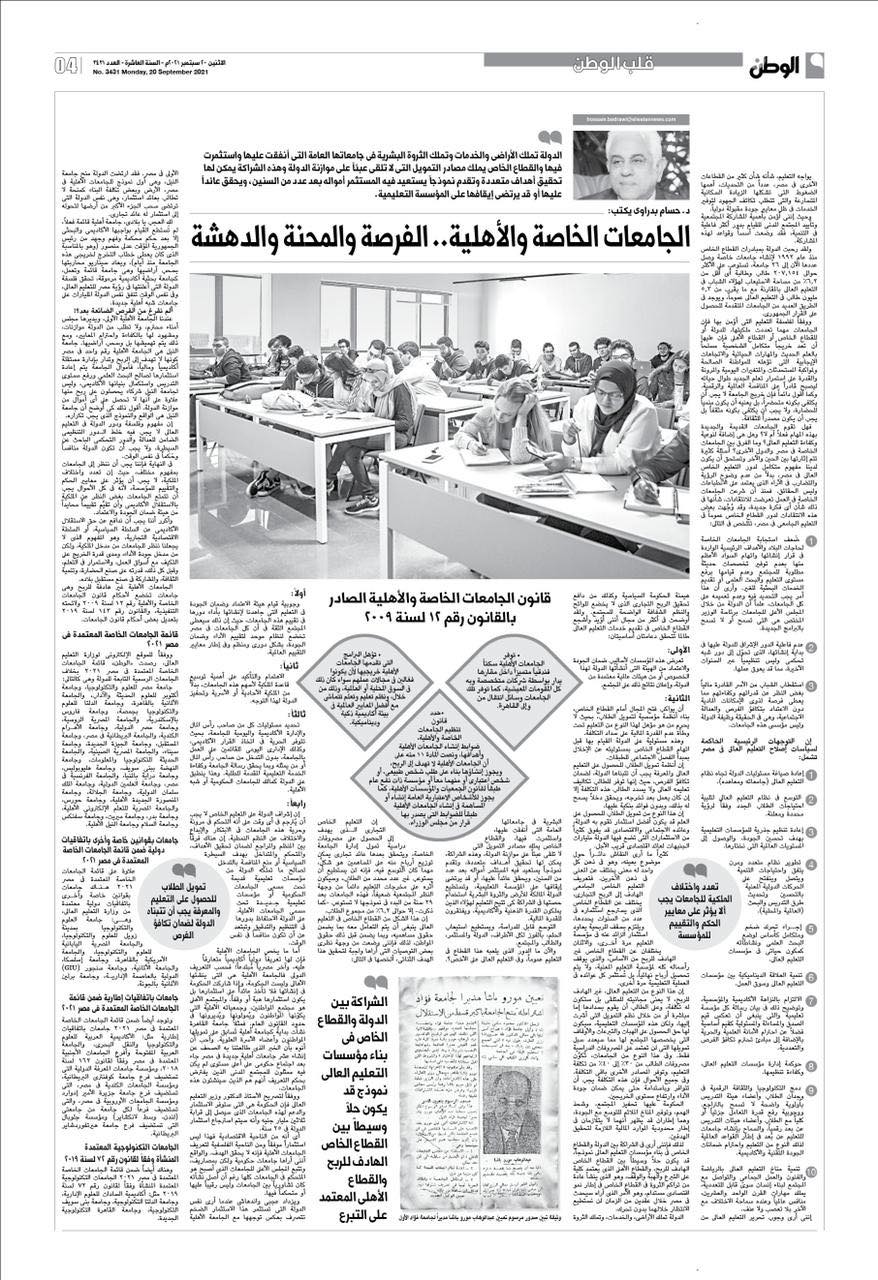
Private and private universities .. opportunity, ordeal and surprise!
The state has welcomed the initiatives of the private sector since 1992 to establish private universities, which now number to 26 universities, accommodating at most about 207,154 male and female students, i.e. less than 6.2% of the space for these young people in higher education, compared to approximately 3. 5 million students in higher education in general. There are many universities on the way forward to obtain the republican decision.
According to the philosophy of higher education in Egypt’s Vision 2030, universities, no matter how many are owned by the state, the private sector, or the private sector, they must prepare graduates with an integrated personality armed with modern science, life skills and positive trends that qualify them for good citizenship and to keep pace with developments and daily changes, flexibility and the ability to continue learning the new Throughout his life, to be able to compete globally and digitally.
I believe that higher education must be liberated from the domination of the political government, as well as from the motive of making commercial profit if it is not subject to the transparent and clear regulations and systems of society. I have made it clear, in more than one field, that I support and encourage the private sector in providing higher education services as long as two basic pillars are achieved.
The first: These institutions present methods of quality assurance and accreditation from the body established by the state for this purpose or from international bodies approved by the state, and announcing the results of that on society.
The second: That opening the way for the private sector goes hand in hand with building institutional systems to finance students, so that those who are qualified for this type of education are not deprived of the burden of financial inability to pay the cost.
This is a responsibility that the state must undertake before accusing the private sector of its responsibility for violating the principle of social separation of classes.
Therefore, I see the partnership between the state and the private sector in building higher education institutions as a model, which may be a mediating solution between the profit-oriented private sector and the private sector, which depends entirely on donation, endowment and endowment, which usually arises from the accumulation of wealth in the private sector within the framework of economic growth Sustainable, which is what I see as it will not happen in Egypt three decades ago, during which we will not be able to wait without action.
The state owns lands and services, and owns human wealth in its public universities, which it has spent on and invested in, and the private sector owns sources of funding that do not place a burden on the state budget, and this partnership can achieve multiple goals, and provides a model in which the investor recovers his money after a number of The state that owns the land and human wealth can use its share in the partnership to provide education for those who have the mental and academic ability, and who lack the financial ability. This expansion is subject to study, and can accommodate the dream of winning for all parties: the state, the investor, the student and society.
The state’s supervision of private education should not be translated at any time as controlling the flexibility and freedom of these universities in innovation and creativity and differing from typical systems. There is a difference between the regulator and the reference to ensure the achievement of goals, and the controller and the interfering with the aim of political control or preventing competition by interfering in favor of the old educational institutions owned by the state under the name of public universities or new educational institutions under the name of private universities. The state should maintain its role in organizing and auditing and avoiding being a competitor at the same time.
As for private universities, they have an internationally recognized academic definition, and an innovative Egyptian one. According to the international definition, a private university is one that is established by the people, not the government. If the government participates in its establishment, it does not take a return on its investment, but rather its investment is a gift or endowment. The civil society is the society of citizens, and its civil institutions that they form, finance and manage within the limits of public law. For example, Cairo University was initially established as a private university whose funding was raced by citizens and members of the Alawite family, and then turned into a public university. I would like to note that the news that the newspapers read about the establishment of ten new private universities in Egypt came after a governmental meeting at the highest level in which there were no representatives of civil society who, by definition, are supposed to be the ones who will establish these universities. According to the statement of the Minister of Higher Education, the government is the one that will provide investment and support for these universities, which will reach nearly thirty billion pounds, and that the state’s investment will be recovered in 25 years. That is, from an economic point of view, this is not a successful investment, and from a philosophical point of view, defining private universities does not achieve the goal of being private. In fact, I see them as government universities, but with expenses, and they follow the Supreme Council of Universities, which has become the controller of all universities, although the origin of its inception was a consultative between universities and not a monitor or control over them.
And my astonishment increases when I see the same country that invests this huge investment acting in the opposite direction with the first private university in Egypt, which is the Nile University, which is the first model for private universities in Egypt, where the land and some of the cost of construction were a grant from the state that does not demand a return on investment for it, and it is the same state Which accepts to withdraw the bulk of its land to turn it into an investment with a commercial return.
The surprise here is that the National Nile University actually existed, and it faced difficulties in its early inception, as it was unable to carry out its academic and research duties except after a court ruling and the understanding and effort of the interim President of the Republic, Adly Mansour (which by the way was giving the graduation letter to graduates of this university a few days ago), And the scenario of impeding its development is repeated after its maturity by withdrawing its lands, which is an existing and prestigious civil university, and it achieves the philosophy of the state that it announced in Egypt’s vision for higher education, and at the same time the same state spends billions on new semi-civil universities starting from scratch.
I love
The state has welcomed the initiatives of the private sector since 1992 to establish private universities, which now number to 26 universities, accommodating at most about 207,154 male and female students, i.e. less than 6.2% of the space for these young people in higher education, compared to approximately 3. 5 million students in higher education in general. There are many universities on the way forward to obtain the republican decision.
According to the philosophy of higher education in Egypt’s Vision 2030, universities, no matter how many are owned by the state, the private sector, or the private sector, they must prepare graduates with an integrated personality armed with modern science, life skills and positive trends that qualify them for good citizenship and to keep pace with developments and daily changes, flexibility and the ability to continue learning the new Throughout his life, to be able to compete globally and digitally.
I believe that higher education must be liberated from the domination of the political government, as well as from the motive of making commercial profit if it is not subject to the transparent and clear regulations and systems of society. I have made it clear, in more than one field, that I support and encourage the private sector in providing higher education services as long as two basic pillars are achieved.
The first: These institutions present methods of quality assurance and accreditation from the body established by the state for this purpose or from international bodies approved by the state, and announcing the results of that on society.
The second: That opening the way for the private sector goes hand in hand with building institutional systems to finance students, so that those who are qualified for this type of education are not deprived of the burden of financial inability to pay the cost.
This is a responsibility that the state must undertake before accusing the private sector of its responsibility for violating the principle of social separation of classes.
Therefore, I see the partnership between the state and the private sector in building higher education institutions as a model, which may be a mediating solution between the profit-oriented private sector and the private sector, which depends entirely on donation, endowment and endowment, which usually arises from the accumulation of wealth in the private sector within the framework of economic growth Sustainable, which is what I see as it will not happen in Egypt three decades ago, during which we will not be able to wait without action.
The state owns lands and services, and owns human wealth in its public universities, which it has spent on and invested in, and the private sector owns sources of funding that do not place a burden on the state budget, and this partnership can achieve multiple goals, and provides a model in which the investor recovers his money after a number of The state that owns the land and human wealth can use its share in the partnership to provide education for those who have the mental and academic ability, and who lack the financial ability. This expansion is subject to study, and can accommodate the dream of winning for all parties: the state, the investor, the student and society.
The state’s supervision of private education should not be translated at any time as controlling the flexibility and freedom of these universities in innovation and creativity and differing from typical systems. There is a difference between the regulator and the reference to ensure the achievement of goals, and the controller and the interfering with the aim of political control or preventing competition by interfering in favor of the old educational institutions owned by the state under the name of public universities or new educational institutions under the name of private universities. The state should maintain its role in organizing and auditing and avoiding being a competitor at the same time.
As for private universities, they have an internationally recognized academic definition, and an innovative Egyptian one. According to the international definition, a private university is one that is established by the people, not the government. If the government participates in its establishment, it does not take a return on its investment, but rather its investment is a gift or endowment. The civil society is the society of citizens, and its civil institutions that they form, finance and manage within the limits of public law. For example, Cairo University was initially established as a private university whose funding was raced by citizens and members of the Alawite family, and then turned into a public university. I would like to note that the news that the newspapers read about the establishment of ten new private universities in Egypt came after a governmental meeting at the highest level in which there were no representatives of civil society who, by definition, are supposed to be the ones who will establish these universities. According to the statement of the Minister of Higher Education, the government is the one that will provide investment and support for these universities, which will reach nearly thirty billion pounds, and that the state’s investment will be recovered in 25 years. That is, from an economic point of view, this is not a successful investment, and from a philosophical point of view, defining private universities does not achieve the goal of being private. In fact, I see them as government universities, but with expenses, and they follow the Supreme Council of Universities, which has become the controller of all universities, although the origin of its inception was a consultative between universities and not a monitor or control over them.
And my astonishment increases when I see the same country that invests this huge investment acting in the opposite direction with the first private university in Egypt, which is the Nile University, which is the first model for private universities in Egypt, where the land and some of the cost of construction were a grant from the state that does not demand a return on investment for it, and it is the same state Which accepts to withdraw the bulk of its land to turn it into an investment with a commercial return.
The surprise here is that the National Nile University actually existed, and it faced difficulties in its early inception, as it was unable to carry out its academic and research duties except after a court ruling and the understanding and effort of the interim President of the Republic, Adly Mansour (which by the way was giving the graduation letter to graduates of this university a few days ago), And the scenario of impeding its development is repeated after its maturity by withdrawing its lands, which is an existing and prestigious civil university, and it achieves the philosophy of the state that it announced in Egypt’s vision for higher education, and at the same time the same state spends billions on new semi-civil universities starting from scratch.
I love
The expansion of higher education, and he commended the state for investing in it within the framework of a sustainable and understandable philosophy, but at the same time I do not like to do the opposite of what we have achieved.
Haven’t we run out of missed opportunities yet?!
We have the first private university, and it is managed by a respected board of trustees, and it does not ask the state for budgets, and it is known for its efficiency and respect for standards, yet it is marginalized and even withdrawn from its lands.
Nile University is the number one private university in Egypt as it is not for profit and is managed by an independent academic and financial administration. The university’s funds are reinvested in the interest of scientific research, raising the level of teaching and completing its academic structure, and Nile University has no partners who receive a profit from it. I say this in order to make it clear that Nile University is the reality and the model that must be repeated and built upon. At the same time, as it is within the limits of my information, the Japanese university is a private university with the same definition and is supposed to be Zewail University in the same framework.
The concept, philosophy, and role of the state in higher education should not confuse the regulatory role that guarantees justice and the regulatory role that seeks control, or the role of the competing investor owner, as the state should not be a competitor and an arbitrator at the same time.
In the end, we must look at universities with a different concept, as the multiplicity and difference of ownership should not affect the standards of judgment and evaluation of the institution, because in all cases, universities, regardless of ownership, must enjoy academic independence, and evaluate a neutral evaluation by the Quality Assurance Authority. and accreditation. And I repeat: We must defend the right to academic independence from political authority, or economic and commercial authority, a concept that does not make us look at universities from the entrance of ownership, but from the entrance to the quality of performance, and the extent of the graduate’s ability to adapt to labor markets, continue learning, and before All of this is his ability to create civilization, develop culture, and participate in making the future of his country
To read the full article
https://www.almasryalyoum.com/news/details/2422093
Haven’t we run out of missed opportunities yet?!
We have the first private university, and it is managed by a respected board of trustees, and it does not ask the state for budgets, and it is known for its efficiency and respect for standards, yet it is marginalized and even withdrawn from its lands.
Nile University is the number one private university in Egypt as it is not for profit and is managed by an independent academic and financial administration. The university’s funds are reinvested in the interest of scientific research, raising the level of teaching and completing its academic structure, and Nile University has no partners who receive a profit from it. I say this in order to make it clear that Nile University is the reality and the model that must be repeated and built upon. At the same time, as it is within the limits of my information, the Japanese university is a private university with the same definition and is supposed to be Zewail University in the same framework.
The concept, philosophy, and role of the state in higher education should not confuse the regulatory role that guarantees justice and the regulatory role that seeks control, or the role of the competing investor owner, as the state should not be a competitor and an arbitrator at the same time.
In the end, we must look at universities with a different concept, as the multiplicity and difference of ownership should not affect the standards of judgment and evaluation of the institution, because in all cases, universities, regardless of ownership, must enjoy academic independence, and evaluate a neutral evaluation by the Quality Assurance Authority. and accreditation. And I repeat: We must defend the right to academic independence from political authority, or economic and commercial authority, a concept that does not make us look at universities from the entrance of ownership, but from the entrance to the quality of performance, and the extent of the graduate’s ability to adapt to labor markets, continue learning, and before All of this is his ability to create civilization, develop culture, and participate in making the future of his country
To read the full article
https://www.almasryalyoum.com/news/details/2422093