
June 30: Between the Past and the Present
By Pen and Brush of Hossam Badrawi
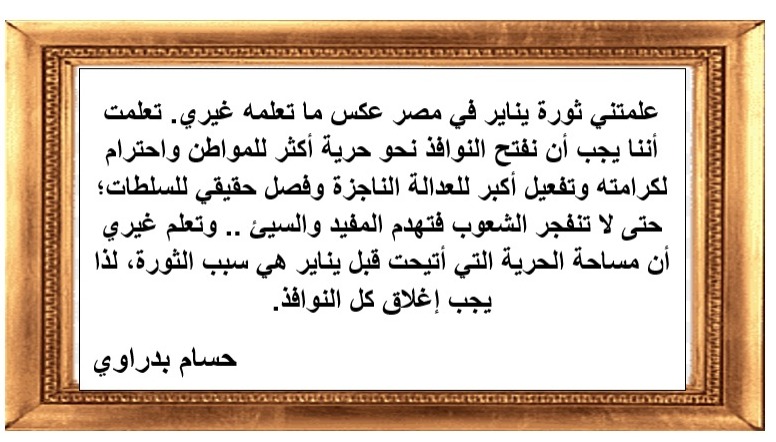
I believe that what is not documented does not exist. I like to revisit, from time to time, what I have recorded in my notes—my positions during historic moments—so I don’t forget how my mind processed events at the time. As time passes, events unfold, and new facts come to light, opinions may change, and we may not realize that unless we read what we wrote for ourselves in the moment.
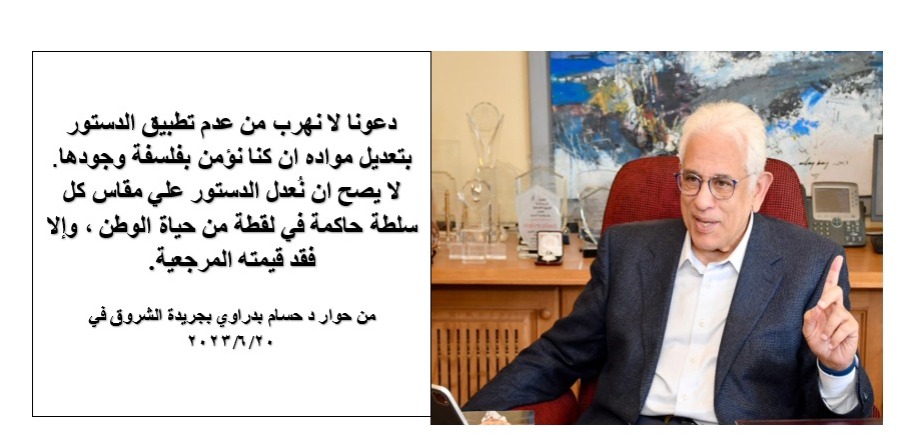
I’ve also found that people adapt and become accustomed, and may find themselves accepting what they were once passionately opposed to. It becomes necessary to remind oneself of the importance of voicing free opinions, even when the scene changes—different director, different script, different actors—as a matter of principle.
A few days before Mohamed Morsi, the Muslim Brotherhood’s candidate, won the presidential elections, the Supreme Constitutional Court ruled to dissolve the Parliament, which had a religious majority, due to the unconstitutionality of some provisions of the electoral law.
Shortly after he won, on July 8, 2012, Morsi issued his first presidential decree—Decree No. 11 of 2012—to reinstate the dissolved Parliament and return its legislative authority.
At the time, I described the decision as follows:
“Ignoring the Supreme Constitutional Court’s ruling on the illegitimacy of the Parliament’s existence makes all subsequent decisions by that Parliament illegal. It represents a failure of the executive authority to respect the other branches of power. This is the very behavior that previously undermined democracy in Egypt. We are returning to a state where the executive authority dominates others—a seed of dictatorship in any political system. This is a threat and warning to all civil forces in Egypt that we are heading toward a new era of dictatorship.”
Following that, on November 22, 2012, Morsi issued a constitutional declaration, in which the most prominent clause stated:
“The constitutional declarations, laws, and decisions issued by the President since taking office and until a new Constitution is passed and a new Parliament elected shall be final and binding by themselves and not subject to appeal by any means before any entity. No authority may suspend or cancel them, and all related lawsuits currently before any court shall be terminated.”
At the time, I issued a statement calling Morsi’s unilateral constitutional declaration an “execution of democracy and an unprecedented authoritarian act in Egypt’s history.” I said:
“The President must not be overcome by the intoxication of power or the narrow-mindedness of his advisors. I have seen this scene before and know its consequences. O God, I have conveyed the message.”
In another statement, I clarified my rejection of the declaration:
“There are restrictions on the executive authority regarding the detention of citizens under suspicion, judicial oversight within specific time limits, and a citizen’s right to a fair trial. All these guarantees vanish with this constitutional declaration, which effectively imposes a state of emergency without announcing it and without safeguards.”
I went on to say:
“Preventing the Constitutional Court judges from holding their session will go down in history as a shameful stain against freedom and democracy, which cannot exist without the protection of justice and the rule of law. Freedom cannot grow or prosper without respecting the judicial institution. When a ruling authority undermines the judiciary, disrespects its prestige, and applies the law selectively against whomever it pleases, whenever it pleases—then there is no freedom, no dignity, and no safety.”
Here are some of my documented tweets from that time, reflecting my thoughts in those historical moments:
December 2012
- The real challenge facing religious political movements is cultural. The Egyptian people will triumph through openness, pluralism, and belief in citizenship more than we expected.
- A majority has the legitimacy of the ballot box, but that legitimacy is conditional on accountability—by the people, through institutions, the media, the law, and the constitution. That is why the president swears to uphold them.
January 2013
- Post-revolution Egypt does not deserve another dictatorship under the guise of religion, nor a constitution that discriminates, excludes, and undermines rights, nor chaos and state collapse.
- Democracy without freedom and respect for the separation and balance of powers is merely using the ballot box to entrench dictatorship.
February 2013
- O Lord, help me continue to speak the truth so I may win myself, and not speak falsehood to win the weak and lose myself. Grant my mind the capacity to comprehend, and my soul the elevation to love and not hate.
April 2013
- Freedom cannot grow and thrive without respecting justice and enforcing the law.
- A president’s true responsibility is to embrace his opponents before rallying his supporters.
- A nation cannot be ruled when it seeks conflict and division, focuses on revenge and violence. Take wisdom from Gandhi and Mandela—true Muslims in action, not merely in faith.
- Disputes arise when one group imposes its vision on others and denies them partnership.
- Democracy is not only about elections—it also involves resisting undue influence, respecting the law, and maintaining the balance of power.
June 1, 2013
- Post-revolution Egypt does not deserve another dictatorship under the banner of religion, nor a constitution that discriminates and undermines rights, nor chaos and the collapse of the state.
June 13
- Message to whom it may concern: Those who do not learn from history are doomed to repeat it. Insisting on defying the people is political suicide—I’ve seen it happen before.
June 16
- Changing the political reality without an alternative plan or strong popular organization will either lead back to military rule or to chaos resulting in a new dictatorship. The lesson is clear.
- The options are limited, and the armed forces must protect the people’s choice, uphold minority rights, and prevent anyone in power from overstepping the bounds of authority.
June 25
- Any authority that does not respect its opposition loses everything in the end.
- What took years to unravel in Iran, Afghanistan, Pakistan, and Sudan—the great Egyptian people managed to defeat in a single year, with their deep history and civilization.
June 28
- Egypt proves once again that it is greater, deeper, and more enduring than any individual or group.
June 30
- What the Egyptian people are doing today in Tahrir Square and across Egypt is unprecedented. A great people are writing a new history.
- If any president rules with the same standards as the current regime, this will be the people’s reaction—because such a rule becomes a threat to the very existence of the state, not just to societal stability.
July 1
- The Muslim Brotherhood cannot claim this revolution; it is against them, extremism, and exclusion.
- The lesson the Egyptian people are teaching everyone is almost complete. Thanks to the Brotherhood for uniting the people with the army and police once again.
- A dictator is a ruler who believes, thanks to his inner circle, that he still enjoys the people’s trust and support—even minutes before his downfall.
July 2
- Morsi’s speech is incomprehensible—he threatens and warns, offering people a choice between the Brotherhood’s rule or bloodshed. I believe this speech ends the Brotherhood’s myth once and for all.
- As a doctor, I see that the Brotherhood, through the President’s unprecedented speech threatening bloodshed against opponents, has transformed from a chronic disease that could have been treated into a malignant tumor that must be removed.
- Unbelievable—I’ve never seen a government official threaten his own people like this. It’s irrational, it’s insane—it needs a mental institution.
- They asked me who moved the crowds—I said it was the will of a people with civilizational DNA and a collective conscience that rejects intolerance and incompetence, empowered by a free media worthy of respect.
- Narrow-mindedness and ideological absolutism cannot control Egyptian society or force a way of life upon it that it does not accept. This is what the people are rising against.
- The Egyptian people are diverse in identity, yet united in love for their homeland. Naturally religious—both Muslim and Christian—but open-minded and globally aware. They cannot be colonized mentally.
- What the people are doing is directed at the Brotherhood—a rejection of incompetence, exclusion, lies, threats, narrow-mindedness, and the abuse of Islam through words and actions.
July 3
- Congratulations on lifting the curse and removing the burden. Egypt is bright again, full of promise and joy, thanks to its great people and, God willing, a better future.
- This is a revolution of both people and state. All official state institutions supported the unprecedented popular will.
On a bright morning in Egypt, after lifting the darkness and breaking the curse, I feel a joy I hope fills everyone. I breathe the freedom that comes from liberating the mind and soul.
I write this twelve years after June 30, 2013, to remind myself of what I felt and believed in that moment. As Albert Einstein once said:
“Insanity is doing the same thing over and over again and expecting different results.”