
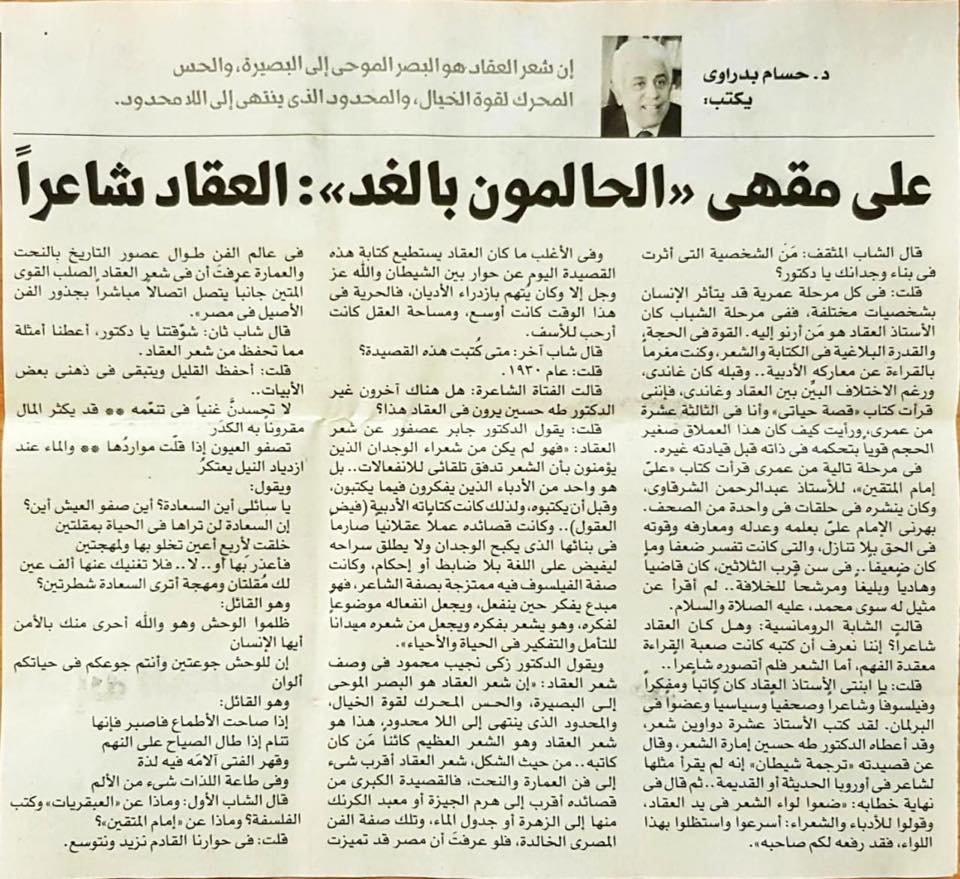
Dr. Badrawi writes in Al-Masry Al-Youm: On the Cafe “Dreamers of Tomorrow”: Al-Akkad is a Poet
The educated young man said: Who is the personality that influenced the building of your conscience, Doctor?
I said: At every age, a person may be affected by different personalities. In the youth stage, Professor Al-Akkad was the one I wanted. Strength in argument, and rhetorical ability in writing and poetry, and I was fond of reading about his literary battles.. Before him was Gandhi, and despite the clear difference between Al-Akkad and Gandhi, I read the book “The Story of My Life” when I was thirteen years old, and I saw how small this giant was Strong in controlling himself before leading others.
At a later stage in my life, I read the book “Ali, the Imam of the Righteous,” by Professor Abdel Rahman Al-Sharqawi, and he used to publish it in episodes in one of the newspapers. Imam Ali dazzled me with his knowledge, justice, acquaintances, and strength in the truth without compromise, which was explained by weakness and what was weak.. At the age of near thirty, he was a judge, guiding, eloquent and a candidate for the caliphate.. I have not read about anyone like him except Muhammad, peace and blessings be upon him.
The romantic young woman said: Was Al-Akkad a poet? We know that his books were difficult to read and complicated to understand. As for poetry, I did not imagine him as a poet.
I said: O my daughter, Professor Al-Akkad was a writer, thinker, philosopher, poet, journalist, politician and member of Parliament. The professor wrote ten collections of poetry, and Dr. Taha Hussein gave him the Principality of Poetry, and he said about his poem “Translation of a Devil” that he had not read anything like it by a poet in modern or ancient Europe.. Then he said at the end of his speech: “Put the banner of poetry in the hands of Al-Akkad, and tell the writers And the poets: Hurry up and take shelter in this banner, for its owner has raised it for you.”
In most cases, Al-Akkad could not write this poem today about a dialogue between Satan and God Almighty, except that he was accused of contempt of religions. Freedom at this time was wider, and the space of the mind was unfortunately wider.
Another young man said: When was this poem written?
I said: 1930.
The poetic girl said: Are there others besides Dr. Taha Hussein who see this in Al-Akkad?
I said: Dr. Jaber Asfour says about Al-Akkad’s poetry: “He was not one of the poets of conscience who believed that poetry is an automatic flow of emotions.. Rather, he is one of the writers who think about what they write, and before they write it, and that is why his literary writings were (overflow of minds).. His poems were a strict rational work in their construction that restrains the conscience and does not release it to overflow the language without control or provisions, and the character of the philosopher in him was mixed with the poet’s character, as he is a creative person who thinks when he gets excited, and makes his emotion the subject of his thought, and he feels his thought and makes his poetry a field for contemplation and contemplation of life and the living.
Dr. Zaki Naguib Mahmoud says in describing Al-Akkad’s poetry: “Al-Akkad’s poetry is the sight that inspires insight, the sense that motivates the power of imagination, and the limited one that ends with the infinite. Al-Akkad is the closest thing to architecture and sculpture. The major poem of his poems is closer to the Giza pyramid or Karnak temple than to Venus or the stream of water, and that is the immortal characteristic of Egyptian art. Akkad, the solid, strong and durable aspect is directly related to the roots of the original art in Egypt.
A second young man said: You made us excited, Doctor. Give us examples of what you have memorized from Al-Akkad’s poetry.
I said: I memorize a few and some verses remain in my mind.
Do not be envious of a rich man in his luxuries ** wealth may be abundant coupled with distress
The springs become clear if their resources diminish ** and the water becomes cloudy when the Nile increases
and say:
Oh, where is the happiness? Where serene live where?
Happiness will not be seen in life with two eyes
I was created for four eyes that are free from them, and for two eyes
So excuse her or.. no.. let not a thousand eyes suffice you for it
You have two words and a spell, do you see happiness in two parts?
He is the one who says:
They wronged the beast, and God is better than you to be safe, O human
The beast has two hungers, and your hunger in your life has colors
He is the one who says:
If greed cries out, be patient, for it is
You sleep if the yelling is long
And the boy conquered his pain, in which there is pleasure
And in self-obedience is something of pain
The first young man said: What about “genius” and philosophy books? And what about “the imam of the righteous”?
I said: In our next dialogue, we will increase and expand.