
2025 Collective Activities & ArticlesAl AhramAll ArticlesBy Dr BadrawiTranslated Articles

Dr. Hossam Badrawi Writes for Al-Ahram: The Meeting of Past, Present, and Future : The Grand Egyptian Museum

Out of that beautiful abundance, a dream was born: that Egypt should build a new museum worthy of the vastness of its history – one that would present its antiquities through a modern scientific and philosophical lens, preserving the past while speaking to the future.

Since the Egyptian Museum was founded in Tahrir Square in 1902 by the French architect Marcel Dourgnon, that edifice stood as a declaration of modern Egypt’s awakening to its own history – marking the transition of antiquities care from the hands of colonial administrators to the embrace of a rising national state.

From its halls emerged the first generations of Egyptian Egyptologists, giving birth to a national school dedicated to preserving heritage and safeguarding memory.

For more than a century, the museum remained the cultural heart of Cairo, a destination for generations of Egyptians and visitors from across the world – until its walls grew too narrow for the treasures it held, treasures that exceeded its capacity for display and preservation.

Out of that beautiful abundance, a dream was born: that Egypt should build a new museum worthy of the vastness of its history – one that would present its antiquities through a modern scientific and philosophical lens, preserving the past while speaking to the future.

Because Egypt views its history not through the eye of nostalgia but through the lens of evolution and awareness, another great project arose—the National Museum of Egyptian Civilization in Fustat, inaugurated in 2021—to embody yet another dimension of the country’s modern cultural vision.

While the Grand Egyptian Museum embraces the heritage of the Pharaohs and the fragrance of eternity, the Museum of Civilization presents a comprehensive journey through all Egyptian eras – from prehistory to the modern age – revealing that Egyptian civilization is an unbroken river, where human creativity has always been the child of time and the offspring of renewal.

The majestic procession of the Royal Mummies, moving from Tahrir Square to the Museum of Civilization, was a profoundly symbolic event: as if the ancient kings themselves were marching in glory from the past into the future – a journey of consciousness and reverence for the dignity of human history.

At the foot of the Pyramids, where sunset meets the golden sands, a new monument now stands – like a ship of light sailing upon the sea of history.

This is the Grand Egyptian Museum—a project that has transcended the notion of a mere building filled with antiquities to become a message of awareness and a civilizational call restoring Egypt’s rightful place as a beacon of human consciousness.

This inauguration is not a touristic event; it is a historic moment in which Egypt declares that it still possesses the power to shape the future from an inexhaustible memory, to transform stone into thought, symbol into awareness, and the past into energy for life.

From Dream to Reality

In the early 1990s, amid the world’s preoccupation with globalization, a bold Egyptian idea emerged:

that the nation should build a museum worthy of its magnificent civilization – a home for treasures accumulated over thousands of years, priceless expressions of human genius.

In 1992, former President Hosni Mubarak announced a national project to build the “Grand Egyptian Museum,” a vision befitting Egypt’s history and its standing in global consciousness.

Then–Minister of Culture Farouk Hosny translated this dream into an executable plan, believing that a museum is not a warehouse for relics, but a living space for the spirit of a nation.

He understood that every statue or papyrus is a testament to Egyptian genius – and that bringing them together under one roof would revive the collective memory of a people who taught the world the meaning of eternity.

The Genius of Place and Design

The choice of site was no accident. The Grand Museum was built on the plateau overlooking the Giza Pyramids, creating an open dialogue between antiquity and modernity, between ancient stone and modern concrete, between the symbolism of immortality and the adventure of renewal.

In 2003, the Irish architectural firm Heneghan Peng won the international design competition, presenting a vision where architecture and philosophy harmonize.

The sweeping glass façade appears like a page of light reflecting the desert glow and carrying the spirit of ancient Thebes, while the interior pathways unfold like arteries of time flowing from past to future.

Covering more than 500,000 square meters, the museum is the largest in the world dedicated to a single civilization, housing over 100,000 artifacts—from the Narmer Palette to Khufu’s solar boat, from the colossal statue of Ramses II to the complete treasures of Tutankhamun, displayed together for the first time in one place.

Those Who Carried the Torch

We must not forget those who began the dream and carried it forward. President Hosni Mubarak had the merit of launching the project, and Minister Farouk Hosny preserved and propelled it with a comprehensive cultural vision.

Then came Dr. Zahi Hawass, who turned the project into a national cause, championing it as the emblem of Egyptian identity in the 21st century.

Work never ceased, even through the nation’s most turbulent times. Egyptian engineers and archaeologists continued construction after 2011, defying economic and political challenges.

Japan contributed financing and technical support, and UNESCO offered its expertise – making the museum a fruit of cooperation between Egypt’s unbreakable will and a world that recognizes the timeless greatness of its heritage.

The Museum as a Message to the Future

The goal is not merely to display antiquities—but to rekindle awareness of them.

In the Grand Egyptian Museum, artifacts are presented within a context linking humanity to the evolution of its mind, not merely to the shapes of its tools.

Using the latest technologies of lighting, display, and virtual reality, the visit becomes a journey through human memory.

At its heart lie centers for conservation, research, and education, restoring Egypt’s natural role as a global school of historical knowledge and a center for the study of early human civilization.

It is a museum that speaks not only to tourists but to humanity itself, for Egypt’s eternal message has never changed: Civilization is the human capacity to transform existence into meaning.

The Unfading Memory of a Nation

When Egypt opens the doors of the Grand Egyptian Museum, it does not simply open exhibition halls – it opens the doors of consciousness itself.

Every artifact displayed there is a message from ancestors speaking to us of craftsmanship, faith, and the quest for eternity.

Every visitor who stands before a statue, a mummy, or an inscribed stone sees their own reflection in a mirror seven thousand years old.

The Grand Egyptian Museum is not merely a salute to the past – it is a promise to the future: that Egypt shall remain, as it has always been, a river of light that never runs dry.

A land that unites construction with contemplation, memory with awareness, dream with achievement.

And thus… when we stand before its gates, we do not merely see antiquities – we see ourselves.

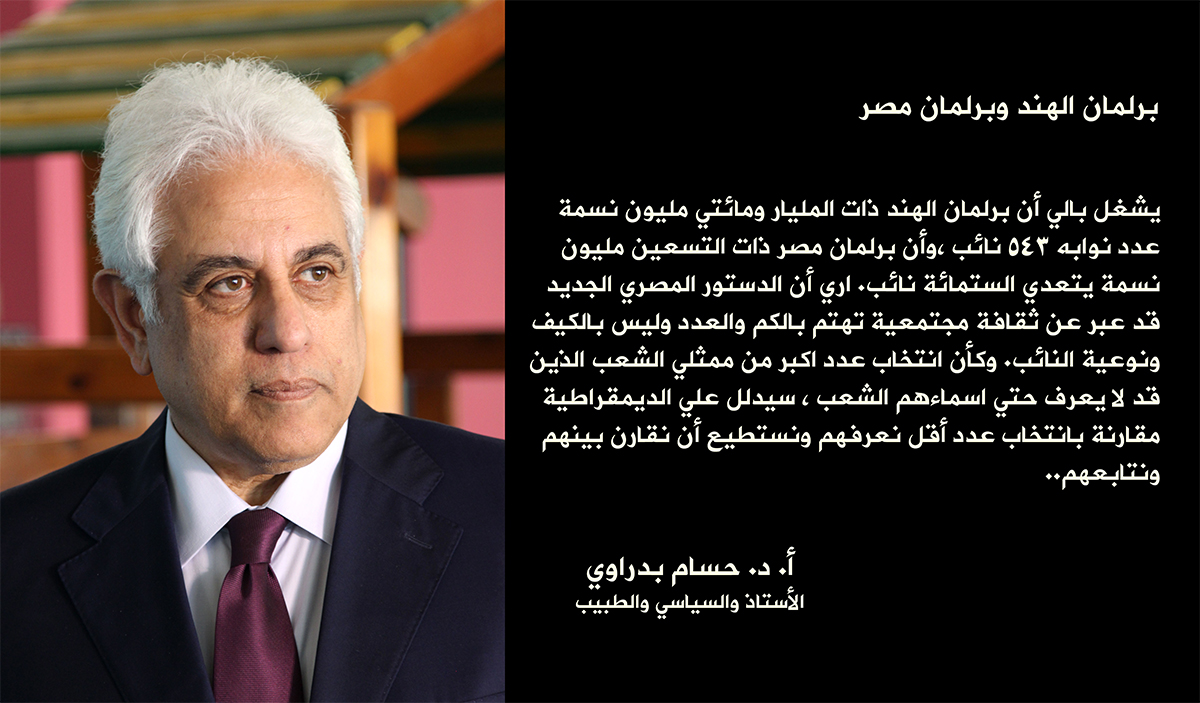
Dr. Hossam Badrawi

He is a politician, intellect, and prominent physician. He is the former head of the Gynecology Department, Faculty of Medicine Cairo University. He conducted his post graduate studies from 1979 till 1981 in the United States. He was elected as a member of the Egyptian Parliament and chairman of the Education and Scientific Research Committee in the Parliament from 2000 till 2005. As a politician, Dr. Hossam Badrawi was known for his independent stances. His integrity won the consensus of all people from various political trends. During the era of former president Hosni Mubarak he was called The Rationalist in the National Democratic Party NDP because his political calls and demands were consistent to a great extent with calls for political and democratic reform in Egypt. He was against extending the state of emergency and objected to the National Democratic Party's unilateral constitutional amendments during the January 25, 2011 revolution. He played a very important political role when he defended, from the very first beginning of the revolution, the demonstrators' right to call for their demands. He called on the government to listen and respond to their demands. Consequently and due to Dr. Badrawi's popularity, Mubarak appointed him as the NDP Secretary General thus replacing the members of the Bureau of the Commission. During that time, Dr. Badrawi expressed his political opinion to Mubarak that he had to step down. He had to resign from the party after 5 days of his appointment on February 10 when he declared his political disagreement with the political leadership in dealing with the demonstrators who called for handing the power to the Muslim Brotherhood. Therefore, from the very first moment his stance was clear by rejecting a religion-based state which he considered as aiming to limit the Egyptians down to one trend. He considered deposed president Mohamed Morsi's decision to bring back the People's Assembly as a reinforcement of the US-supported dictatorship. He was among the first to denounce the incursion of Morsi's authority over the judicial authority, condemning the Brotherhood militias' blockade of the Supreme Constitutional Court. Dr. Hossam supported the Tamarod movement in its beginning and he declared that toppling the Brotherhood was a must and a pressing risk that had to be taken few months prior to the June 30 revolution and confirmed that the army would support the legitimacy given by the people

Related Articles

Back to top button