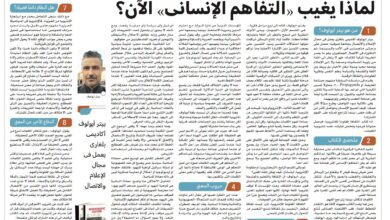

Amid the madness of extremism and violence carried out in the name of Islam on one side, and the absurdity of extremism directed against it on the other, I found myself thinking about the birthday of Prophet Muhammad, the bearer of the message, in a different way.
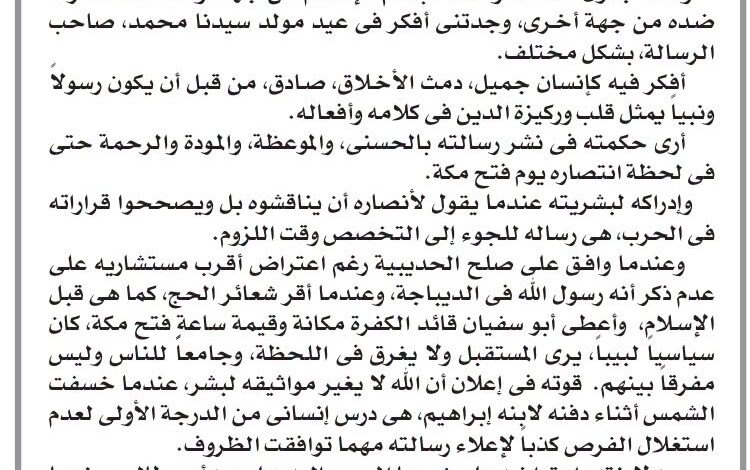
I think of him as a beautiful human being—gentle in character and truthful—before thinking of him as a messenger and prophet, the embodiment and cornerstone of the faith through his words and actions.
I see his wisdom in spreading his message through kindness, counsel, affection, and mercy, even at the moment of his victory on the day of the conquest of Mecca.
His recognition of his own humanity, when he told his companions that they could debate his decisions and even correct him in matters of warfare, offers a lesson in turning to expertise when expertise is needed.
When he accepted the Treaty of Hudaybiyyah despite the objection of one of his closest advisers to omitting the phrase identifying him as the Messenger of God from its preamble…
When he preserved the rituals of pilgrimage as they had existed before Islam…
When he granted Abu Sufyan, the leader of those who had opposed him, dignity and standing at the moment of the conquest of Mecca…
He was a perceptive statesman who could see beyond the present moment, who did not become trapped by it, and who brought people together rather than dividing them.
His insistence that God does not alter His laws for human beings, when the sun was eclipsed during the burial of his son Ibrahim, offers a profound human lesson: never exploit circumstances through falsehood to elevate your own message, even when events appear to support it.
His love for his daughter, and his objection to her husband, his beloved Ali ibn Abi Talib, when Ali sought to marry another woman, was deeply human.
My beloved Prophet Muhammad was a beautiful man in his character, merciful toward those around him, wise in his words, and faithful to his covenants.
He brought together the roles of the caring father, the devoted husband, the successful leader, the perceptive statesman, the beloved prophet, the philosopher, and the wise human being.
He was the one who completed his message, documented it through his life, and lived the word of God as an example to be followed.
On the anniversary of your birth,
I close my eyes and send you a message of love, gratitude, and respect.
You are an exemplary model among God’s creation.
Praying for the Prophet: From Ritual to Meaning
A comment on the article caught my attention. It came from a friend whose opinion I had sought before sending the article to the newspaper. He said to me:
“Your article is beautiful, except that I take issue with the fact that you did not invoke blessings upon the Prophet after mentioning his name, even though God commanded us to do so.”
The comment did not simply pass by me. Instead, it stirred questions within me that deserved reflection.
Must I write the phrase “peace and blessings be upon him” every time I mention the Prophet’s name?
Is it a devotional obligation that cannot be omitted? Or is praying for the Prophet deeper and broader than a repeated linguistic ritual?
Between the Word and the Essence
The common understanding among many people is that the invocation of blessings upon the Prophet must follow every mention of his name, whether in writing or speech.
Whoever does not do so may be accused of falling short, or even of showing disrespect.
But is the essence of praying for the Prophet really dependent upon the movement of the tongue or the writing of a phrase in parentheses?
In my view, praying for the Prophet is far greater than being reduced to words.
It is a continual awareness of his status, an affirmation of his message, and a connection between his life and our present consciousness.
To write about him truthfully, and to bring his values into our lives and our thinking, is itself an act of prayer, even if the phrase is not written every time his name appears.
Does God “Pray”?
One of the difficulties that reflects a limited understanding is the idea held by some that God “prays” for the Prophet in the same way that we pray.
Such an understanding conflicts with the transcendence of God and the principle that He is unlike His creation.
The proper understanding is that God’s “prayer” upon the Prophet means His mercy, support, and affirmation of His Prophet and his message.
The prayer of the angels, meanwhile, is their seeking forgiveness and offering supplication.
As for the prayer of believers, it is an expression of reverence, remembrance, and supplication for peace and blessings.
When we overlook this symbolic and spiritual dimension and assume that God performs the very same act that we perform, we fall into comparing the Creator with His creation—a notion incompatible with God’s transcendence and greatness.
From Symbolism to Ritualism
Here lies a deeper problem:
How do religious symbols become formal rituals performed without awareness, until they become ends in themselves rather than means to meaning?
Praying for the Prophet is a symbol that reminds us of the spiritual connection between us and him, and that his message was not merely a historical event that ended, but an enduring light in our lives.
But when it becomes a repeated formal obligation devoid of emotional presence, it is reduced to letters without spirit.
And this is what leads some people to become more concerned with whether the phrase has been written than with what has actually been written about the Prophet.
The Missing Meaning
To write about the Prophet and reflect upon his life is, in itself, a form of prayer.
To draw inspiration from his mercy, justice, and courage, and translate those qualities into practical behavior, is the highest form of praying for him.
Words are reminders. The essence is following his example.
Therefore, when someone reads my article about his birth, they are witnessing an act of prayer from me for him, because writing about him is an invitation to remember him and bring his example into our consciousness.
What is the value of repeating the phrase every time if my heart is not present and my mind is not reflecting?
The Danger of Becoming Preoccupied with the Shell
This is not a call to abandon the verbal invocation of blessings upon the Prophet. It is a noble Sunnah and an expression of love and reverence.
The danger lies in becoming preoccupied with the shell while neglecting the core.
Someone who writes “peace and blessings be upon him” dozens of times without carrying even an ounce of the mercy that the Prophet taught has not truly prayed for him.
But someone who remembers his status, understands his message, and strives to embody it in his life has, in a deeper sense, prayed for him—even if he did not write the phrase.
The Messenger Muhammad was not merely a religious symbol. He was a human being living among people, capable of being right or wrong in worldly matters, while remaining an example in the essence of faith and the highest human values.
Praying for him, therefore, is not merely a greeting directed toward a historical figure. It is a reminder that the human ideal can approach perfection when connected to revelation.
Conclusion: Returning to the Essence
What struck me in that comment was something that happens within our collective consciousness: when symbols become formal obligations, the spirit can disappear with them.
Praying for the Prophet is a bridge of connection with him and with God. It is not a slogan to be imposed or repeated without awareness.
It is a living meaning—not something confined to writing or speech, but something that extends into action, conduct, and sincere intention.
Let us strive, then, to make our prayers for the Prophet an invitation to follow his message, a reminder of his place, and an embodiment of his mercy in our lives.
Only then do these words cease to be mere writing on paper and become a light that illuminates hearts and minds, returning us to the essence of faith, far from its outer shell.