
I recently read a translation of the French sociologists Pierre Bourdieu and Jean-Claude Passeron’s Reproduction: In Education, Society and Culture (La Reproduction), the seminal work in which Bourdieu developed the idea that the educational system—including examinations—often reproduces social inequalities rather than correcting them, through what he called “symbolic violence” and “cultural capital.”
I found myself agreeing with the essence of his philosophy, particularly when he reveals how a system that appears neutral and fair can reproduce social inequality and then give it an official certificate, making it seem like the natural result of some students’ hard work and others’ lack of effort.
In its traditional form, an examination does not always measure intelligence or the capacity to learn. It may instead measure how closely a student’s language, culture, and ways of thinking correspond to those favored by the designers of the educational system.
A child who grows up in a home filled with books, conversation, and questions enters school carrying a cultural and linguistic capital that another child, who has not had the same environment, may not possess. Yet both sit before the same examination paper, at the same time, and we are told that the opportunity between them is equal.
But Equality on an Exam Paper Does Not Necessarily Mean Justice.
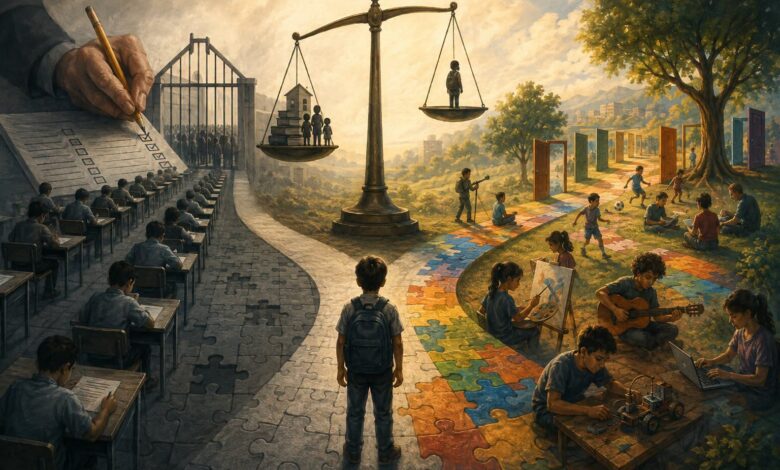
Justice does not mean giving everyone the same test. It means giving every child the means to demonstrate the best of what they are capable of. When starting points differ, standardizing the finish line and the rules for reaching it can turn formal equality into genuine injustice.
I do not see the examination merely as a test of the student. It is also a test of the teacher, the school, the curriculum, and the educational system as a whole.
When a large number of children fail, we are quick to accuse them of negligence and failure and ask: Why did they not learn? But we rarely ask the school and the teacher: Why were you unable to teach them?
The starting point should be that every child is capable of succeeding, provided that we do not confine success to one narrow definition and that we discover the right way into each child’s abilities.
This does not mean that children are equal in all their aptitudes, or that they will achieve the same results. It means that every child has a domain through which they can learn, progress, and create.
The purpose of education is not to prove that some children are smarter than others. It is to help every child discover the best version of what they can become.
One child learns through reading, another through images, a third through experimentation, and a fourth through dialogue, movement, and practice. One may excel in mathematics, another in language, while a third may distinguish themselves in music, sports, leadership, or teamwork. If we insist on teaching them all in the same way and then testing them with the same instrument, we are not measuring their diverse abilities. We are measuring their ability to adapt to a single mold.
When a teacher or an educational system fails to discover the different pathways into these abilities and instead treats children as a homogeneous group, failure, in my view, can sometimes be more a certificate of institutional shortcomings than a judgment on the child.
From Assessment and Evaluation to Sorting
There is a fundamental difference between three concepts that are often confused in our educational systems: assessment, evaluation, and sorting.
Assessment means determining where a student stands: What have they understood? What have they not understood? What skills have they acquired?
Evaluation goes beyond diagnosis to correction: How can we help the student overcome weaknesses? How should we change the way we teach? What support does the student need?
Sorting, however, is something else entirely. Sorting does not ask how each child can progress. It decides who moves forward and who is excluded, who deserves the available place and who is denied it.
Examinations have become, in many educational systems, a means of sorting rather than a means of education. This happens because the system either cannot or does not want to provide enough quality places and diverse pathways to accommodate everyone. It therefore needs a tool that gives scarcity the appearance of fairness. Instead of acknowledging that the problem lies in the limited opportunities available, we tell the student that the problem lies in their grade.
At that point, the examination ceases to be a tool within the educational process and becomes a gatekeeper standing at its entrance.
The grade is no longer a message that helps the student and teacher improve learning. It becomes a verdict determining who enters a particular college, who is pushed into a path they did not choose, whose doors to social status are opened, and whose are closed.
The deeper challenge is that education is a right for all children, not a competition designed to select a limited number of winners. If a system is incapable of providing a good education for everyone, it should not turn its institutional failure into a personal accusation against students.
Thanaweya Amma: An Entire Future in a Single Moment
This crisis appears most clearly in Egypt’s Thanaweya Amma system, where, for decades, a student’s future has been reduced to a single aggregate score produced by standardized examinations, within a limited amount of time and under enormous psychological pressure.
The system emerged, in part, to serve an understandable purpose: preventing favoritism, nepotism, and corruption, while providing a clear central standard for university admissions. It has achieved a degree of procedural fairness: the examination paper does not know the identity of its owner, and the published score is difficult to manipulate compared with personal interviews or inconsistent local assessments.
But our fear of corruption in a diversified assessment system has driven us to reduce assessment itself to a single examination.
Instead of building a transparent system that combines cumulative academic performance, diverse examinations, projects, research, the arts, sports, and the ability to think and communicate, we have resorted to the administratively easiest solution: a single score, on a single certificate, at a single moment, upon which a large part of a student’s future is determined.
And so the system has become fair in a narrow procedural sense, but unjust in its human consequences.
A student may be creative, widely cultured, and capable of leadership and teamwork, yet unable to retrieve a vast amount of information under time pressure. Another may be highly skilled at solving repetitive patterns of questions without possessing deep knowledge or independent thinking skills. Yet the grade formally rewards one as superior while overlooking many of the other’s abilities.
Worse still, the single examination has created an entire parallel educational system outside the school. Trust has shifted from the classroom to private tutoring centers, from the teacher as educator to the teacher capable of predicting the questions, and from the textbook as a gateway to knowledge to the summary sheet as a shortcut to a grade.
The goal is no longer for the student to learn, but to learn how to pass the examination.
Thus emerged a vast economy devoted to obtaining grades, regardless of broad knowledge, school activities, cultural development, or athletic, artistic, and social abilities. In many cases, the school has become little more than an administrative entity that gives the student the right to sit for the examination, while the actual preparation takes place elsewhere.
The Fairness of the Examination Is Not Enough
The paradox is that a system may be extremely rigorous in marking examination papers while remaining unfair in distributing the opportunities needed to prepare for them. A student who can afford private tutoring, books, educational platforms, and a quiet place and sufficient time to study does not, in reality, stand at the same starting point as a student in an overcrowded classroom, with limited resources and no one available to explain the material or provide a suitable place to study.
Here we return to Bourdieu: the examination does not create inequality by itself, but it can conceal its social roots and then present its outcomes as nothing more than differences in individual merit.
This does not mean abolishing examinations. Measurement is necessary, and common standards protect against arbitrary judgment and favoritism. What is needed, however, is to free education from the authority of the single examination and build a multi-dimensional system, with clear rules for review, appeals, and oversight to prevent the return of favoritism and corruption.
Such a system could include examinations distributed across different stages, disciplined cumulative assessment, practical projects, measures of understanding and application, and a student portfolio, alongside genuine recognition of the arts, sports, and community service. There should also be multiple educational pathways of equal dignity, with the possibility of moving between them, so that the type of education a young person enters does not become a final judgment on their worth.
The Question We Should Be Asking
Instead of asking, “How can we design a more difficult examination that distinguishes high achievers from everyone else?” we should ask: How can we build a better education system that enables the greatest possible number of children to succeed and excel, each according to their own abilities?
A fair examination is not one that becomes more skilled at excluding students. It is one that reveals strengths and weaknesses, directs education toward improvement, and gives students more than one opportunity and more than one path.
Children are not raw materials moving along an industrial sorting line, nor are they examination numbers awaiting a final verdict. They are diverse human potentials. The responsibility of the school is to discover and nurture those potentials, not to waste them and then give that waste a respectable name: “merit.”
Perhaps, at the end of every academic year, the real question should not be:
How many children failed the examination?
But rather:
How many schools and educational systems passed the test of helping children realize their potential and achieve the true purpose of education?