
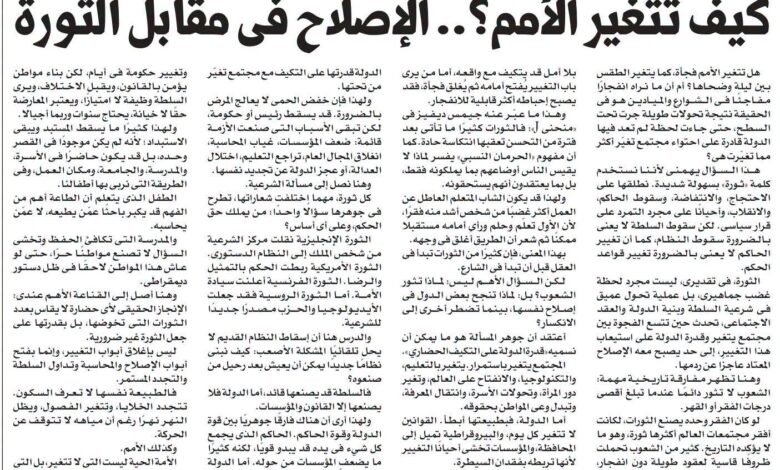
Do nations change suddenly, as the weather shifts overnight? Or are the dramatic scenes we witness in streets and public squares merely the visible culmination of profound transformations that have been unfolding beneath the surface—until the state can no longer accommodate a society that has evolved far more rapidly than it has?
This question matters because we use the word revolution far too casually. We apply it to protests, uprisings, the fall of rulers, coups, and sometimes even to resistance against a political decision. Yet the collapse of a government does not necessarily mean the collapse of a political system, just as replacing a ruler does not necessarily transform the rules by which a country is governed.
In my view, a revolution is not merely a moment of collective anger. It is a profound transformation in the legitimacy of political authority, the structure of the state, and the social contract. It occurs when the gap between a changing society and the state’s ability to absorb that change becomes so wide that ordinary reform is no longer capable of bridging it.
Here lies one of history’s most intriguing paradoxes: societies do not always revolt when they reach the deepest levels of poverty or oppression.
If poverty alone produced revolutions, then the poorest societies in the world would also be the most revolutionary. History suggests otherwise. Many nations have endured harsh conditions for decades without erupting, while revolutions have broken out in societies that had already begun to experience meaningful improvements.
This is where Alexis de Tocqueville’s famous observation becomes particularly relevant: the most dangerous moment for a poorly governed regime is not when repression intensifies, but when reform begins.
Reform does more than ease public frustration—it awakens hope. A person who has lived for years without hope may eventually adapt to reality. But someone who glimpses the possibility of change, only to see that opportunity suddenly disappear, may experience a far deeper sense of frustration—one far more likely to erupt.
James C. Davies expressed this idea through his famous J-Curve Theory, arguing that revolutions often occur after a period of improvement followed by a sharp decline. Likewise, the concept of relative deprivation explains why people judge their circumstances not merely by what they possess, but by what they believe they deserve.
This helps explain why an educated young person unable to find work may feel greater resentment than someone living in even greater poverty. The former studied, dreamed, and believed a better future was within reach—only to discover that the path had been blocked.
In this sense, many revolutions begin in the mind long before they reach the streets.
Yet perhaps the more important question is not why societies revolt, but why some states succeed in reforming themselves while others must first break apart.
I believe the answer lies in what might be called a state’s capacity for civilizational adaptation.
Societies are constantly changing—through education, technology, globalization, shifting gender roles, evolving family structures, expanding knowledge, and growing public awareness of individual rights.
The state, by contrast, is naturally slower to change. Laws are not rewritten every day. Bureaucracies tend toward continuity. Institutions often resist change because they associate it with the loss of control.
The real danger emerges when society and the state begin living in different historical eras: citizens thinking with the mindset of the twenty-first century while institutions continue operating according to the logic of a previous one.
A medical analogy illustrates this well. A physician does not regard a fever as the disease itself, but rather as a symptom of a deeper disorder. Revolutions are much the same. The revolution is the fever; the true illness is the state’s inability to adapt to a society that has already changed beneath it.
Lowering the fever alone does not cure the disease. A president or government may fall while the underlying causes remain intact: weak institutions, lack of accountability, a restricted public sphere, declining education, unequal justice, or a state’s inability to renew itself.
This brings us to the question of legitimacy.
Every revolution, regardless of its slogans, ultimately asks a single question: Who has the right to govern—and on what basis?
The English Revolution shifted legitimacy from the person of the monarch to the constitutional order. The American Revolution tied government to representation and consent. The French Revolution proclaimed the sovereignty of the nation. The Russian Revolution established ideology and the ruling party as a new source of legitimacy.
The enduring lesson is that dismantling an old system does not automatically solve the more difficult challenge: how to build a new political order capable of surviving its founders.
Power may be created by a leader, but a state is built only through law and institutions.
For this reason, I draw a sharp distinction between the strength of a state and the strength of its ruler. A leader who concentrates all authority in his own hands may appear powerful, yet often weakens the institutions surrounding him. A truly strong state is one whose institutions continue to function effectively regardless of who occupies the highest office.
From this perspective, the peaceful transfer of power is not merely a democratic ideal; it is a fundamental mechanism for renewing the state and protecting it from institutional aging.
Changing a political system, however, is far easier than changing a culture.
A constitution can be drafted within months, and a government replaced within days. But nurturing citizens who believe in the rule of law, accept disagreement, view political authority as a public responsibility rather than a privilege, and regard opposition as a legitimate right rather than an act of betrayal—this requires years, perhaps generations.
That is why dictators may fall while authoritarianism survives. Its roots often extend far beyond the presidential palace. It may be embedded within the family, the school, the university, the workplace, and even in the way we raise our children.
A child taught that obedience matters more than understanding may grow into an adult searching for someone to obey rather than someone to hold accountable.
A school that rewards memorization while discouraging questions cannot produce free citizens, even if those citizens later live under a democratic constitution.
This leads me to what I believe is the most important conclusion.
The true achievement of any civilization should not be measured by the number of revolutions it experiences, but by its ability to make revolution unnecessary.
Not by closing the doors to change, but by opening the doors to reform, accountability, peaceful transfers of power, and continuous renewal.
Nature itself never stands still. Cells regenerate. Seasons change. A river remains the same river even though its waters never cease to flow.
So it is with nations.
A living nation is not one that never changes, but one that knows how to change without breaking.
When reform becomes a culture, renewal a habit, disagreement a source of creativity, and institutions stronger than individuals, society no longer requires every generation to begin again through revolution.
Wisdom does not lie in preventing autumn.
Wisdom lies in knowing how to ensure that every autumn is followed by spring.
And Egypt is no exception.