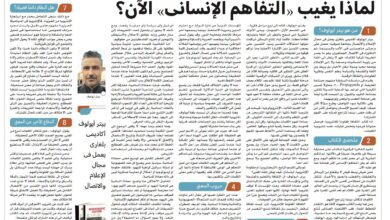

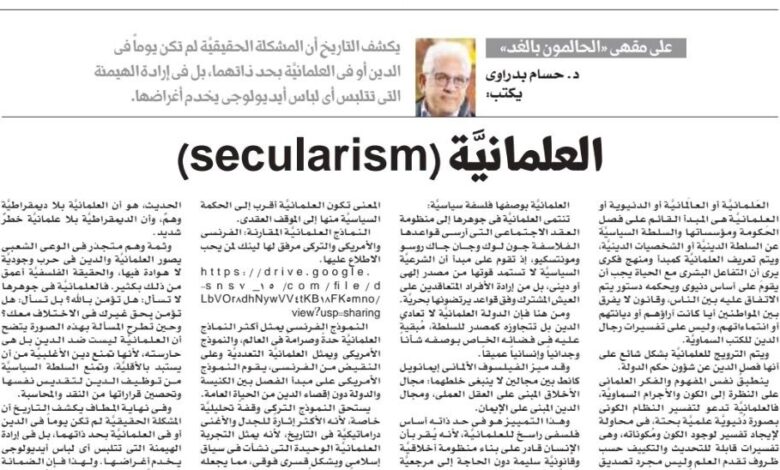
Secularism, secularity, or worldly humanism is the principle based on separating government, state institutions, and political authority from religious authority or religious figures. It is defined as a principle and intellectual approach that sees human interaction with life as something that should be grounded in worldly realities and governed by a constitution agreed upon by the people, and by laws that do not discriminate between citizens regardless of their beliefs, religion, or affiliations — rather than being governed by clerical interpretations of sacred texts.
Secularism is commonly promoted as the separation of religion from the affairs of state governance.
The same secular concept and philosophy also applies to the understanding of the universe and celestial bodies. Secular thought calls for interpreting the cosmic order through a purely worldly and scientific lens, attempting to explain the existence of the universe and its components through interpretations that remain open to revision and adaptation as science advances, rather than accepting metaphorical explanations as fixed scientific truths.
Unfortunately, secularism is often portrayed by its opponents as atheism — a definition that never existed within the philosophy itself except among those opposing the separation of religion and state. Linking secularism to atheism is often used to mobilize citizens emotionally against a political idea by presenting it as an attack on their religion, even though it clearly is not.
This is manipulation of definitions in order to influence people’s emotions toward political orientations by framing them as anti-religious.
Historically, this has not been unique to one faith tradition. It occurred in Christianity, Islam, and Judaism alike. Those who use religion in politics — and religious extremists throughout history — are often similar in methodology, because they seek power and control over others under the claim that they alone are right and everyone else is wrong.
Secularism as a Political Philosophy
At its core, secularism belongs to the tradition of the social contract developed by philosophers such as John Locke, Jean‑Jacques Rousseau, and Montesquieu. It is based on the principle that political legitimacy derives not from divine or religious authority, but from the will of individuals who agree to live together according to rules they freely accept.
Accordingly, the secular state does not oppose religion; rather, it transcends religion as a source of political authority while preserving it within its own private sphere as a deeply human and spiritual matter.
The German philosopher Immanuel Kant distinguished between two realms that should not be confused: the realm of morality, grounded in practical reason, and the realm of religion, grounded in faith.
This distinction itself forms a solid philosophical foundation for secularism, because it acknowledges that human beings are capable of building sound ethical and legal systems without requiring a religious authority in public affairs, while still respecting religion in personal life.
In contemporary political philosophy, another central issue concerns the idea of “public reason”: How can citizens with diverse religious and philosophical beliefs agree on fair principles to govern their shared lives?
The answer proposed is that this becomes possible only when every group abandons the claim of possessing absolute truth in the political sphere and accepts the principle of equal rational dialogue — which is, at its essence, the heart of secular practice.
In conclusion, secularism is not a closed or final ideology; it is an open, negotiative method based on accepting difference as a fundamental human reality and on viewing authority as a temporary trust subject to accountability, not as a sacred and unquestionable right. In this sense, secularism is closer to political wisdom than to doctrinal belief.
Comparative Models of Secularism: French, American, and Turkish
The French model represents one of the strictest and most assertive forms of secularism in the world.
The American model, by contrast, represents pluralistic secularism. Unlike the French approach, it is based on separating church and state without excluding religion from public life.
The Turkish model deserves special analytical attention because it is perhaps the most controversial and dramatically complex secular experiment in history. It represents the only major secular experiment that emerged within an Islamic context through a top-down, coercive process, making it an exceptional case in modern political thought and revealing the profound difference between secularism as a philosophy of freedom and secularism as an ideology of power.
When we examine secular experiences across history and geography — from Paris to Washington to Ankara — it becomes clear that secularism is not a ready-made formula that can simply be copied and pasted onto any society. Rather, it is an ongoing process of negotiation between human beings, authority, identity, and history.
Human beings are both spiritual and material creatures at the same time. They need faith in something beyond themselves, and they also need reason to organize their shared lives with others. A wise state is one that allows both without coercing people into either.
The deeper lesson revealed particularly by the Turkish experience — and confirmed by modern political history — is that secularism without democracy is an illusion, while democracy without secularism can become extremely dangerous.
There is also a deeply rooted misconception portraying secularism and religion as being in an existential war. The philosophical reality is far more nuanced. Secularism, at its core, does not ask: “Do you believe in God?” Rather, it asks: “Do you believe in the right of others to disagree with you?”
When framed this way, it becomes clear that secularism is not against religion; in fact, it protects religion by preventing the faith of the majority from dominating minorities and by preventing political authority from using religion to sanctify itself and shield its decisions from criticism and accountability.
Ultimately, history reveals that the real problem has never been religion or secularism in themselves, but rather the will to dominate that can disguise itself in any ideological clothing that serves its interests. Therefore, the true safeguard lies not in choosing the “correct” ideology, but in building institutions that limit power and hold it accountable regardless of the ideology it wears.
My own view is that no one possesses the complete truth, and therefore everyone must have the right to express themselves freely without imposing their will on others.
That sentence represents secularism in its purest form, democracy in its deepest sense, and at the same time the spirit of every genuine religious message before politics seized it and transformed it into an instrument of power.
If the state attempts — and I believe there are signs of this emerging — to suppress or prevent secular civil dialogue, then it is effectively siding with the domination of religion over political life, ultimately leading toward a religious rather than civil state. This would contradict the nature of Egyptian society, which is inherently pluralistic and whose citizens have long lived within a framework of citizenship rights as affirmed by the constitution.