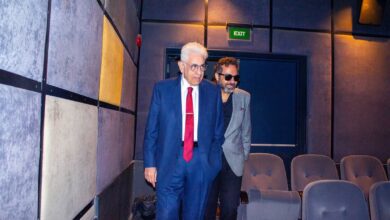

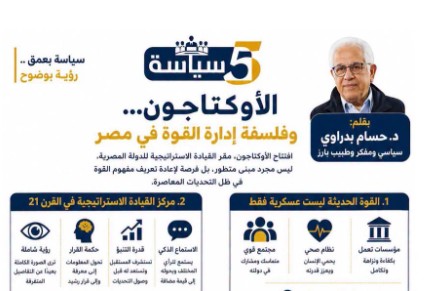
The inauguration of The Octagon, the headquarters of Egypt’s Strategic Command, is an occasion whose significance extends far beyond the opening of a new building, regardless of its size or technological sophistication.
Buildings, no matter how impressive, do not create power on their own.
Technology, however advanced, cannot by itself guarantee sound decision-making.
Command centers do not become influential simply because they bring together screens and streams of information. Their true value lies in their ability to transform information into knowledge, knowledge into vision, vision into decisions, and decisions into coordinated action that serves the nation’s objectives and safeguards the future of its citizens.
That is why I believe the question we should ask with the opening of this landmark is not: How large is it? How much did it cost? How advanced is its technology?
The more important question is: What concept of power do we want this institution to embody?
The concept of power has changed around the world.
A nation’s strength is no longer measured solely by the number of its soldiers, aircraft, or tanks—important as they remain in defending the homeland. Modern power has become a characteristic of the entire system.
A strong state is one that possesses a capable military, a productive economy, an educational system that cultivates minds, universities that generate knowledge, efficient institutions, a public administration that respects time, a healthcare system that protects people, and a society that trusts its state and feels like a partner in shaping its future.
True power does not reside in a single institution; it flows through all institutions.
In my view, this is perhaps the most important meaning of any strategic command center in the twenty-first century.
The threats facing nations today are no longer exclusively military. They include economic, water, food, technological, cyber, environmental, and public health threats. They also include information warfare, manipulation of public awareness, and an increasing ability to influence societies from within without a single soldier crossing the border.
For that reason, the concept of national security has expanded beyond military defense, even though military defense remains one of its essential pillars.
A modern strategic command center should, in my view, function as a mind capable of seeing the complete picture—not merely as a room that receives information.
The difference between the two is profound.
Possessing information does not necessarily mean possessing knowledge, and possessing knowledge does not necessarily mean possessing the wisdom required to make sound decisions.
Today’s world is flooded with data, yet nations do not advance simply because of how much they know. They advance through their ability to understand relationships between seemingly separate issues, to listen to differing opinions, to question long-held assumptions, and to anticipate the unintended consequences of decisions before they occur.
This is where the word “strategy” becomes essential.
Strategy is not merely about managing the present; it is about imagining the future and preparing for it.
In my opinion, strategy is not simply knowing what we will do tomorrow. Rather, it begins by asking: Where do we want Egypt to be twenty years from now? And what decisions must we begin making today to reach that destination?
Egypt’s future is determined not only at its borders but also in its classrooms, university laboratories, factories, the innovative potential of its youth, equality of opportunity among its citizens, the efficiency of its public administration, and its ability to build trust within society.
A child who does not receive a quality education is a national security issue.
Water is a national security issue.
Energy is a national security issue.
Scientific research is a national security issue.
A productive economy is a national security issue.
And citizens’ trust in their country’s institutions is also a national security issue.
For this reason, I hope that the inauguration of The Octagon marks the beginning of a broader evolution in the philosophy of governing the state—a philosophy founded on integrating power rather than monopolizing it, coordinating institutions rather than allowing them to compete against one another, relying on knowledge rather than impressions, and embracing long-term planning rather than temporary reactions.
History has taught us that states may possess enormous instruments of power and still weaken if the system that connects those instruments becomes dysfunctional.
History has also shown us that countries with limited natural resources have become highly influential because they succeeded in building efficient institutions, quality education, productive economies, and cultures that encourage the exchange of ideas and the correction of mistakes.
Power, therefore, is not merely something a nation possesses.
Power is the way the entire system functions.
I see the opening of the Strategic Command Headquarters as an opportunity to present this idea to Egyptian society:
Protecting the state is not solely the responsibility of the military.
Building the future is not solely the responsibility of the government.
And national progress cannot be achieved by any single institution, regardless of its strength.
The modern state is an interconnected network. If one link weakens, every other link is affected.
I view The Octagon as a symbol that can represent something greater than the building itself: the transition from managing isolated sectors to viewing the state as one integrated system.
From defense to the economy.
From education to technology.
From water to energy.
From healthcare to the environment.
From security to responsible freedom that allows society to think, innovate, debate, and correct itself.
A state that listens to its citizens is stronger than one that merely speaks to them.
A state that welcomes diverse perspectives is better equipped to identify mistakes before they become crises.
And true strategic leadership does not fear questions, because questions asked early may spare the nation from difficult answers later.
Egypt is a great nation because of its history, geography, people, armed forces, and culture. Yet it can become even stronger when its diverse capabilities are transformed into an integrated system working toward a common purpose.
That is our real challenge.
To develop a shared vision for the future.
To know where we want to go.
And to ensure that the institutions of both the state and society work together—each fulfilling its own role—to achieve that vision.
The inauguration of The Octagon is an important event. Yet the true value of any institution is measured not only by the beauty of its architecture or the sophistication of its equipment, but by the ideas it generates, the quality of the decisions it improves, the crises it prevents before they occur, and the future it helps the nation build.
In the twenty-first century, power is no longer defined by the sound of weapons alone.
Power is science.
Power is the economy.
Power is education.
Power is culture.
Power is trust.
Power is the effectiveness of institutions.
Power is the ability to see the future before it becomes the present.
When all these elements work together in harmony, power becomes a characteristic of the entire state, not merely a tool in the hands of one part of it.
That, in my view, is the deeper meaning through which we should understand the inauguration of The Octagon.