
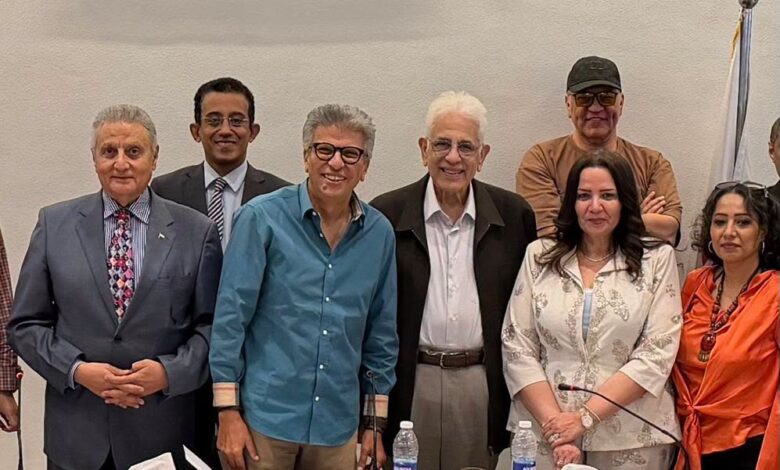
I participated in an engaging discussion about the book “Suad’s Era” with its author, Dr. Khaled Montaser, along with the distinguished literary critic Dr. Amani Fouad, Ambassador Reda El-Taifi, and a group of intellectuals and artists on Sunday, June 21, at the Cairo Public Library in Giza.
I praised the book, its style of presentation, and the smoothness of its language, but more importantly, I praised the philosophy behind its writing. The book is not really about Suad Hosny herself; it is about her era—an era caught between the Nasserist leftist current, the rise of religious extremism, the struggle between them, and the current of freedom, liberalism, and a culture open to beauty, science, and life.
The beauty of the book lies in this artistic blending of Suad Hosny—her personality and her art—with a period that witnessed profound and conflicting intellectual transformations in modern Egyptian history during the 1960s, 1970s, and 1980s.
It is not easy to write about Suad Hosny, and even more difficult to write for her without falling into the trap of nostalgia or elegy.
But the book “Suad’s Era,” which my dear friend Khaled Montaser gifted to me, does not do that. Instead, it goes somewhere more truthful: to the human being behind and around the image.
This is not a conventional book, nor is it an attempt to settle scores with a harsh era.
It is direct and symbolic at the same time.
It is an act of love and an acknowledgment that some faces are unforgettable because they stir emotions within us—sometimes more than we can bear.
Suad Hosny was not merely an actress. She was the girl from the neighborhood, the university friend, the love story that both was and wasn’t completed. She was the smile hiding uncertainty, and the strength that enters through the doorway of vulnerability.
When we see her today, we do not remember only her films—we remember ourselves: our simple dreams, our first disappointments, and our innocence, which we only recognized after losing it in her time.
We remember her colleagues, the writers of her works, and her directors. We remember Hassan El Imam, Salah Jahin, Hussein Fahmy, Nour El Sherif, Mahmoud Yassin, Salah Zulfikar, Roshdy Abaza, and Ahmed Zaki.
Writers whose works she performed in—or whose works were adapted for her films (which also reflect the spirit of her era)—included Naguib Mahfouz in Karnak and Cairo 30. Mahfouz was among those who gave Suad some of her deepest political and social roles.
Salah Jahin wrote for her the legendary film “Khalli Balak Min Zozo” (Watch Out for Zouzou), a film that remained in theaters for more than a year and achieved unprecedented popular success.
Many people think it was simply an entertaining film, but it actually revealed the beginnings of dangerous political and social transformations in Egypt—as if Salah Jahin and Hassan El Imam could see the future.
What distinguishes this book is that its author did not treat Suad as a case, a mystery, or journalistic material. He wrote it as if saying:
“I know you… and perhaps I could not save you, but I will not allow you to be distorted.”
He wrote it with the mind of a physician who understands pain, the heart of an intellectual who understands society’s cruelty toward those who are different, and the conscience of a friend who refuses to reduce a full life to a tragic ending.
The most beautiful aspect of the book is that it restores Suad to her natural place: living memory, not newspaper pages.
Here, Suad is not merely a victim, but a woman who paid the price for deep sensitivity in a harsh world, and an artist ahead of her time in expressing women’s experiences, freedom, and human anxiety.
I salute Dr. Khaled Montaser for this sincere book, and I salute in him the courage to write against the current, against vulgarity, and against easy cruelty.
I also enjoyed what Dr. Amani Fouad wrote and said with her insightful academic and artistic vision, and Ambassador Reda El-Taifi, Director of the Egypt Public Libraries Fund, who carried us back into Suad’s era, as well as the contributions of poet Ahmed El-Gaafary, Mr. Ishaq Hanna, writer Lamia El-Khouly, and many others.
And I salute Suad Hosny—not as a sad memory, but as an enduring presence, a smile that still lives in our collective consciousness and reminds us that some people leave physically, yet remain an entire life within us.
Thank you, Khaled Montaser.