
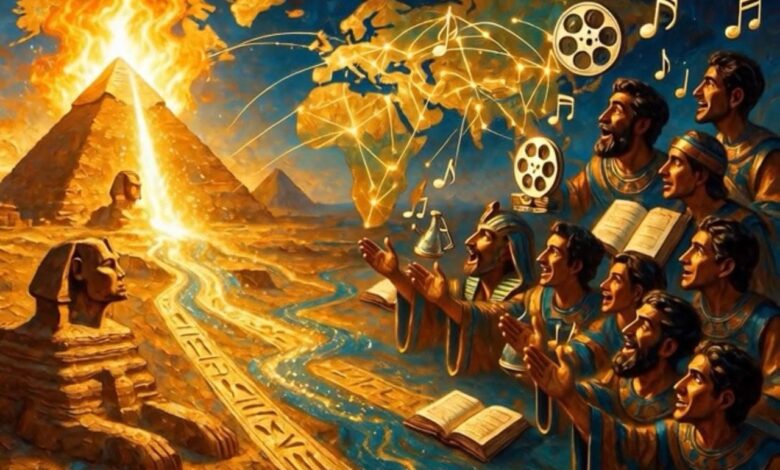
Imagine a tourist standing at the foot of the Great Pyramid, lifting their eyes toward its summit and suddenly feeling that they are not standing before stones, but before time itself speaking. This same feeling is repeated, in different forms, all over the world: in a museum in Paris, in a Hollywood film, in a Japanese school textbook. One name echoes through all these distant scenes: Egypt.
Nations may once have been built through armies and wealth, but they are remembered for something entirely different. Some countries possess power and are feared; others possess civilization and memory, and thus are loved and remembered.
It is memory and legacy—not power—that create immortality in human consciousness.
What makes the name of a nation remain present in people’s minds after thousands of years, while the names of empires that were once stronger and wealthier disappear?
In 2025, a Gallup report revealed that Egypt’s image among American citizens was viewed more positively than Israel’s. This result may seem surprising to those who associate influence solely with military power, economic strength, or the influence of the Zionist lobby in American society. But the true surprise lies not in the numbers, but in the question they raise: How does Egypt maintain a global presence that transcends politics and the fluctuations of time?
There are countries that surpass Egypt economically, others that lead the world technologically, and still others that possess greater political influence in the current moment. Yet when a child in Tokyo, Paris, or New York is asked about an ancient civilization, the first things that often come to mind are the pyramids, the Sphinx, and the Nile River.
Moreover, Egypt still occupies an exceptional place in global geography. The Suez Canal is not merely a waterway; it is an artery connecting East and West, making Egypt’s name present every day in international trade and in calculations of both economics and politics.
So what is the secret behind this presence?
Perhaps it is because Egypt is not merely a country but an enduring human story. While some nations build their influence through power, Egypt built its status through time—and time is the greatest form of soft power humanity has ever known.
Perhaps Egypt is almost unique as a country around which an entire global academic field emerged bearing its name: Egyptology.
Thousands of researchers and dozens of university departments around the world dedicate their efforts to studying ancient Egypt: its language, antiquities, arts, ideas, and the lives of its people thousands of years ago.
The existence of a field named after a country is not merely an honor to its past; it is recognition that this nation was not a passing event in history but one of its makers.
This is why Egypt remains present in global consciousness—not because it has always been the richest or strongest, but because it is among the few nations that succeeded in transforming itself from geography into civilization, from civilization into memory, and from memory into part of humanity’s identity itself.
Empires have ruled the world and then disappeared, but Egypt did not rule the entire world; rather, it occupied the imagination of the entire world.
And in this truth lies not only comfort but hope.
The Egypt that built its wealth from time now possesses something it never had before in any previous era: a future time shaped by young hands in numbers unprecedented in its history.
The number of people under fifteen approaches thirty-five million children, and if we add those up to the age of thirty, the number approaches sixty-five million people—more than half of Egypt’s population.
This is not a demographic burden, as some fear, but a renewable energy, an inexhaustible force, and a tremendous civilizational resource—if properly educated, if their skills are developed, and if they are launched toward the future rather than left on the margins of time.
It is education—the path of knowledge.
But “education” here does not merely mean more schools or more certificates added to statistical records. It means minds trained to ask questions before seeking answers; hands skilled in the tools of this age—programming, artificial intelligence, and entrepreneurship; and spirits open to the world without losing their roots.
The measure is not the number of university degrees people hold, but the number of people capable of solving problems, creating products, and competing intellectually in a global market that shows no mercy to those who remain trapped in the past.
If Egypt succeeds in transforming this immense quantity of youth into quality—that is, into skill, knowledge, and competitiveness—then Egypt will not only remain present in the world’s consciousness as a memory, but will become an active partner in shaping its future.
The civilization that invented writing, measured time through the sun, and built structures that challenge both gravity and time itself has not lost its ability to innovate; it has merely lost those who remind it of that ability.
And with every child born today in a village in Upper Egypt or in a neighborhood in Cairo, a new opportunity is born to write a chapter yet unwritten.
If this generation is given the tools, language, and sciences of the modern age, it will not merely inherit the pyramids but will build new pyramids of another kind: pyramids of knowledge, technology, and creativity.
Then the world will no longer ask, “What has Egypt done?” but rather, “What will Egypt do next?”
Immortality is not an inheritance to be consumed; it is a seed planted in every generation.
And Egypt, through its youth and children, today stands not at the end of its ancient story, but at the first page of its coming one.
If Egypt is now in the autumn of its age, I am confident that its spring will come. Yet together—with social and political will—we must scatter the seeds, water them, nurture them, and understand that regardless of whatever power or wealth some of us gain in the present, it is our children and grandchildren who will reap the fruits in the future.
Believe me, Egypt deserves it.