
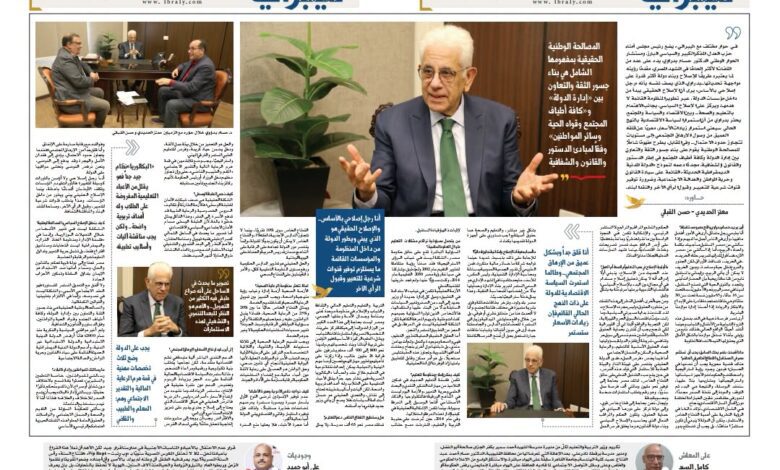
- National reconciliation means building trust and cooperation, while genuine reform begins from within the state.
- Concern over growing social exhaustion; the North Coast is not a class conflict.
- Genuine national reconciliation, in its broadest sense, means building bridges of trust and cooperation between the “state administration” and “all segments of society, its active forces, and all citizens,” based on the principles of the Constitution, the law, and transparency.
- “I am deeply and seriously concerned about social exhaustion. As long as the state’s economic policy continues along its current course, price increases will continue.”
- “I am fundamentally a reformer. Genuine reform is about building and developing the state from within its existing institutions and system. This requires legitimate channels for expression, acceptance of differing opinions, and room for constructive criticism and transparent discussion of state policies.”
- “I strongly support the model of the modern democratic civil state, founded on the rule of law, individual freedom, and social justice. I completely reject the model of the authoritarian religious state and the authoritarian non-civil state.”
- The state should place three professions at the top of the hierarchy of financial support and social recognition: teachers, doctors, and judges.
- “Portraying what is happening on the North Coast as a class conflict involves considerable exaggeration. What matters is examining the developmental and employment dimensions of these investments.”
- “The Egyptian Baccalaureate is a very good system. It reduces the educational burdens placed on students and has clear educational objectives, but its mechanisms and methods of implementation need to be discussed.”
Interview conducted by: Moataz El-Hadidy and Hassan El-Qabbani
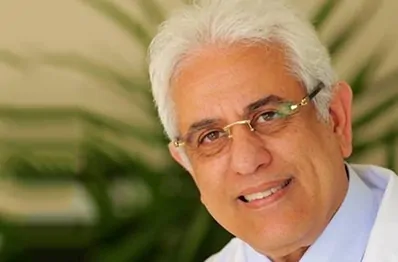
In a wide-ranging interview with Liberal, Dr. Hossam Badrawi—Chairman of the Board of Trustees of the Justice Party, prominent intellectual and politician, and adviser to the National Dialogue—addresses some of the most pressing issues facing Egypt today, presenting his vision of what he considers a path toward reform and building a state better equipped to confront its challenges.
Badrawi, who describes himself as “fundamentally a reformer,” believes genuine reform begins within state institutions by developing the existing system rather than dismantling it. He emphasizes political reform alongside greater attention to education and healthcare.
Moving between economic, political, and social issues, Badrawi warns that continuing along the current economic policy path will mean continued price increases. He also expresses deep concern that “social exhaustion” may reach levels beyond what people can reasonably bear.
At the same time, he puts forward a comprehensive concept of national reconciliation based on building bridges of trust and cooperation between the state administration and all segments of society, within the framework of the Constitution, the law, and transparency. He reiterates his support for the model of the “modern democratic civil state,” founded on the rule of law, individual freedom, and social justice, and stresses the need for legitimate channels of expression, acceptance of differing opinions, constructive criticism, and transparent debate.
Where does Dr. Hossam Badrawi see Egypt’s present and future?
I am optimistic by nature. I tend to see the best in things and the finest qualities in people.
If you ask me about “the Egypt of the future,” I would answer with one word: “spring.”
But if you ask me about “Egypt today,” I would tell you that it is going through a period of “autumn.”
In autumn, leaves fall, but the roots and branches remain alive and resilient. Without autumn, spring cannot come.
My faith in the future stems from a historical conviction that civilizations are built and renewed by the living forces that create the future.
Today, Egypt has around 18 million people under the age of 16 and 65 million under the age of 30. These are renewable sources of energy capable of creativity, innovation, and leadership if we manage our human resources properly.
I see a golden opportunity for Egypt tomorrow because of this wealth of children and young people. When I sometimes criticize the current reality, it is because I believe we are not making optimal use of our resources in a way that creates the added value they are capable of generating.
What did you mean when you previously said that Egypt should invest in the future while the private sector invests in the present?
There is a fundamental issue that we must keep in mind.
Without a clear strategic vision on the basis of which governments and state agencies formulate their policies, strategies, and projects, we will lose our sense of direction.
The result is that we start, stop, and return once again to square one, going around in circles among different choices without successfully completing the economic path.
In economic affairs, our theoretical vision has always emphasized the importance of the private sector and investment. We repeatedly say that the state should not be a competing investor, but rather serve as the referee, regulator, supervisor, and auditor—not the principal investor.
The problem lies in the wide gap between what we say theoretically and what we actually implement on the ground. Statements and economic plans are announced while actual practices move in an entirely different direction.
What should be Egypt’s reform priority: education, healthcare, or employment?
When discussing reform, we must first recognize that sustainable reform in any field cannot be achieved without beginning with political reform. Developmental issues as a whole are closely connected to it.
At the same time, I prefer to look at these issues from the perspective of “rights” rather than simply “reform.”
Since the beginning of my political career, I have believed—and continue to believe—in the free-market economy and liberalism. But experience and reality have taught me that for liberalism to succeed, it must be accompanied by protection of citizens’ fundamental rights.
Yes, we seek a free and competitive market, provided that the state fulfills its responsibility toward fundamental rights such as education, healthcare, housing, and social security.
As for employment opportunities, the state’s real role is to create an attractive investment climate and environment that generates these opportunities. The actual responsibility for employment lies with the private sector.
Egypt therefore needs to create approximately 1.2 million jobs every year, a figure that requires massive and carefully calculated investment.
In short, we need a strong private sector and a state that focuses on its sovereign role in protecting rights and acts as an effective referee and regulator capable of holding people accountable.
Political reform and building a state governed by the rule of law create employment opportunities indirectly, while education and healthcare are fundamental rights and constitutional obligations that state institutions must provide efficiently.
What are the obstacles to reform, and how can they currently be overcome?
To put it very simply: when a company suffers repeated financial losses, it is only natural for its general assembly to question and hold its executive management accountable—not the other way around.
Unfortunately, what we see in our administrative landscape is a persistent effort to justify and protect the continued existence of the administration rather than subjecting it to genuine accountability.
This represents a serious strategic mistake.
Egypt is a fertile country, rich in enormous energy and talented human resources across all segments of society.
I am not speaking theoretically or from a position of superiority. I am speaking from direct experience on the ground and from my continued visits to nurseries, schools, and universities, where I see tremendous potential in the eyes of our children and young people—potential that genuinely deserves to be given the opportunity to prove itself and lead the future.
Who bears responsibility for the accumulation of education problems over the past decades?
The direct responsibility lies with the Egyptian government.
The problem is not the absence of strategic visions. We developed an integrated vision for education reform in 2002, but it was not implemented. We also participated in developing Egypt’s Education Vision 2030 in 2014, and I was responsible for it, but it did not find its way into actual implementation.
The real crisis lies in the absence of “sustainability in implementation.”
Every new administration or minister tends to start from scratch and change previous policies instead of building on them and completing what has already begun.
Everyone who has held responsibility has been a capable national figure with sufficient knowledge. The real problem is not knowledge; it is the inability to sustain and effectively execute policies.
As for the scientific and practical solutions to developing education, they are clear and already exist. I did not invent them. Other countries have successfully implemented them and achieved their developmental objectives.
Overcoming these obstacles is not impossible. It is entirely achievable if there is genuine political will.
How can the education system be reformed?
The philosophy of modern education is to equip students with critical-thinking skills, scientific research capabilities, and freedom of expression.
The crisis today is not primarily about printed curricula. Technology and artificial intelligence have made access to knowledge remarkably easy. The real challenge is how to manage and make effective use of that knowledge.
In 2014, when I was offered the position of Minister of Education, I stipulated that the ministries of education, higher education, culture, youth, and information should be integrated into a unified system concerned with shaping the nation’s consciousness and collective mind.
Egypt does not need such a large number of separate ministries. It needs a structure focused on building the Egyptian personality and investing in the potential of its young people.
The teacher remains the fundamental pillar.
Teachers are entrusted with educating our children and shaping their personalities. We have approximately 800,000 to 900,000 teachers overseeing nearly 26 million students.
If we focus on training them, developing their skills, and improving their professional and living conditions, we can achieve a qualitative transformation in education within a decade.
As for the Egyptian Baccalaureate, it is a very good system. It reduces the educational burden on students and has clear educational objectives. However, its mechanisms and methods of implementation need to be discussed.
The real challenge is ensuring policy continuity. It is not acceptable for a new minister to arrive and cancel what his predecessor had started.
Can the private sector support education?
Egypt has approximately 63,000 schools, of which the private sector accounts for only around 10 percent. Foreign schools represent no more than approximately 1 percent.
The private sector cannot be a substitute for the state. The state’s role toward it should be limited to regulating curricula, ensuring that Arabic is taught, and protecting national identity.
The real solution is to develop public schools and raise the standard of the education system as a whole.
The same principle applies to healthcare.
Why is the healthcare system struggling?
The healthcare crisis is fundamentally a crisis of management and the absence of a clear, systematic vision.
We must distinguish between financing healthcare and the efficiency with which healthcare services are delivered.
The private sector currently accounts for between 20 and 25 percent of healthcare provision. Why do citizens turn to it despite having to bear the cost? And where is the state’s responsibility for regulation and quality control?
Changing the names of government hospitals does not change the substance of the service.
Healthcare should be divided into three levels: primary, secondary, and tertiary specialized care.
The focus should be on primary care, family medicine units, and local clinics because they are the true gateway to the success of any health-insurance system.
A citizen’s right is to receive decent healthcare without an unbearable financial burden, while government hospitals must be subjected to strict performance and quality oversight.
How can we address medicine shortages and the migration of doctors?
Failing to provide affordable insulin continuously to patients with Type 1 diabetes exposes them to serious complications in the future.
Providing insulin is therefore a preventive and economic investment that protects the state from much greater financial burdens later.
As for the migration of doctors, it cannot be solved by preventing them from traveling.
The solution is to provide incentives through a decent working environment, an income that guarantees a dignified life, opportunities for continuing medical education, and professional advancement.
Strategically, three professions should be placed at the top of the hierarchy of financial support and social recognition:
teachers, doctors, and judges.
Even if their incomes exceed those of ministers or the prime minister, they should receive this level of recognition because they are pillars of society and essential to securing its future.
How can we protect the middle class?
The real problem is the weakness of safety nets for the middle class.
An unexpected crisis, the cost of private tutoring, or medical expenses can push a family into poverty.
This erosion is extremely dangerous because the middle class is a social, political, and economic safety valve.
As for portraying what is happening on the North Coast as a class conflict, that involves considerable exaggeration and risks creating unnecessary social tension.
What matters is examining the developmental and employment dimensions of these investments, while ensuring that economic activity extends throughout the year rather than being limited to the summer months.
Where will rising prices and social exhaustion lead?
Direct cash support is a mechanism used in advanced economic systems, but its success requires appropriate technological and digital infrastructure as well as consideration of inflation.
As long as the current economic policy continues to rely on closing fiscal gaps through increased fees and reduced subsidies without a genuine surge in production, price increases will continue.
What we are witnessing in terms of rising prices is “a symptom,” not “the disease.”
The real disease lies in the structure of the economy, which requires fundamental reform based on strengthening industrial and agricultural production.
Borrowing should be directed toward productive projects that generate sufficient returns to repay both the principal and interest, with strict oversight of spending.
I am deeply concerned about social exhaustion.
When it exceeds the limits of what people can bear, it can lead to a loss of hope and increased migration, and may push society toward disorder.
We reject disorder and fear its consequences for the state.
I am a reformer, and I do not believe in revolutions as a means of change.
Revolutions destroy institutions and impose enormous costs on nations, whereas genuine reform builds and develops from within institutions.
That requires legitimate channels for expression, acceptance of differing opinions, and room for constructive criticism and transparent discussion.
How can political reform and national reconciliation be achieved?
The problem is not simply changing individuals through cabinet reshuffles. It is about the “philosophy of administration and the decision-making system.”
Democracy is not limited to elections and ballot boxes. It also includes freedom of expression, access to information, oversight, and accountability.
Egypt needs a strong state governed by law and justice.
Its safeguard against authoritarianism is a commitment to the peaceful transfer of power and the empowerment of serious political parties.
I do not agree with repeatedly amending the Constitution. It is the supreme social contract.
The problem is not its provisions, but adherence to them and to the laws that give them practical effect.
Genuine national reconciliation means building bridges of trust and cooperation between the “state administration” and all segments of society, its active forces, and citizens, within the framework of the Constitution, the law, and transparency.
I have not changed my political or intellectual positions since 2000.
I reject the authoritarian religious state as well as the authoritarian non-civil state, and I support the model of the modern democratic civil state, based on the rule of law, individual freedom, and social justice.
What is your message to citizens and the country’s leadership?
My message to citizens, particularly educated and enlightened citizens, is this:
Speak in a language that allows disagreement without division or conflict, because that gives you genuine influence.
My message to the country’s leadership is:
There must be room for disagreement and differing opinions. As long as we are not destroying, we can build together.
And my message to the government responsible for education, healthcare, social security, transportation, and public rights is:
Make these vital issues your primary and foremost concern.