
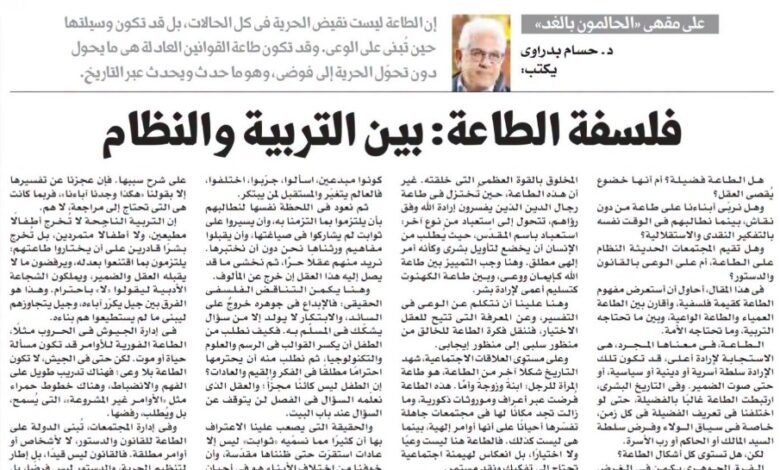
Is obedience a virtue, or is it a form of submission that excludes reason?
Do we raise our children to obey without question while simultaneously demanding that they think critically and act independently?
Do modern societies establish order through obedience, or through an understanding of the law and the constitution?
In this article, I seek to explore obedience as a philosophical value, comparing blind obedience with conscious obedience, and examining what upbringing requires versus what a nation needs.
In its abstract sense, obedience is the act of responding to a higher will. That will may belong to a family authority, a religious or political authority, or even the voice of one’s conscience. Throughout human history, obedience has often been associated with virtue, even though the definition of virtue has varied across different eras, particularly in the context of loyalty and the assertion of authority by a master, ruler, or head of a household.
But are all forms of obedience equal?
The fundamental difference lies in the purpose behind obedience and the means through which it is secured. Obedience driven by fear produces submission. Obedience rooted in love builds trust. And obedience arising from understanding and conviction fosters awareness and cohesion.
Obedience founded on the notion that one person owns another, or on the coercion of individuals by a ruling authority, is an entirely different matter.
Perhaps one of the cruelest forms of obedience in human history is the obedience associated with enslavement: the submission of enslaved people to their masters over centuries, during which subjugation was accepted as an unspoken social law, ensuring the master’s control and the enslaved person’s survival. This is obedience without dignity, obedience that strips human beings of their humanity and reduces them to instruments.
In religion, obedience to the Creator has been regarded as the highest expression of worship, reflecting the relationship between the created being and the supreme power that brought it into existence. Yet when this obedience is reduced to obedience to religious authorities who interpret God’s will according to their own perspectives, it becomes another form of enslavement: enslavement in the name of the sacred, in which individuals are asked to submit to human interpretations as though they were absolute divine commands.
Here, we must distinguish between obedience to God as an expression of faith and awareness, and obedience to the clergy as blind surrender to the will of human beings.
This brings us to the need to discuss awareness in religious interpretation and the knowledge that enables the mind to make choices. In doing so, we can transform the idea of obedience to the Creator from a passive concept into a positive one.
At the level of social relationships, history has witnessed another form of obedience: women’s obedience to men, whether as daughters, wives, or mothers. This obedience was imposed through patriarchal customs and inherited traditions, and it continues to find a place in societies lacking in awareness, where it is sometimes interpreted as a divine command, even though it is not. Here, obedience is neither an expression of awareness nor a matter of choice. Rather, it reflects a form of social dominance that requires continuous examination and criticism.
In traditional upbringing, obedience was an end in itself: “Just say, ‘Yes, sir,’ and don’t argue.”
In modern upbringing, however, the priority has shifted toward questioning, understanding, and constructive criticism. Today, we encourage our children to ask, “Why?” to discuss instructions, and to express their opinions at home and at school. Yet, at the same time, we expect them to follow rules, respect order, and comply with schedules and instructions.
Obedience in Raising Children: A Contradiction We Live With but Refuse to Acknowledge
Perhaps the most sensitive arenas of obedience are the home and the school, where a person’s first relationship with authority takes shape.
We, the older generation, stand before our children and grandchildren with two conflicting messages. We tell them to be creative, to ask questions, to experiment, and to embrace differences, because the world is changing and the future belongs to innovators.
Then, in the very same breath, we demand that they adhere to the same commitments we have upheld, follow principles they had no part in formulating, and accept concepts we inherited without ever putting them to the test ourselves. We want them to have free minds, yet we fear what those minds might discover if they venture beyond the familiar.
Here lies the real philosophical contradiction: creativity, by its very nature, involves moving beyond the status quo, and innovation emerges only when someone questions what has long been taken for granted. So how can we ask a child to break conventions in art, science, and technology, only to demand absolute respect for those same conventions in thought, values, and customs?
A child is not a fragmented being. The mind we teach to ask questions in the classroom will not stop asking them at the doorstep of the family home.
The difficult truth we struggle to acknowledge is that much of what we call “unchangeable principles” is nothing more than custom that has endured long enough for us to mistake it for something sacred. And our fear of our children’s differences is often, in many cases, a fear of losing our authority over them rather than a genuine fear for their well-being.
But the solution is not to abandon every form of obligation. Children need boundaries to protect them, just as a young tree needs a support to help it stand until its trunk grows strong.
The solution lies in distinguishing between three levels.
The first consists of rules essential to safety and order that are non-negotiable in early childhood, such as crossing the road safely, maintaining bedtime routines, and respecting others.
The second consists of fundamental human values that we instill through example rather than commands, including honesty, justice, compassion, and respect for human dignity.
The third is a broad space of ideas, customs, and interpretations that the new generation has every right to question and reshape, and even to move beyond.
The standard I propose is simple: we must be able to explain the reason behind every rule we impose on our children. If we cannot justify a rule except by saying, “That is how our parents did things,” then perhaps the rule itself needs reconsideration, not the children.
Successful upbringing does not produce children who merely obey, nor children who simply rebel. It produces human beings capable of choosing what they obey: people who commit themselves to what they believe to be just, reject what reason and conscience cannot accept, and possess the moral courage to say “no” respectfully.
This is the difference between a generation that merely repeats its parents and one that moves beyond them to build what they themselves were unable to build.
In military operations during wartime, for example, immediate obedience to orders can be a matter of life and death. Yet even in the military, obedience is not supposed to be devoid of awareness. There is extensive training designed to develop understanding and discipline, as well as clear red lines concerning “unlawful orders,” which service members are permitted—and indeed required—to refuse.
In governing societies, the state is built on obedience to the law and the constitution, not to individuals or absolute commands. The law is not a restriction for its own sake; it is a framework for organizing freedom. And the constitution is not an imposition, but a social contract to which the people have consented.
Obedience is not always the opposite of freedom. When grounded in awareness, it can be a means of preserving freedom. Indeed, obedience to just laws may be what prevents freedom from descending into chaos, as history has repeatedly demonstrated.
A child who obeys out of conviction becomes a responsible human being.
And a citizen who obeys the law out of respect, rather than fear, is the kind of citizen who builds a just state.
In an age marked, at times, by blind rebellion and, at others, by disguised tyranny, we need to revive the value of conscious commitment—not as submission, but as a free choice to embrace duty and responsibility.