
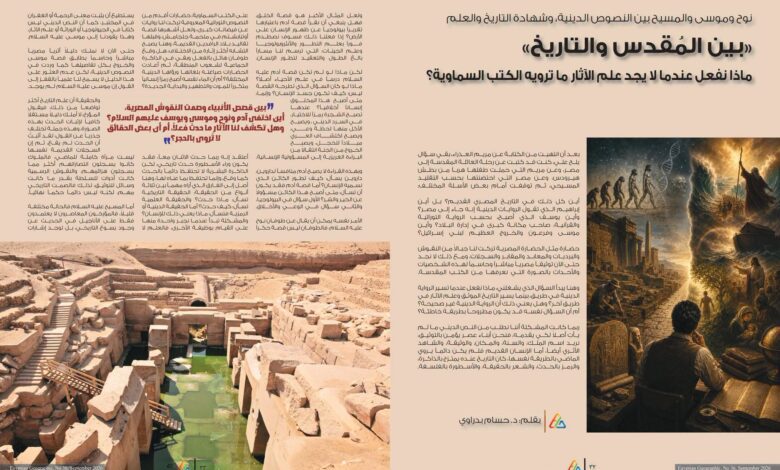
After I finished writing about the Virgin Mary, one question continued to press upon me.
I had written about the Holy Family’s journey to Egypt, about Mary carrying her child as she fled the brutality of Herod, and about Egypt, which, according to Christian tradition, gave her refuge. Then I stopped before a different question:
Where is all of this in ancient Egyptian history?
Where, for that matter, is Abraham, whom religious traditions tell us came to Egypt? Where is Joseph, who, according to the biblical and Quranic accounts, rose to a position of great importance in the administration of the country? And where are Moses, Pharaoh, and the great Exodus of the Children of Israel?
A civilization as ancient as Egypt left behind mountains of inscriptions, papyri, temples, tombs, and records. Yet, to this day, we do not have direct and conclusive Egyptian documentation of these figures and events in the form in which we know them from the sacred scriptures.
And this is where the question that occupies my mind begins.
What do we do when the religious narrative travels in one direction, while documented history and archaeology travel in another?
Does this mean that the religious narrative is untrue?
Or might the question itself be framed incorrectly?
Perhaps the problem is that we are asking the religious text to provide something it was never intended to provide in the first place.
We are children of an age that believes in documentation. We want the king’s name, the year, the place, the document, and the archaeological evidence.
But ancient people did not always recount the past in the same way. For them, history was intertwined with memory, symbolism with events, poetry with truth, and myth with philosophy.
Perhaps the greatest example is the story of creation.
Should we read the story of Adam as a biological account of the emergence of human beings on Earth?
If we do, we will immediately collide with evolutionary science, anthropology, and genetics, all of which trace an extraordinarily long and complex path in the development of humanity.
But what if the story of Adam was never intended as a lesson in biology?
What if the question the story poses is not: How did the human body come into being? But rather: When did this creature become a moral human being?
Under such a reading, the tree becomes a symbol of choice in the religious narrative. Eating from it becomes a moment of awakening. The discovery of nakedness becomes the birth of shame. And the expulsion from Paradise becomes the transition from instinctive innocence to human responsibility.
In this reading, Adam does not become a rival to Darwin.
Darwin asks: How did the creature we call human evolve?
The story of Adam may be asking: When did this creature become responsible for good and evil?
The first is a question of biology.
The second is a question of consciousness and morality.
The same could be said of Noah’s Flood.
The Flood is not a story exclusive to the sacred scriptures. Civilizations that predate the known biblical texts left us accounts of great floods. Perhaps the most famous is the story of Utnapishtim in the Epic of Gilgamesh, preceded by even older traditions from ancient Mesopotamia.
Here, the similarity is more intriguing than the difference.
Did a massive flood actually occur and remain in the collective memory of the peoples of the region, after which different civilizations reshaped the story according to their own languages and religious worldviews?
Or did water itself become a recurring human symbol of death, purification, and new beginnings?
Perhaps both happened.
There may have been a historical event behind the myth, but human memory does not always preserve an event exactly as it occurred. Instead, it preserves what that event meant to those who experienced or remembered it.
And here I arrive at what I consider an important distinction between three kinds of truth:
Historical truth asks: What happened?
Scientific truth asks: How did it happen?
Religious or symbolic truth asks: What does it mean for human beings?
The problem begins when we force one of these forms of knowledge to perform the function of another.
Science cannot prove the meaning of mercy or forgiveness in a laboratory, just as a religious text is not a textbook of geology, genetics, or archaeology.
This brings us to Moses.
To this day, we do not possess direct and conclusive Egyptian archaeological evidence that corresponds to the story of Moses and the Exodus in all the detail presented in the religious texts.
But the absence of such evidence does not scientifically permit us to leap to the conclusion that Moses never existed.
History is more humble than that.
The historian says:
“I do not possess sufficient independent evidence to establish the event in this form.”
That sentence is radically different from saying:
“I have proved that the event did not happen.”
Moreover, ancient records themselves are not a perfect mirror of the past. Kings recorded their victories far more often than their defeats, and official inscriptions were instruments of power as much as they were means of documentation.
Historical silence, therefore, is significant—but it is not always a final verdict.
As for Christ, the situation is somewhat different.
Contemporary historians do not rely solely on the Gospels when discussing the historical existence of Jesus. There are also ancient non-Christian references to Jesus and his followers in Roman and Jewish sources. The Quran later records his story from a different perspective.
For this reason, the existence of a historical figure known as Jesus of Nazareth is widely accepted among scholars, while the miracles, the Resurrection, and his divine nature belong to matters of faith and theology that historical inquiry cannot prove or disprove using the same tools.
This distinction is essential.
A historian may investigate:
Did this man live?
But the historian does not possess an archaeological instrument capable of answering:
Was he the Son of God? Was he a prophet? Were his miracles acts of divine intervention?
Here the tools of history reach their limit, and another realm of knowledge and faith begins.
Perhaps our modern problem is that we want a single kind of truth to perform every function.
We want science to answer the meaning of life, religion to explain the age of the universe, and history to prove miracles. Then we declare a contradiction when each tool proves incapable of performing a task for which it was never designed.
I do not see any necessity for such a conflict.
I can believe in the religious meaning of the story of Adam while accepting, at the same time, the scientific evidence for human evolution.
I can contemplate Noah’s Flood as a story about human corruption, survival, and new beginnings, while at the same time searching for its roots in the memory of the floods of Mesopotamia.
I can read the story of Moses as one of the most important narratives of liberation in human consciousness, while simultaneously acknowledging that archaeology has not, so far, provided the evidence necessary to transform every detail of the story into documented history.
This does not diminish religion.
Perhaps it liberates religion from a battle it was never required to fight in the first place.
A symbol is not a lie.
And myth, in the civilizational sense of the word, is not necessarily fiction.
Sometimes it is the way humanity preserves its greatest questions when ordinary language is incapable of carrying them.
Human beings used stories before they invented philosophy.
They told of the tree in order to speak about choice.
They told of the Flood in order to speak about death and new beginnings.
They told of the Exodus in order to speak about freedom.
And they told of the lost Paradise in order to speak about an innocence that cannot be recovered once consciousness has been born.
Perhaps, then, we should redefine the entire question.
Instead of asking only:
Did the story happen exactly as it was told?
We might add another question:
Why has humanity continued to tell it for thousands of years?
An event that happened once belongs to history.
But a story that can live for thousands of years, crossing languages, civilizations, and religions, has become part of something larger:
humanity’s memory of itself.
This does not mean abandoning historical inquiry or retreating into symbolism whenever evidence contradicts us.
On the contrary, archaeology must be allowed to search freely, science to advance without fear, and historians to question, examine, and compare.
Faith that fears questions becomes fragile.
And science that believes it can answer every question of existence likewise exceeds its boundaries.
Perhaps what is required is not for one to triumph over the other, but for us to know which question to direct to which door.
When I ask about the age of the Earth, I turn to science.
When I ask what happened during the reign of Ramesses, I turn to history and archaeology.
But when I ask why I should not kill, why I feel guilt, what mercy means, and why human beings search for God and immortality, I enter another realm—one in which fossils alone are not enough.
Perhaps the most beautiful thing about religious stories is that they have survived not because they gave us a complete record of what happened, but because they attempted to answer a more difficult question:
What does it mean to be human?
And here, perhaps, the believer, the historian, the scientist, and the philosopher can meet without any of them having to erase the others.
History searches for the traces of humanity upon the Earth.
Science searches for the laws that shaped its existence.
Religion and philosophy, each in its own way, search for the meaning of this human being existing in the first place.
And between truth and meaning, there remains an open space for questions.
Perhaps the question itself is one of the greatest gifts ever given to humanity.