
From Obedience to Commandments to an Awakened Conscience
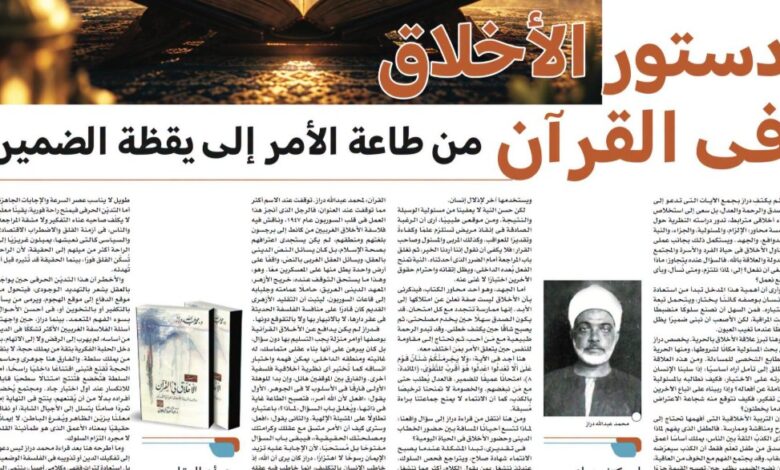
By Muhammad Abdullah Draz
By Hossam Badrawi
What makes a human being moral? Is it fear of punishment, the expectation of reward, or an inner conviction that justice deserves to be upheld, even when it runs counter to our interests? And is knowing what is good enough to make a person do it, or is the gap between knowledge and behavior the true arena in which we are tested?
These questions lead us to The Moral Constitution in the Qur’an by Muhammad Abdullah Draz, a work that moves the discussion of ethics beyond simply listing virtues and toward examining the foundations that make human beings accountable for their choices.
Draz, who was born in 1894 and died in 1958, was an Egyptian scholar of Al-Azhar who combined a deep study of Islamic heritage with philosophical training in France. He submitted the original version of this book in French to the Sorbonne, where he earned his doctorate in 1947. The book was subsequently translated into Arabic by Dr. Abdel Sabour Shaheen. This intellectual journey reflects the contours of Draz’s project: reading the Qur’an with the depth of a scholar steeped in its heritage, while engaging with philosophy using the tools of a researcher who understands its questions.
Draz did not simply collect Qur’anic verses calling for honesty, compassion, and justice. Instead, he sought to derive a coherent moral framework. His theoretical inquiry revolves around five central themes: moral obligation, responsibility, moral recompense, intention and motivation, and effort. He complements this theoretical foundation with a practical examination of ethics in the life of the individual, the family, society, the state, and the relationship with God. For Draz, the question extends beyond What should we do? to include: Why should we adhere to moral principles? When are we held accountable? And what motivates our actions?
I believe the importance of this approach begins with restoring the human being to the position of a choosing individual who bears the consequences of those choices. It is easy to enforce disciplined behavior under surveillance. The harder task is to cultivate a conscience that remains alert when no one is watching.
This is where the relationship between ethics and freedom becomes crucial. In his discussion of responsibility, Draz addresses the conditions that make it possible, including freedom and the personal nature of accountability. This relationship leads me to a reflection I consider fundamental: if we deprive people of their ability to choose, how can we hold them fully responsible for their actions? And if we raise them to follow others without thinking, how can we expect them to have the courage to object when those others are wrong?
The moral education I believe in requires explanation, discussion, and practice. A child who understands why lying undermines trust between people has a deeper foundation for honesty than a child who has merely learned that lying will lead to punishment. Understanding may coexist with fear of consequences, but a mature conscience emerges when a moral value becomes part of a person’s convictions about themselves and the rights of others.
Reading this book leads me to another question: Does virtue become a transaction when it is tied to reward?
Draz examines recompense in its moral, legal, and divine dimensions, while also exploring the motivations behind human action. This opens the door to a broader understanding of morality than one that reduces behavior to a calculation of profit and loss.
I believe that a person may begin their moral journey through fear or hope, only to develop a deeper awareness in which justice becomes a value they cherish and compassion a quality they want to embody. Their belief in divine recompense does not disappear, but their relationship with goodness becomes richer than simply waiting for something in return.
The Qur’anic verse, “We desire from you neither reward nor gratitude” (Qur’an 76:9), expresses a profoundly elevated human ideal: helping someone in need without turning that help into a moral debt that must be repaid through gratitude or obedience. How much generosity has been corrupted by the giver’s desire to control the very person they have helped!
Then comes intention, that inner world capable of making two outwardly identical actions differ in moral value. One person may give to charity out of compassion, while another gives in pursuit of influence. One of us may speak the truth to defend a right, while another uses the same truth to humiliate someone.
Yet good intentions do not absolve us of responsibility for the means we employ or the consequences we produce. As a physician, I believe that a sincere desire to save a patient requires knowledge, competence, and careful consideration of the consequences. The same applies to educators, public officials, and decision-makers. It is not enough to say that we intended to do good and then close the door to examining the harm we may have caused. Intention gives an action its inner dimension, but carrying it out competently and respecting the rights of others remain indispensable tests.
Effort, another of the book’s central themes, reminds me that morality is not a quality we can claim to possess forever. It is a practice renewed with every test. Honesty may come easily when it serves our interests, but become difficult when it exposes our mistakes. Compassion may feel natural toward those we love, yet require us to resist our own impulses when dealing with someone with whom we disagree.
Here, I find a profound test of conscience in the Qur’anic verse:
“And do not let the hatred of a people cause you to deviate from justice. Be just; that is nearer to righteousness.” (Qur’an 5:8)
Justice is required even toward those we dislike. Disagreement does not give us permission to lie, just as belonging to a particular group does not grant that group automatic innocence.
From here, I move from reading Draz to examining our own reality: Why does the gap between the prominence of religious discourse and the presence of ethics in everyday life sometimes grow wider?
In my view, the problem begins when religious affiliation becomes a certificate of righteousness and the examination of behavior takes a back seat. We then become more concerned with who is speaking than with whether what they say is true. We ask which group someone belongs to before asking whether they have acted justly or committed an injustice. Yet a serious commitment to moral standards requires us to apply them to ourselves and those we love with the same rigor we apply to our opponents.
If we extend this reflection to the state, the integrity of individuals alone will not be enough. We need institutions that make accountability possible, protect people’s rights, and limit the ability of those in power to turn personal whims into public policy. This is an additional conclusion I draw from the book for our own circumstances: conscience needs to be cultivated, while power needs rules and oversight. Public ethics also requires us to organize our shared life responsibly.
The value of The Moral Constitution in the Qur’an lies in its ability to reopen questions that we may have obscured beneath an abundance of ready-made answers. Through this book, I see that the sincerity of our commitment to a moral value becomes apparent at the very moment that upholding it becomes costly: when justice requires us to be fair to an opponent, integrity requires us to admit a mistake, or compassion requires us to relinquish our power to inflict harm.
When Reason Becomes the Guardian of Religion, Not Its Adversary
When I reread Muhammad Abdullah Draz’s The Moral Constitution in the Qur’an, I found myself reflecting on the man behind the book’s title as much as on the work itself.
Draz completed this work at the heart of the Sorbonne in 1947, engaging Western moral philosophers, from Kant to Bergson, in their own language and according to their own logic. He was not seeking their recognition of Islam’s validity. Rather, he examined religious scripture through reason and questioned Western reason through scripture, standing on common intellectual ground from which he could look toward both traditions.
And this is what deserves particular attention: Draz was a graduate of Al-Azhar, the venerable institution of Islamic learning. He carried his turban and traditional robes into the lecture halls of the Sorbonne to demonstrate that the old Azharite tradition was capable of competing with modern philosophy on its own ground—not by being dazzled by it, nor by retreating from it.
Draz did not defend Qur’anic ethics as a set of revealed commandments that must be accepted without question. Instead, he demonstrated that they constitute a coherent intellectual framework, with its own purpose and internal logic, which can be understood and tested for consistency just like any other philosophical theory of ethics.
The difference between these two approaches is enormous, even if, at first glance, it may appear to be a difference in style rather than substance.
The first says: “Do this because God has commanded it.” Obedience then becomes an end in itself, and the question “Why?” is shut down as though it were an affront to the divine will.
The second says: “Do this, and you will see how the command is consistent with your reason, your dignity, and your genuine interests.” The door to questioning remains open—and is even encouraged—because answering such questions strengthens faith rather than undermining it.
Draz believed that when God addressed human beings through moral obligations, He was addressing their capacity for reason and understanding before appealing to obedience in its barest form. The Qur’an itself repeatedly asks, “Will you not reason?” and “Will you not reflect?” rather than calling only for blind obedience.
I believe this is where our contemporary religious and intellectual crisis lies. We have replaced the rational religiosity represented by Draz and the great scholars of Al-Azhar of his generation with a literalist, text-bound religiosity that fears questions and treats those who ask them as skeptics or outsiders to the community.
The word “Why?” has almost come to be treated as though it were a form of atheism, with all the imagined danger that entails. Yet in its golden ages, Al-Azhar itself was a school of questioning before it was a school of memorization. Its great scholars engaged with Greek philosophy and Aristotelian logic without feeling that doing so weakened their faith. On the contrary, they regarded such engagement as a way of deepening it.
The paradox is that this scholar, who demonstrated to the West the rationality and systematic nature of Qur’anic ethics, has become almost forgotten in our broader religious discourse. Meanwhile, the public stage is increasingly occupied by those who regard reason as a danger to be contained rather than an instrument to be employed and respected.
Why has this reversal of priorities occurred?
Because rational religiosity demands effort: reading, comparison, and the patience to endure temporary uncertainty before arriving at conviction. It is a long road, ill-suited to an age of speed and ready-made answers.
Literalist religiosity, by contrast, offers immediate comfort: packaged certainties that demand neither the effort of thought nor the difficulty of reconsideration. In times of anxiety and economic and political turmoil, such as those we are living through, people instinctively gravitate toward comfort more readily than toward truth. Comfort soothes anxiety immediately, whereas truth may intensify it before eventually bringing peace.
More dangerously, when this kind of literalist religiosity is confronted by reason, it can feel existentially threatened. It shifts from defense to attack, accusing those who ask questions of heresy or disloyalty—or, at best, of deliberately misunderstanding the faith.
Draz, however, when confronted with questions from Western philosophers who were deeply skeptical of religion itself, did not retreat into rejection or resort to accusations. He entered the intellectual arena with the confidence of someone who possessed an argument, not merely the authority to impose one.
The difference is fundamental and decisive. An argument persuades and builds a firm inner conviction. Authority, by contrast, compels submission and produces superficial compliance that may collapse at the first serious test.
A society that forces its members to submit rather than persuading them ultimately produces either a quiet rebellion that gradually takes root among younger generations or an outward hypocrisy that decorates appearances while emptying the inner self of meaning. It does not produce genuine faith in its deepest sense: a tranquility of the heart rather than mere conformity in behavior.
What I am proposing after reading Muhammad Draz is not a call to dismantle religion or dissolve it into positivist philosophy. It is a call to reclaim an authentic tradition of Islamic jurisprudence and theology to which Draz, Al-Ghazali, Ibn Rushd, Muhammad Abduh, and other leading figures of this rationalist tradition belong.
This tradition holds that reason and revelation are companions, not adversaries; that religion, when examined through sound reason, becomes more firmly established rather than weakened; and that fear of questioning is, in reality, an implicit admission that ready-made answers are fragile.
Those who truly possess a sound and well-founded answer do not fear the person who asks for it. They welcome the question as an opportunity to deepen understanding rather than a threat to certainty. This is precisely how Draz welcomed the questions he encountered at the Sorbonne: he engaged with them rather than evading them.
Today, more than ever, amid the intellectual polarization sweeping through our societies, we need to reclaim Draz—not merely as a name mentioned in passing at academic occasions, but as a model for how we engage with religious texts and with those whose ideas differ from our own.
We must restore ethics to its rightful place as the essence of religion, not a decorative supplement to it. And we must restore reason to its position as a faithful guardian of religion, not an adversary to be feared and fought.
When reason disappears, little remains of religion beyond its outer shell: rituals without spirit, rulings without the wisdom to justify them, and a form of religiosity that grows more rigid and more strident as it becomes increasingly detached from the deeper meaning that religion was originally intended to bring to human life.