
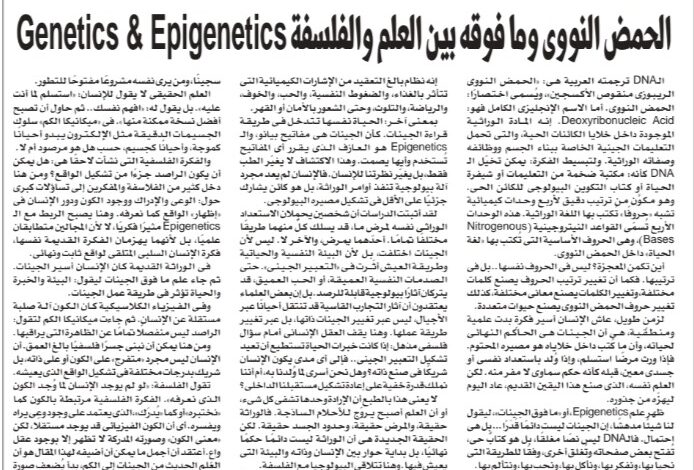
DNA and Beyond: Between Science and Philosophy
Genetics & Epigenetics
DNA, translated into Arabic as “deoxyribonucleic acid,” is commonly referred to simply as the genetic material. Its full English name is Deoxyribonucleic Acid. It is the hereditary material found inside the cells of living organisms, carrying the genetic instructions responsible for building the body, regulating its functions, and determining inherited traits.
To simplify the idea: DNA can be imagined as a vast library of instructions, the code of life, or the biological blueprint of a living being. It is composed of a precise arrangement of four chemical units that resemble “letters” forming the language of genetics. These four units are called nitrogenous bases, the fundamental letters with which the “language of life” is written within DNA.
Where does the miracle lie? Not in the letters themselves, but in their arrangement. Just as rearranging letters creates different words, and changing words creates different meanings, rearranging the letters of DNA creates different forms of life.
For a long time, humanity lived captive to an idea that seemed both scientific and logical: that genes were the ultimate rulers of our lives, and that whatever was written within our cells constituted an unavoidable destiny. If someone inherited a disease, they surrendered to it. If they were born with a particular psychological or physical predisposition, they accepted it as though it were an inescapable decree.
But science itself—the very force that created this old certainty—has now returned to shake it at its roots.
The field of Epigenetics, or “what lies above genes,” emerged to tell us something astonishing: genes are not always destiny; they are possibility. DNA is not a closed text, but a living book whose pages may be opened or sealed according to how we live, think, eat, love, and suffer.
Scientists discovered that humans inherit not only genes, but also “the way those genes are activated.” Here begins the intellectual revolution.
A human cell contains thousands of genes, yet not all of them function at the same time. Some genes are activated, others silenced, and some remain dormant until specific conditions awaken them. Who decides this? This is where epigenetics enters the picture.
It is an extraordinarily complex system of chemical signals influenced by nutrition, psychological stress, love, fear, exercise, pollution, and even feelings of safety or oppression.
In other words, life itself intervenes in how genes are read.
Genes are like piano keys, while epigenetics is the pianist deciding which keys are played and which remain silent.
This discovery changes not only medicine, but also our entire understanding of the human being. Humans are no longer viewed as biological machines merely executing hereditary commands, but as living beings who participate—at least partially—in shaping their own biological destiny.
Studies have shown that two individuals carrying the same genetic predisposition for a disease may follow entirely different paths. One may become ill while the other remains healthy. Not because their genes differ, but because their psychological environment, lifestyle, and life experiences influence their gene expression.
Even deep emotional trauma—or profound love—can leave measurable biological traces. Some scientists even believe that the effects of severe experiences may sometimes pass across generations, not by altering genes themselves, but by altering how those genes function.
At this point, the human mind encounters a breathtaking philosophical question:
If life experiences can reshape gene expression, then to what extent is a human being a participant in the making of the self? Are we prisoners of what we were born with, or do we possess a hidden ability to reshape our inner future?
This does not mean, of course, that willpower alone can cure everything, nor that science has become a promoter of naïve fantasies. Genetics is real. Disease is real. The limits of the body are real.
But the new truth is that heredity is not always a final verdict; rather, it is the beginning of a dialogue between the individual, the self, and the surrounding environment.
Here, biology meets philosophy.
Complete surrender to what is “genetically predetermined” may itself be a form of intellectual and spiritual passivity, because the human being is not merely a chemical code, but a living entity interacting with the world, influencing it and being influenced by it.
We cannot change the genes we were born with, but we can sometimes change the way they function. And that difference is enormous. It is the difference between seeing oneself as a prisoner and seeing oneself as an open project capable of growth and transformation.
True science does not tell people: “Surrender to what you are.”
It tells them: “Understand yourself, then strive to become the best possible version of yourself.”
In quantum mechanics, the behavior of subatomic particles such as electrons sometimes appears wave-like and sometimes particle-like, depending on whether they are being observed.
From this emerged a philosophical idea: could the observer be part of shaping reality itself?
This question opened the door for philosophers and thinkers to explore profound issues concerning consciousness, perception, the nature of existence, and humanity’s role in “revealing” reality as we know it.
This is where the connection to epigenetics becomes intellectually fascinating—not because the two fields are scientifically identical, but because both challenge the same old assumption: the notion of the human being as a passive recipient of a fixed and final reality.
In classical genetics, humans were prisoners of their genes. Then epigenetics arrived to say: environment, experience, and life influence how genes function.
In classical physics, the universe was viewed as a rigid machine independent of humanity. Then quantum mechanics suggested that the observer is not entirely separate from the phenomenon being observed.
From here, one may build a deeply philosophical bridge:
Human beings are not merely spectators of the universe or of themselves, but participants—at varying degrees—in shaping the reality they experience.
Philosophy says: “Without humanity, the universe we know would not exist.”
This philosophical idea relates to the universe as it is experienced or perceived—something dependent on conscious awareness that observes and interprets it. The physical universe may indeed exist independently, but the meaning and perceived image of the universe only emerge through the presence of a conscious mind.
Perhaps the most beautiful conclusion to this reflection is that modern science—from genetics to quantum theory—has begun to weaken the image of the human being as a helpless creature entirely ruled by external forces, and instead reintroduces humanity as a living, interactive element within the network of existence.
Not the absolute master of the universe, nor its absolute slave.
But a participant in uncovering its possibilities, shaping part of its future, and transforming potential into reality.
And this may well be one of the deepest intellectual revolutions of our age.