
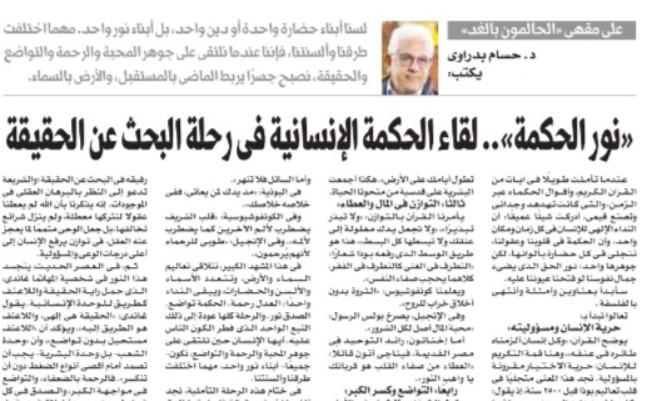
When I reflected deeply on verses from the Qur’an and the sayings of sages throughout history—words that soothed my soul and shaped my values—I realized something profound: that the divine call to humanity, across all times and places, is one and the same. Wisdom resides within our hearts and minds, manifesting in every civilization in different forms, yet its essence remains one: the light of truth that illuminates the beauty of our souls, if only we open our eyes to it.
I will begin with themes and examples, and conclude with philosophy.
Let us begin with:
Human Freedom and Responsibility:
The Qur’an states: “And every human being—We have bound his fate to his neck.” Here lies the highest form of human dignity: freedom of choice coupled with responsibility. This meaning is echoed in the heart of Buddha’s teachings 2,500 years ago: “What we are today is the result of what we thought yesterday. Thought is the foundation of action, and action creates destiny.”
In China, Confucius taught his students: “If you do wrong, you will bear the burden of your actions; if you do good, reward will not fail you.”
And the Gospel is clear: “Each of us will give an account of ourselves to God.”
It is a freedom conditioned by awareness, responsibility, and mindfulness.
Second: Honoring Parents as the Cornerstone of Ethics:
The Qur’an commands: “And show kindness to parents.” Here, all teachings converge. In Buddhism, honoring parents is among the greatest acts of “good karma,” as Buddha says: “Be to your mother and father like a fruitful tree, giving them shade and fruit without expecting return.”
Confucius places filial piety at the root of all virtue: “The noble person begins with honoring his parents and ends with loving all people.”
And in the Gospel: “Honor your father and mother, so that your days may be long upon the earth.”
Thus, humanity has unanimously sanctified those who gave us life.
Third: Balance in Wealth and Giving:
The Qur’an calls for moderation: “Do not spend wastefully” and “Do not keep your hand chained to your neck nor extend it completely.” This is the middle path that Buddha elevated: “Excess in wealth is like excess in poverty—both cloud the soul.”
Confucius teaches: “Wealth without ethics is the ruin of the soul.”
In the Gospel, Paul declares: “The love of money is the root of all evil.”
And Akhenaten, pioneer of monotheism in ancient Egypt, prays to Aten: “Giving from a pure heart is your offering, O Giver of Light.”
Fourth: Humility and the Breaking of Arrogance:
The Qur’an says: “Do not walk upon the earth arrogantly—you will neither pierce the earth nor reach the mountains in height.”
The humility of prophets and sages is evident in their words. Buddha says: “The full grain bows its head, while the empty one raises it in pride.”
Confucius teaches: “The world does not fear the learned, but it fears the one who is humble despite knowledge.”
And the Gospel says: “Whoever exalts himself will be humbled, and whoever humbles himself will be exalted.”
Fifth: Knowledge and Guarding Against Ignorance:
In the Qur’an: “Read, and your Lord is Most Generous—Who taught by the pen, taught humanity what it did not know.”
Buddha advises: “Do not believe simply because you were told—experience, reflect, let the light of reason guide you.”
Confucius warns: “Wisdom begins in knowing the limits of one’s ignorance.”
And the Gospel says: “You shall know the truth, and the truth shall set you free.”
Sixth: Compassion for the Weak:
The Qur’an commands: “So do not oppress the orphan, nor repel the one who asks.”
In Buddhism: “Extend your hand to those who suffer, for in their salvation is yours.”
In Confucianism: “The noble heart trembles for others’ pain as it does for its own.”
And the Gospel says: “Blessed are the merciful, for they shall receive mercy.”
In this vast panorama, the teachings of heaven and earth converge. Names, languages, and civilizations differ, yet the call remains one: justice is mercy, wisdom is humility, truth is light. The journey is a return to that single source from which humanity was created. O human being, when we meet upon the essence of love, compassion, and humility, we become—together—children of one light, no matter how our paths and tongues differ.
In Conclusion: The Eternal Philosophy
At the end of this contemplative journey, we stand before an enduring philosophical truth—what thinkers have called the “Perennial Philosophy.” It is that timeless wisdom that transcends geography and history, uniting all streams of human thought in essence. It is not merely agreement in words, but unity in substance: the light of truth guiding humanity since the dawn of awareness, affirming that reason, spirit, and revelation can coexist in harmony.
Consider Plato’s words: “The unexamined life is not worth living.”
Socrates, in humility, said: “I know that I know nothing.” Wisdom begins in recognizing our ignorance.
Aristotle saw the human as a social being seeking happiness through virtue: “The whole is greater than the sum of its parts.”
Within the Arab-Islamic tradition, Ibn Rushd (Averroes) powerfully affirms this harmony: “Truth does not contradict truth; rather, it agrees with and supports it.” He declared that reason is not the enemy of religion, but its companion in the search for truth. Divine law calls us to reflect rationally upon existence. God did not grant us minds to leave them idle, nor revelations that contradict them. Instead, revelation completes what reason cannot reach, in a balance that elevates humanity.
In the modern era, this light appears in Mahatma Gandhi, who carried the banner of truth and nonviolence as a path to human unity. Gandhi said: “Truth is my God, and nonviolence is the path to it.” He affirmed that “nonviolence is impossible without humility,” and that “the unity of humanity must withstand the greatest pressures without breaking.” Compassion, humility, and truth are not merely personal virtues, but transformative forces capable of building bridges between nations and civilizations.
At the heart of this eternal philosophy, the human being is not merely material, but a soul carrying a spark of divine light.
In an age of speed and distraction, where voices clash and screens multiply, let us remember: we are all one—if only we knew. Freedom is bound by responsibility, humility crowns knowledge, compassion bridges hearts, and truth is a light that unites rather than divides.
In the end, we are not the children of one civilization or one religion—we are the children of one light. No matter how our paths and languages differ, when we meet upon love, compassion, humility, and truth, we become a bridge connecting past to future, earth to heaven.
Go forth into the world, young people, and be that light—in your actions, your thoughts, and your dreams of tomorrow.
The universe awaits you to complete the painting, and to bear witness to the unity of human wisdom.