
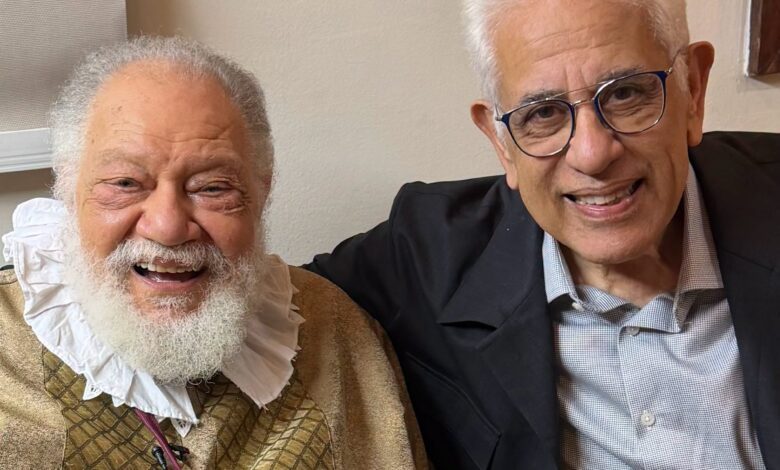
Today, I attended the magnificent production of King Lear at the National Theatre, starring the legendary Yehia El-Fakharany and the brilliant Tarek El-Desouky, directed by the internationally acclaimed Shady Sorour.
I am not flattering anyone here. I am simply describing what I saw.
This is a professional theatrical production, performed in Classical Arabic, with a remarkable theatrical fabric woven from the set design, music, the actors’ movements and agility, and their mastery of their craft. Their performances were truly astonishing to me.
Everyone was impressive.
I must also speak about the set design, lighting, and music, which, under the director’s artistic vision, came together to create images of extraordinary beauty and professionalism.
The story of King Lear, written by William Shakespeare, revolves around an aging king who, in the autumn of his life, decides to divide his kingdom among his three daughters according to the degree of love and loyalty they express toward him.
The two eldest, Goneril and Regan, secure their shares through flattery and hypocrisy, while the youngest, Cordelia, refuses to exaggerate her feelings and remains truthful. Her father becomes enraged, disinherits her, and banishes her.
From this impulsive decision, Lear’s kingdom begins to collapse, and so does his mind. He finds himself wandering in the wilderness between madness and wisdom, only to discover too late the meaning of genuine love in contrast to the false sweetness of words, and the value of loyalty in an age of deception.
Running alongside this central story is a parallel one: the story of Gloucester, portrayed with outstanding skill by Tarek El-Desouky, and his two sons, Edgar, his legitimate son, and Edmund, his illegitimate one.
The two actors, Ahmed Othman and Tamer El-Kashef, were simply magnificent.
This production marks the third time Yehia El-Fakharany himself has performed King Lear, following his first production in 2001 and its revival in 2019.
He returns to the role today in an unprecedented experience in the history of Egyptian theatre, carrying with him the wisdom of the years and the maturity of experience.
The production is being staged at the National Theatre with an exceptional translation by Dr. Fatma Moussa, set design by Hamdy Attia, lighting by Hussein “Kago,” music by Ahmed El-Nasser, and choreography by Diaa Shafik.
Alongside Yehia El-Fakharany and Tarek El-Desouky, there were outstanding performances by Hassan Youssef, Amal Abdullah, Eman Ragai, and others.
I was particularly struck by the actors’ fluid movement across the stage, their agility in portraying battles and deaths, and the beautiful visual compositions created by the groups of young actors in the forest surrounding King Lear after his daughter banishes him into the storms and rain.
I want to assure readers that this is a production worthy of praise and appreciation. I invite you to experience refined art on the stage of the National Theatre, and I take my hat off to this remarkable group of artists.
King Lear in the Age of Generation Z
I left the National Theatre after watching King Lear with more than the beauty and pleasure of the performance on my mind. Two questions stayed with me all the way home.
The first was:
What if someone from Generation Z were to sit in that seat?
A performance lasting more than two and a half hours, in a single place, where the viewer cannot pause it, fast-forward it, or leave halfway through to jump to another, more exciting scene.
This is a generation whose consciousness has been shaped by platforms that give it compressed content in sixty seconds and allow it to swipe away the moment it feels even the slightest hint of boredom.
How, then, does it respond to an art form that does not recognize the very idea of “swiping”?
Are we witnessing a decline in taste? Or are we asking a mind shaped by an entirely different rhythm to adapt to a rhythm that is no longer its own?
The second question is deeper, and concerns older generations as well—not Generation Z alone.
How do we explain the fact that we, who are supposedly “civilized,” and whose values, laws, and public morality have changed, can still sit spellbound before a drama in which the king dies, his daughters and their husbands die, and betrayals intertwine until some moments seem closer to black comedy than pure tragedy?
This is a text from the seventeenth century.
Why, then, do we still recognize ourselves in it?
The answer I came away with from the performance is that I found no real difference between the violence of this drama, written four hundred years ago, and the drama human beings live through in the twenty-first century.
Children fighting over inheritance.
Brothers plotting against one another.
Power built on sweet words rather than genuine feelings.
And a father discovering too late who truly loved him and who merely flattered him.
None of this has changed.
Only the mediums through which the story is told have changed: from a theatre stage to a phone screen, from a poetic scene to a tweet.
And here the two questions meet at a single point:
What has changed is not the essence of human drama, but our ability—and Generation Z’s ability most of all—to remain with it without interruption.
The question is no longer, “Does Edmund’s betrayal of his father and brother still move us?”
The answer is yes, as demonstrated by the theatre being full and the audience sitting breathlessly silent.
The real question is:
Are we still capable of giving a single story two and a half uninterrupted hours of our attention?
Or has the small screen reshaped our brains to such an extent that sustained concentration is no longer a natural skill, but something we need to retrain ourselves to recover—like a muscle that has long been neglected?
Perhaps this is part of the value of keeping such a production alive on a real stage rather than recording it on a screen.
Theatre, unlike any other medium, imposes a silent contract upon the person sitting before it:
Either stay with me until the end, through everything I contain in my length and weight—or leave.
Perhaps this very resistance—the resistance to surrendering to the culture of the one-minute clip—is the greatest thing Shakespeare can offer Generation Z today, even more than the story of the king, his rejection, and his two daughters.
And as I watch my grandchildren and children of their generation at home, I see this difference every day without needing a study to confirm it.
A child can spend hours in front of a screen, but those hours are rarely “continuous” in the theatrical sense. They are divided into dozens of fragments, each one a self-contained world that ends before the next begins.
I am not here to blame them.
I cannot ask a generation born into this rhythm to behave as though it had been born before it.
But I admit that when I watch them, I feel a kind of healthy envy:
The envy of a man who lived in a time when a story was told in full, from beginning to end, without anyone interrupting it.
Perhaps that is why King Lear, for me, was an evening of rediscovery and pleasure—not merely an evening at the theatre.