
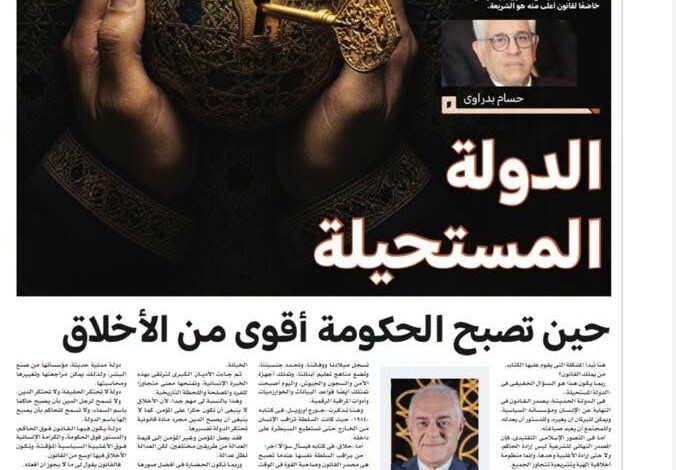
I read a book by Wael Hallaq titled:
The Impossible State: Islam, Politics, and Modernity’s Moral Predicament
It is a book that does not discuss, as its title might suggest, the impossibility of having a state in a Muslim society, nor does it argue that Muslims are incapable of building a modern state.
Rather, it presents a more complex and intellectually provocative proposition:
That combining the concept of an “Islamic state” with the concept of the “modern state,” in the form in which it developed in Europe, may contain an inherent contradiction.
The modern state, as Hallaq sees it, is not merely a government, parliament, ministries, police, army, and judiciary.
It is an entire philosophical construct based, above all, on the concept of sovereignty.
The state is the holder of supreme authority within its borders.
It is the state that legislates.
It is the state that executes.
And it is the state that monopolizes the legitimate use of force.
The historical Islamic order, Hallaq argues, emerged from a different philosophy.
The ruler was not, in principle, the one who created the law. Rather, he himself was subject to a higher law: the Sharia.
And here begins the problem at the heart of the book.
Who Owns the Law?
Perhaps this is the real question in The Impossible State.
In the modern state, law ultimately emanates from human beings and their political institutions. Parliament can change it, constitutions can amend it, and society can reshape it.
In the traditional Islamic conception, however, the ultimate source of legitimacy is neither the will of the ruler nor even the will of the majority alone. It is a moral and legal system that stands above everyone.
The caliph or sultan ruled, but—at least in theory—he did not own the Sharia.
Jurists, judges, and social and religious institutions occupied a space that was not entirely controlled by political authority.
From here, Hallaq argues that attempting to establish a “modern Islamic state” may lead to a strange paradox:
We take the apparatus of the modern state, with all its powers, instruments, and capacity for control, and then place a sign above it that says “Islamic.”
But the apparatus remains the same apparatus.
And here the question becomes:
Have we Islamized the modern state, or have we turned religion itself into one of the state’s instruments?
The Problem Is Not Unique to Islam
This is where the book became more fascinating to me.
Because I found that the issue Hallaq raises goes far beyond Islam.
He is, in fact, asking a question about modernity itself:
What happens when the state becomes the ultimate authority over law while moral authority recedes into the background?
The modern state has achieved enormous accomplishments that cannot be denied.
It established the concept of citizenship, organized rights, built institutions, expanded education, healthcare, and public services, created mechanisms for the transfer and accountability of power, and—in many historical experiences—liberated human beings from the absolute authority of kings and inherited privileges.
But at the same time, it created an apparatus of power unlike anything humanity had known before.
The modern state knows who we are, where we live, what we own, and how much we pay in taxes.
It records our births and deaths, determines our nationality, sets the educational curricula for our children, and possesses security agencies, prisons, and armies.
Today, it also possesses databases, algorithms, and tools of digital surveillance.
Here I remembered George Orwell and his novel 1984, in which authority watched human beings from the outside in order to control what was inside them.
But Hallaq asks another question:
Who watches the authority itself when it becomes both the source of law and the holder of power?
Is Law the Same as Morality?
Here I differ somewhat from an interpretation that might suggest the solution is simply to return to an earlier historical model.
History does not move backward.
Nor do I believe societies can reproduce a political system born centuries ago and simply place it, unchanged, within a world of artificial intelligence, the global economy, the nation-state, citizenship rights, equality between men and women, and religious and cultural pluralism.
But I agree with Hallaq on something deeper:
Law alone does not create a moral society.
Something may be legal but unjust.
A decision may be constitutional but inhumane.
A state may commit a grave crime while relying on laws, regulations, and institutions that it created itself.
Here we see the difference between two questions that we often confuse:
Is this legal?
and
Is this right?
Civilization begins when we refuse to treat the first question as a substitute for the second.
Morality Is Older Than the State… and Older Than Religions
Here I would take the argument one step further than the book.
Human beings did not wait for the emergence of the modern state to understand justice and injustice, nor did they wait for the prophets to discover every meaning of good and evil.
Long before the Abrahamic religions, human societies had already developed forms of cooperation and loyalty, prohibitions against killing within the community, care for children, respect for agreements, and punishment for betrayal.
The great religions then elevated this accumulated human experience and gave it a meaning transcending the individual, self-interest, and the historical moment.
This is very important to me.
Morality should not be the exclusive property of the believer, just as religion should not become merely a body of laws whose interpretation is monopolized by the state.
A believer and a non-believer may arrive at the value of justice through different paths, but justice remains justice.
Perhaps civilization at its best is the space in which revelation, reason, and human experience converge to protect human dignity.
When the State Becomes a God
Perhaps the most dangerous conclusion I drew from the book was not the impossibility of an “Islamic state,” but the danger of the absolute state.
When the state becomes the authority that defines law, morality, truth, memory, education, and the media, it approaches a position that no human authority should ever occupy.
Here, in an indirect way, Hallaq meets Orwell.
Big Brother in 1984 was not merely a dictator.
He wanted to become the authority that determined for human beings what had happened yesterday, what was true today, and even what they would be permitted to think tomorrow.
A state that recognizes no moral value above its own authority becomes capable of making law serve power, rather than making power serve the law.
But at the same time, I do not want a religious state in which some human beings monopolize the right to speak on behalf of God, because the same problem would simply return in another form.
If the danger of the modern state is for it to say:
I am the source of legitimacy.
Then the danger of the religious state begins when human beings say:
We alone—the ruling group—know the will of God.
In both cases, human beings become vulnerable to tyranny.
So… What Is the Possible State?
After finishing the book, I found myself searching neither for an “Islamic state” nor for a “secular state,” but for something else:
The ethical state.
A modern civil state whose institutions are created by human beings and can therefore be reviewed, changed, and held accountable.
A state that does not monopolize truth.
Nor does it monopolize religion.
A state that neither allows a religious figure to become a ruler in the name of heaven, nor allows a ruler to become a god in the name of the state.
A state in which the law stands above the ruler, the constitution above the government, and human dignity above the temporary political majority.
And a state in which morality is broader than the law.
The law tells me what I must not do.
But morality asks me:
What kind of human being do I want to be?
This is a space that no state can ever completely fill.
What I Took Away from the Book
I may not agree with Wael Hallaq in all of his conclusions, but important books are not those that make us agree with their authors.
Important books are those that leave us with a question after we close the final page.
The Impossible State left me with a question larger than its title:
Is the real problem the impossibility of the modern Islamic state, or is it that we have built an extraordinarily powerful modern state and then forgotten to ask: From where does this power derive its moral limits?
The state is necessary.
Law is necessary.
Institutions are necessary.
But civilization cannot be built on necessities alone.
There is something that must always remain higher than power, deeper than law, and beyond politics:
Human dignity.
Perhaps the possible state I am looking for is neither a religious state nor an anti-religious state; neither a state that is weak before society nor one that devours it.
It is a state that knows its limits.
For the most dangerous moment in the life of any state is not merely when it becomes weak, but when it becomes convinced that it has the right to everything.
And at that point, the state may become “impossible” not because it cannot exist…
but because human beings can no longer live freely within it.
About Wael Hallaq
Wael Hallaq is a Palestinian-born, Canadian scholar and academic. He was born in Haifa in 1955.
He earned his PhD from the University of Washington and subsequently joined the Institute of Islamic Studies at McGill University, where he became an assistant professor of Islamic law in 1985.
- He currently serves as a professor of Social Sciences at Columbia University, in the Department of Middle Eastern Studies.