

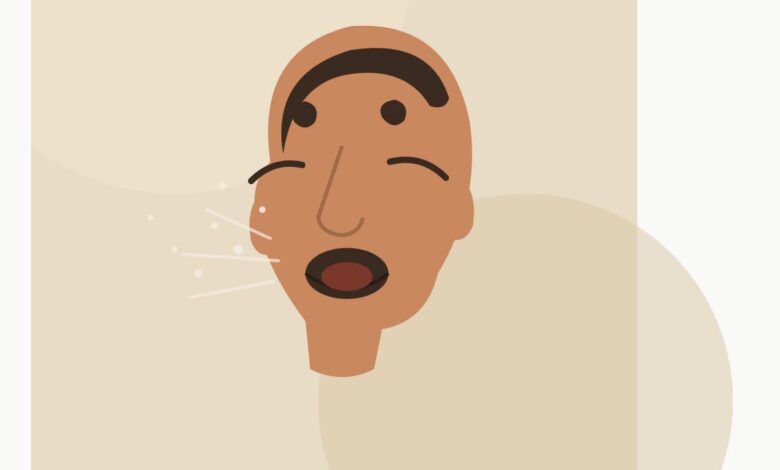
Sneezing is an act we have performed almost since birth without ever thinking about it.
We feel a small tickle in the nose. Our facial expression changes. We take a deep breath, usually close our eyes, and then comes the explosion:
“Achoo!”
One second later, we return to our lives as though nothing happened.
But when I began thinking about sneezing, I found it far more fascinating than it appears.
Who decides that we should sneeze?
Why can we sometimes no longer stop a sneeze once it has begun?
Why do we feel relief afterward—and sometimes even a certain degree of pleasure?
Why do some people sneeze when they look at the sun?
And, more strangely, is there really a connection, however rare, between sneezing and sexual arousal or psychological emotion?
Behind this tiny movement lies a beautiful neurological story.
Who Gives the Command to Sneeze?
A sneeze is, fundamentally, a defense mechanism.
Dust enters the nose, or pollen, or a strong odor, or an irritating chemical substance. Or the mucous membrane becomes inflamed during a cold.
Sensory nerve endings detect this irritation, and the signal travels, particularly through branches of the trigeminal nerve, to neural networks in the brainstem responsible for coordinating the sneeze reflex.
And here the nervous system takes over.
It commands the body to take a deep breath.
The muscles of the larynx, chest, diaphragm, and abdomen move in an extraordinarily precise sequence. For a brief moment, the opening between the vocal cords in the larynx—the glottis—closes.
Pressure then builds up inside the chest.
Suddenly, the pathway opens, and air is expelled forcefully through the nose and mouth.
In other words, what appears to be a random movement is actually a coordinated neuromuscular program involving a large number of nerves and muscles within an extremely short period of time—a symphony performed by an ensemble of instruments.
The body does not sneeze for no reason.
It is trying to expel something it does not want.
Sneezing and Coughing… Members of the Same Family
Sneezing and coughing may appear to be two different things, but they are actually closely related defensive mechanisms.
The fundamental difference is the location of the alarm.
With a sneeze, the warning usually comes from the nose and nasal passages, with the aim of clearing the upper respiratory tract.
With a cough, the irritation usually originates in receptors in the larynx, trachea, and bronchi, with the aim of protecting and clearing the lower respiratory tract.
Put more simply:
The sneeze says: “There is something in my nose that I want to get out.”
The cough says: “There is something in my airway that I want to get rid of.”
Both are wonderful examples of how the body possesses protective mechanisms that operate before we even ask our conscious minds for permission.
Why Can’t We Easily Stop a Sneeze?
Sometimes a sneeze can be interrupted at its very beginning.
But once the neural reflex reaches a certain stage, stopping it becomes much more difficult.
And here a small philosophical point emerges—one that I like.
We usually imagine that we are completely in control of our bodies.
But how many things happen within us without our deciding them?
The heart beats.
The intestines move.
The pupils dilate and contract.
Hormones are released.
We fall asleep and wake up.
And we sneeze.
Human will is important, but it is not the only manager of this entity we call “I.”
Why Does Sneezing Sometimes Feel Good?
This is one of the more amusing observations about sneezing.
Before a sneeze, a sensation of irritation and tension builds.
We feel that something is “coming.”
We inhale.
The muscles contract.
Pressure rises.
And then, suddenly, all of that is rapidly released.
Afterward, we feel relief.
Perhaps this is why sneezing can sometimes feel pleasurable: it represents a rapid transition from tension to release.
Popular explanations sometimes claim that sneezing necessarily causes the release of endorphins or dopamine. Scientifically, however, it is better not to present this as an established fact; the direct evidence that these particular substances are responsible for the pleasurable sensation of sneezing is not conclusive.
It is more accurate to say that a sneeze abruptly ends a state of sensory, muscular, and neurological irritation and tension, and the brain may translate this transition, in some people, into a distinct feeling of relief—and perhaps brief pleasure.
But… What Does Sex Have to Do with Sneezing?
This is where the story becomes even stranger.
There are indeed documented medical cases of people sneezing during sexual arousal, while thinking about sex, or after orgasm.
But this does not mean that sneezing is a hidden sexual symbol, nor that everyone who sneezes has entered a state of arousal!
The matter is simpler—and more interesting—than that.
Sexual arousal is not an event that occurs only in the reproductive organs. It is a neurological and vascular state involving the autonomic nervous system, the same system that participates in regulating a huge number of involuntary bodily functions.
The nose is rich in blood vessels and nerves and is affected by changes in autonomic nervous activity.
It is therefore thought that interactions between some of these neural circuits may explain why sexual stimulation in certain individuals can lead to nasal congestion or sneezing.
So there may indeed be a connection—but it is not a direct relationship between “sneezing and sex.”
Rather, it may arise from overlapping neural networks involved in phenomena that appear separate to us.
The Sun Makes Some People Sneeze Too
Perhaps one day you walked out of a dark room into bright sunlight, looked toward the sky, and sneezed.
This is not necessarily a coincidence.
There is a well-known phenomenon called the photic sneeze reflex—a sneeze reflex triggered by light.
In some people, sudden exposure to bright light can trigger the sneeze reflex.
The likely explanation once again involves the proximity of neural pathways and the interaction between signals coming from the eyes and the circuits associated with the sneeze reflex.
It is as though the nervous system were a vast network of roads, some of which pass extremely close to one another, allowing a signal occasionally to jump onto a neighboring road.
It is, of course, a simplified image, but it helps us understand the idea.
Can Sneezing Be Psychological?
Here we enter an area that requires some caution.
Human beings are not a collection of organs completely detached from their emotions.
Stress, anxiety, fear, and excitement affect the heartbeat, breathing, intestines, sweating, and blood pressure.
Why should we assume that the nose lives outside this system?
There are indeed rare, documented cases of what is known as functional sneezing or sneezing associated with psychological factors, in which people experience recurrent and unusual bouts of sneezing without an obvious organic cause.
But it would be a mistake to jump immediately to a psychological explanation.
Someone who sneezes frequently may have an allergy, an infection, exposure to irritants, or a nasal condition. These possibilities should be investigated before we conclude that the cause is psychological.
This reflects a broader principle in medicine:
The existence of an influence of the mind on the body does not mean that every physical symptom is psychologically caused.
The Body Does Not Know the Boundaries We Drew for It
Perhaps what I find most fascinating about the story of sneezing is that it exposes a mistake we often make when thinking about human beings.
We divide ourselves into sections.
This is the nose.
This is the brain.
These are the nerves.
These are the reproductive organs.
This is the mind.
These are emotions.
Then we are surprised when we discover that light entering the eyes can make the nose sneeze, that psychological emotion can change the heartbeat, and that sexual arousal can affect the blood vessels inside the nose.
The problem is not with the body.
The problem lies in the divisions we created in order to understand it.
The body does not read anatomy books divided into chapters.
The nerve does not know that it belongs in the chapter on the nose.
The hormone does not know that it belongs in the chapter on glands.
And the autonomic nervous system does not recognize the boundaries that medical specialization has drawn between one organ and another.
It is one entity.
And so, perhaps the next time a sneeze surprises us, it deserves more than simply saying:
“Bless you.”
Behind that fleeting second lies a network of nerves, muscles, and senses; a defensive decision made by the brain without consulting us; and an astonishing interaction between what we call the body and what we call the mind.
Perhaps the broader question left to us by a sneeze is this:
If all of this is happening inside me without my deciding it, then who exactly is this “I” that I call myself?