
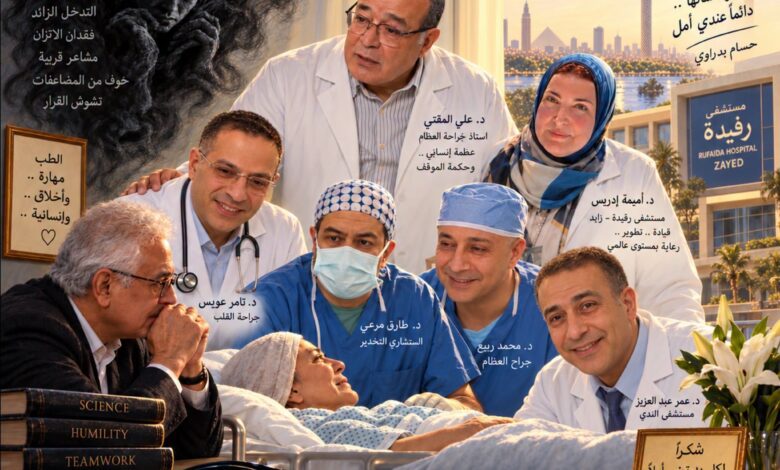
Many medical tumors end with the Latin suffix -oma: fibroma, lymphoma, sarcoma, and many others.
And as a form of humor that doctors sometimes resort to in order to cope with the harshness and ironies of the profession, we came up with a playful term:
Recommendoma.
It is neither a recognized medical diagnosis nor a disease affecting any organ of the body. Rather, it is a psychological and professional condition that may affect a medical team when the patient is a relative, a friend, or someone who has been personally recommended.
In such circumstances, excessive attention may turn into confusion, and excessive caution into unnecessary interventions. The desire to eliminate every possible complication may lead to decisions that create complications that might never have occurred had the patient been treated with the same calmness and discipline applied to any other patient.
It is not only a lack of attention that can harm a patient. Sometimes, an excess of attention can be harmful too, when it loses its balance.
I remembered this term during the health crisis my wife went through only a few hours ago. She slipped in the bathroom, fell, and suffered a fracture of the neck of her femur—a fracture that requires rapid diagnosis and decision-making, particularly given her delicate medical circumstances, her cardiac history, and the blood-thinning medication she takes.
The first person who came to my mind, and to the minds of my daughter and sister at the moment of the accident, was Dr. Ali El-Mofty. We do not consider him merely a doctor or a friend. He has been a member of our family for years. Ever since our days at Nile Badrawi Hospital, we have turned to him and sought his advice.
He needed only a few moments.
He left his clinic and his patients and came to us while Mounira was still lying on the bathroom floor after her fall.
He examined her, immediately understood the seriousness of the situation, and decided that she needed to be taken by ambulance to the hospital for the necessary imaging.
The CT scan confirmed his diagnosis: a fracture of the neck of the femur.
From that moment, Dr. Ali calmly and clearly laid out the map of possibilities before us: the nature of the fracture, the available options, the risks of waiting, and what needed to be done within the first twenty-four hours.
He did not hide the difficulty of the decision from us, but neither did he allow fear to replace reason.
We had to balance competing risks. Urgent surgery was necessary, but operating on a cardiac patient taking blood thinners carried risks that could not be ignored. We also had to determine the type and timing of the surgery and the team that would perform it, among alternatives, none of which was entirely free of painful possibilities.
I contacted my son and my friend, Dr. Tamer Oweis, the renowned cardiac surgeon who supervised Mounira’s valve replacement procedure in Germany ten years ago. He did not perform the operation himself, but without him we would never have been able to complete that journey.
His specialty is minimally invasive valve procedures, without opening the chest. Mounira’s operation involved the mitral valve. While I was in Germany, I witnessed firsthand the greatness of Egypt and its young people—their success, capabilities, and professional excellence.
I have written before about Dr. Tamer’s skills and achievements, and I stood by him afterward because my affection for him and his family created an exceptional relationship between us, and because I am proud of him.
He said to me:
“I will get on a plane, leave all my commitments behind, and come to Cairo to be with you.”
He also introduced me to someone he trusts and works with, anesthesiologist Dr. Tarek Marei. Dr. Tarek contacted me immediately after Dr. Tamer spoke with him and explained Mounira’s cardiac condition, her medications, and the sensitivity of her case.
Dr. Tarek Marei.
Dr. Tarek was another young Egyptian physician whom this crisis introduced me to, along with his team. And once again, a moment of crisis allowed me to see more clearly the beauty of Egypt through the excellence and competence of its young doctors.
Anesthesia in this case was critical in preventing surgical risks and protecting the patient.
And here, ten years later, in a moment of pain, fear, and anxiety, the specter of Recommendoma appeared before me.
Dr. Ali El-Mofty.
I know, with absolute certainty, Dr. Ali’s competence and experience as an orthopedic surgeon, and I have complete confidence in his ability to perform the surgery on my wife.
But our closeness to him, our love for him, and his affection for both Mounira and me allowed anxiety to creep into my mind.
We doctors know that treating those close to us is not a simple matter. When a patient becomes part of a physician’s emotional world, feelings and personal attachment can enter the space where professional decisions are made. A doctor may hesitate to perform a necessary procedure, overdo a precautionary measure, or lose the delicate psychological distance that allows him to see the case as it truly is—not as he fears it might become.
Complete neutrality may be an illusion, but maintaining enough psychological distance is essential for sound judgment.
I asked myself: Would it be better and wiser at this moment to choose another highly qualified surgeon, someone with no personal connection to us, so that the operation could take place in a calm professional environment, away from the emotional weight of closeness and the fear of complications?
Yet this decision itself carried profound human awkwardness.
How could I tell a friend whom I trust completely, a man who had left his clinic and come to us in our moment of crisis, that it might be preferable for another doctor to perform the surgery?
How could I explain that this had nothing to do with any doubt about his ability, but perhaps with an excess of confidence in his affection for us?
My fear was not of him.
It was for him—for the psychological burden that might accompany treating my wife.
It was an extraordinarily delicate moment, in which medicine and friendship, trust and fear, gratitude and embarrassment all became intertwined.
But Dr. Ali El-Mofty saved me from all of that.
Through his wisdom, experience, and understanding of what was going through my mind, he welcomed the idea of choosing another surgeon and, in fact, helped guide us toward that choice. He did not regard it as an insult to his standing. He did not turn it into a professional competition. He did not make himself part of the decision.
He placed Mounira and her safety at the center of the picture, then stepped back so that the person he believed was most appropriate for that moment could step forward.
I thought about his attitude for a long time and asked myself:
What kind of greatness is this? What kind of self-confidence?
We have been taught that self-confidence means stepping forward, demonstrating one’s ability, and saying, “I can do it.”
Sometimes, it even means saying, “I am the only one who can do it.”
But what I witnessed was a higher form of confidence: to know one’s own abilities and still be able to say, “Someone else may be better suited for this moment.”
Fragile confidence constantly needs to prove itself.
Deep-rooted confidence is not afraid to make room for others.
A great physician is not only someone who knows how to perform surgery, but someone who also knows who should perform it.
He is not merely someone who knows when to intervene, but someone who possesses the wisdom to know when to step aside and allow another colleague to take the role.
In medicine, as in life, we may imagine that heroism means doing everything ourselves.
But true heroism can sometimes mean knowing when not to act—knowing how to choose, and giving priority to the outcome rather than the role; to the patient rather than the physician; to duty rather than the self.
This is the difference between practicing medicine as a skill and practicing it as an ethical calling.
A professional physician does not ask: Who will receive the credit?
He asks: What will provide the greatest possible safety for the patient?
He does not regard referring a patient to a colleague as a diminishment of his own standing. Rather, he may see it as an expression of the highest degree of responsibility.
He understands that a patient is not an arena for proving superiority, that a medical decision is not a personal competition, and that recognizing the competence of others does not diminish his own competence. It reveals his maturity.
Dr. Ali was present from the very beginning.
He came to our home, diagnosed the condition, insisted on immediate transportation to the hospital, explained the alternatives, helped us make the decision, and then participated in choosing the surgeon.
He did not abandon us when he chose not to perform the operation himself.
He played an even greater role:
He protected the patient.
He protected the decision.
And he protected us from confusion and embarrassment.
The value is not always in the hand holding the scalpel.
Sometimes it lies in the mind that chooses, the heart that reassures, and the conscience that places the patient’s interests above every other consideration.
This experience taught me that Recommendoma is not overcome by reducing attention, but by disciplining it.
It is not treated by distancing ourselves from the patient we love, but by preventing our love from clouding medical judgment.
True care does not necessarily mean more tests and more procedures. It means greater precision, greater objectivity, and the ability to make the right decision at the right time.
It also taught me that one of the most beautiful things about friendship is not that a friend insists on playing a particular role, but that he can let go of that role when he realizes that your best interests require it.
And the greatest quality in a physician is not the confidence that he is capable of doing everything, but the confidence to such a degree that he can choose someone else without feeling threatened, celebrate that person’s success, and remain present—not necessarily at the forefront, but behind the scenes, protecting the patient and safeguarding the decision.
Thank you, Dr. Ali El-Mofty.
Not only because you were there in a moment of danger, and not only because you helped us with your knowledge and experience, but because you gave us a rare lesson in friendship, professionalism, and self-confidence.
There are people who grow in our eyes because of what they do.
And there are those who grow even more because they are capable of doing something themselves, yet choose, at the right moment, to entrust it to someone else.
That, in my view, is not merely the mark of a competent physician.
It is the greatness of a human being.
I cannot end this article without mentioning Rafida Hospital in Zayed, led by Dr. Omayma Idris, my colleague, former student, and friend, together with her sister, Dr. Amira.
The hospital has expanded and become enriched with institutional expertise, strengthened by the choice of highly competent nursing professionals and equipped with state-of-the-art medical technology.
Its ophthalmology department is outstanding. The addition of an orthopedic surgery department, along with the expansion of its CT imaging services and emergency unit, has developed with remarkable efficiency.
I am proud of the Idris family, of what they have accomplished, and of the way they manage a great medical institution in Egypt.
As for my son and student, Dr. Omar Abdel Aziz, founder and director of Al Nada Hospital, he was outside the country at the time. Yet he moved me deeply by contacting me every few hours and introducing me to the surgeon who performed the operation, Dr. Mohamed Rabie, who impressed me with his professionalism, speed, and surgical skill.
Dr. Omar Abdel Aziz runs a hospital that many consider a competitor to Rafida Hospital.
Yet here was one competitor joining forces with another competitor, sending one of his finest surgeons to us, rising above the moment, illuminating the path with knowledge and wisdom, and surrounding the decisions with compassion and friendship.
I say all this to say that God has woven around us a fabric of colleagues from a profession to which I am deeply proud to belong.
I want to shine a light on the beauty of Egypt and its young people with pride and gratitude.
I share this experience so that everyone can see that our society is doing well—that it is rich with accumulated knowledge, experience, and achievement, and, most importantly, with the ethics of our professions.
I want others to share with me a positive view of the reality of my great country, through its people, its doctors, and its institutions.
I have always held on to hope.