
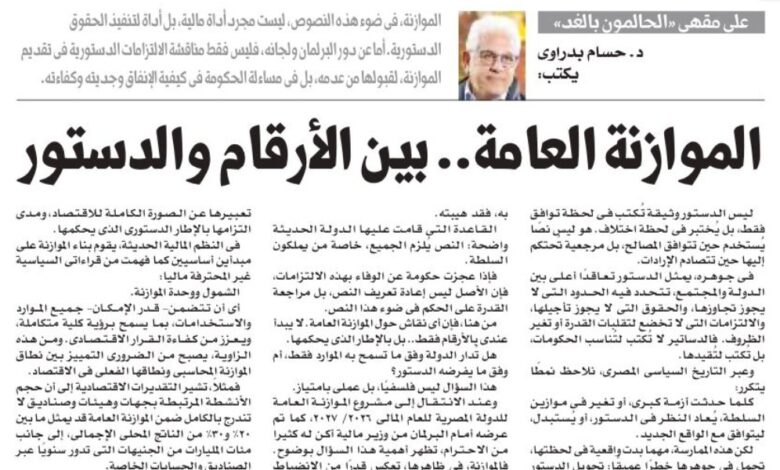
A constitution is not merely a document written in a moment of consensus; it is tested in moments of disagreement. It is not a text used only when interests align, but a reference to be invoked when wills collide.
At its core, the constitution represents a higher contract between the state and society, defining boundaries that must not be crossed, rights that must not be postponed, and obligations that are not subject to fluctuations in capacity or changing circumstances. Constitutions are not written to suit governments; they are written to restrain them.
Throughout Egypt’s political history, a recurring pattern can be observed: whenever a major crisis occurs or the balance of power shifts, the constitution is reconsidered—or replaced—to align with the new reality.
But this practice, however pragmatic it may seem at the time, carries a deeper risk: turning the constitution from a governing authority into a subordinate tool.
The constitution exists to remain relatively stable in the face of change, serving as a fixed point against which governments are measured—not something to be reshaped whenever it proves difficult to implement.
If the text begins to adapt to capability, it loses its meaning. If it is amended every time we fail to uphold it, it loses its authority.
The foundational principle of the modern state is clear: the law binds everyone—especially those in power.
If a government is unable to meet these obligations, the solution is not to redefine the text, but to reassess its capacity to govern in light of that text.
From this perspective, any discussion of the state budget does not begin with numbers alone, but with the framework that governs them.
Is the state managed according to available resources only, or according to what the constitution mandates?
This question is not philosophical—it is deeply practical.
When examining Egypt’s draft state budget for fiscal year 2026/2027, as presented to Parliament by a Minister of Finance for whom I have great respect, the importance of this question becomes evident. On the surface, the budget reflects a degree of discipline in macroeconomic indicators:
A targeted deficit of around 4.9% of GDP, a notable primary surplus, and growth in revenues—particularly tax revenues. These indicators reflect a considerable effort in managing public finances.
However, evaluating the budget is not complete by looking at numbers alone, but also by assessing how well it reflects the full picture of the economy, and how committed it is to the constitutional framework that governs it.
In modern financial systems, budgeting is built on two core principles, as I understand from my non-specialist political readings: comprehensiveness and unity.
That is, the budget should include—as much as possible—all resources and expenditures, enabling a complete and integrated view, and enhancing economic decision-making.
From this perspective, it becomes necessary to distinguish between the accounting scope of the budget and its actual scope within the economy.
For example, economic estimates suggest that activities associated with entities, authorities, and funds not fully included within the general budget may represent between 20% and 30% of GDP, in addition to hundreds of billions of pounds circulating annually through special funds and accounts.
This space, regardless of its nature, raises a legitimate question about the completeness of the state’s financial picture.
The more activities exist outside the full framework of the budget, the harder it becomes to assess the true scale of public spending, the efficiency of resource allocation, or even to accurately estimate the deficit.
Thus, full transparency is no longer an administrative option—it is both an economic and constitutional necessity.
At this point, financial analysis intersects with constitutional commitment. The constitution does not merely set a general framework; it establishes explicit obligations within the budget, particularly regarding spending on health, education, and scientific research.
Therefore, the question is no longer just: Is the budget financially disciplined? It has become: Is it constitutionally disciplined?
This brings us back to the constitutional foundation of spending on human development, which, in my political and philosophical view, lies at the heart of governance.
The minimum levels of spending on health, education, and scientific research in the state budget are based on explicit constitutional provisions, which are binding rules—not merely advisory guidelines—for all state authorities.
1. Article (18) – The Right to Health
It states:
The state shall allocate a percentage of government spending to health of no less than 3% of Gross National Product, gradually increasing to meet global standards.
Implication:
Spending on health is not a financial option, but a constitutional obligation defined by a minimum percentage, measured against GNP—not total expenditures.
2. Article (19) – Pre-University Education
It states:
The state shall allocate no less than 4% of GNP to education, gradually increasing to meet global standards.
3. Article (21) – University Education
It states:
The state shall allocate no less than 2% of GNP to university education.
4. Article (23) – Scientific Research
It states:
The state shall allocate no less than 1% of GNP to scientific research, gradually increasing to meet global standards.
A brief legal reading:
- These provisions define binding minimum percentages, not flexible estimates.
- Measurement is based on Gross National Product, not total government expenditure—a crucial distinction.
- The phrase “gradually increasing” implies a requirement to move upward, not downward or to circumvent the obligation.
- Any accounting treatment (reclassification or merging of items) is not constitutionally valid unless it reflects actual, direct spending on the service—which is, in this case, a right.
The legal conclusion is that compliance with these articles is not a technical matter in budget preparation, but a constitutional legitimacy issue that touches the core relationship between the state and the citizen.
In light of these provisions, the budget is not merely a financial tool, but an instrument for implementing constitutional rights.
As for the role of Parliament and its committees, it is not limited to discussing these constitutional obligations when reviewing the budget for approval or rejection, but extends to holding the government accountable for how funds are spent, and for their seriousness and efficiency.
Parliament represents the people in ensuring that their rights are upheld. The Egyptian people deserve a government that respects its political and social contract with them—and a parliament that holds that government accountable for fulfilling the commitments it approved at the beginning of each legislative cycle.
Egypt deserves the best from all of us.